


Announcement: Baiguan is hosting the AI & Robotics Innovation Tour in Shanghai from April 21–23. If you are interested in coming to China to explore frontier tech and startups, please check out our itinerary and invitation to RSVP here.

Just last year, the majority of people likely agreed that AI-generated videos would remain “toy projects” for a very long time. After all, it was easy to spot an AI video by its awkward hand gestures or the “almost” human-like faces that sparked the uncanny valley effect.
But it seems the narrative is shifting rapidly. In fact, I personally think entertainment, in general, will become one of the biggest markets as a result of the proliferation of AI tool development. Video-making is starting to emerge as the first type of entertainment that can actually go beyond “toy projects” and begin to monetize.
As early as May of last year, the hype over AI-generated short dramas gained a significant amount of attention on Chinese social media. Many netizens started to explore the possibility of becoming real film directors. (Last May also happened to be when Google released Veo 3, whose high-fidelity video quality made cinematic realism a possibility.)
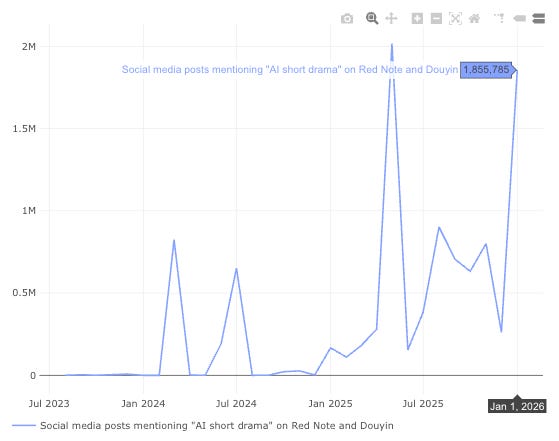
However, these attempts didn’t become a massive sensation back then, partly because the visual quality was still lacking, and partly because they were limited by the high expenses of using video models on a routine basis. But this has quietly shifted coming into 2026. Several interesting things have happened in just a few months:
When the award-winning director makes an AI film
First, renowned award-winning Chinese director Jia Zhangke released an AI film in February, starring an AI version of himself. Although this was not his first attempt at AI filmmaking (he made an AI movie back in 2024), this new release still created a sensation on the Chinese internet. Jia used the Seedance 2.0 model—the latest release from ByteDance—to produce the movie, and its near-perfect image quality sparked awe across Chinese social media.
Jia Zhangke’s AI video “山河故人” created using Seedance 2.0, starring the AI version of himself, total 5:31 in length
The sensation surrounding Jia’s movie went viral mainly because of his reputation in China as one of the country’s most important and respected filmmakers. The fact that a time-honored director remains so open to AI technology says a lot about the creative industry. However, the film’s plot itself—which involves profound, philosophical questions about the ownership of films in the AI age—could feel slow to ordinary audiences.
When AI engineers irresistible dopamine spikes: AI short drama
Soon after, something that truly resonated with netizens started to break out and go viral online: the “CatFu” reels took the Chinese internet by storm. These short videos feature tabby cats in traditional Chinese Kung Fu attire, using AI to replace human actors in scenes that mimic classic 1970s Hong Kong Shaw Brothers martial arts films. After the inaugural reels went viral, “CatFu” quickly became a popular series.
After watching a few, I have to admit that these are definitely beyond “toy project” videos. They are actually something I would watch through (and perhaps I would happily accept any ads embedded in them, just like standard reels produced by humans). What caught people’s attention wasn’t just the near-perfect realism, but the funny plots and exciting turns of events packed into just under 20 seconds.
For instance, this one cracks me up:

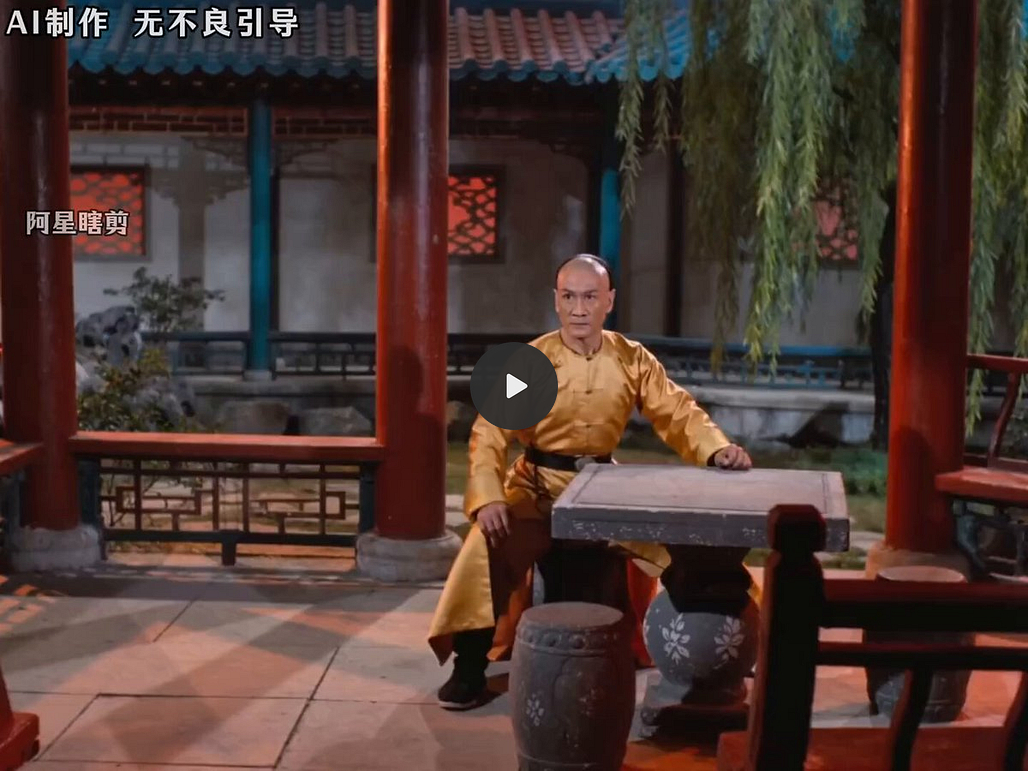
These are early signs that AI-made short videos are starting to become truly monetizable.
However, I do have reservations regarding copyright issues, as CatFu‘s viral success is largely due to the deep nostalgia and lasting legacy of the Shaw Brothers’ classic martial arts films.
But soon after, a completely original AI-generated short drama, Huo Qubing 霍去病, went viral. With no real actors or live shooting, it relied entirely on AI tools via the “Nanoman AI production line” (纳米漫剧流水线), a first-of-its-kind industrial AI cartoon platform in China.
Featuring epic war scenes, the drama gained attention for allegedly costing only 3,000 RMB, being made in 48 hours, and reaching 500 million views. Although the director later clarified that the 3,000 RMB covered only the AI computing costs, that the team included around 20 people, and that production lasted four intense days, the cost was still astonishingly low for such high viewership results.
AI productions are now demonstrating the potential to cost far less than traditional short dramas (thousands versus hundreds of thousands of RMB per episode) and can be produced in days rather than months.
According to industry statistics from DataEye-ADX, the number of domestic AI-generated short dramas (including AI live-action and AI cartoons) released in January 2026 reached 14,634. This averages out to over 470 new releases per day—equivalent to a new drama launching every minute and a half.
Just a few days ago, rumors of a “massive shift in short dramas” sparked heated discussions in the industry. Topics like “Hongguo and others will reduce investment in live-action short dramas” dominated Weibo’s trending search list for consecutive days. (Hongguo is a short-drama platform owned by ByteDance).
In fact, since the beginning of the year, several AI live-action dramas have become massive breakout hits: Zhanxian Tai AI Live-Action Version topped Hongguo’s hit cartoon list within two days of its release, exceeding 100 million views in six days; The Lawful Daughter Weeps Blood, Mother Overturns the Imperial Family amassed over 230 million views, topping industry charts; and Douyin’s Milk Dumpling Empress Dowager’s Palace Schemes and other works have also surpassed 200 million views.
- 36kr.com
This brings us to a fascinating quirk of AI video models: they are built to spike dopamine, not for people to think and reflect deeply. If a generated video has a slight temporal glitch in the background, or if the AI doesn’t perfectly render the physics of shattering glass, no one cares. The audience for a vertical short drama is scrolling on a subway commute, looking for a quick emotional hit. They are paying for the dopamine spike, such as the moment the underdog slaps the arrogant villain.
As we covered in previous newsletters, China’s short-video drama sector is already a billion-RMB industry and is even exporting its productions abroad, as seen in the boom of Chinese-made short dramas in the U.S. Now, these vast amounts of short dramas are becoming the training data that makes cheap AI productions a reality.

Chinese models have ingested oceans of this highly specific aesthetic data. They know exactly how to render the dramatic lighting of a CEO’s corner office or the ethereal glow of a Xianxia (Eastern fantasy) realm. They are skipping the pursuit of perfect physical reality to over-index on emotional and visual hooks. It’s the visual equivalent of junk food: engineered to be irresistible, cheap to produce, but highly profitable.
When AI integrates into more ‘legitimate’ productions
If mass-produced “junk food” doesn’t seem convincing enough that the AI video industry is becoming a reality, perhaps examples of AI integration in more “legitimate” TV shows and movies will be compelling.
For instance, in the TV show Swords Into Plowshares (太平年), which just premiered this January, Kuaishou’s Kling AI video models were integrated into the production workflow. This is absolutely not a “fast-food” production; it is a high-quality historical drama set between the Five Dynasties and Ten Kingdoms periods, focusing on political intrigue, warfare, and the unification of China into the early Northern Song dynasty. The show quickly became one of the most-watched dramas of the year so far.

According to an interview with Chen Yi, founder of Time Axis (时光坐标)—the visual effects team for the show—Swords Into Plowshares production employed AI extensively in both virtual scenes and special effects, with notable contributions from Kling AI. AI accelerated production efficiency: for instance, storm scenes that traditionally took two months were completed in just two weeks using AI-assisted workflows.
For instance, in Swords Into Plowshares, the stormy naval battle scenes utilized Kling AI to generate the fluid dynamics of the ocean waves. This was then layered with 3D modeling to refine the details of the warships and compositing techniques to achieve the final rain effects. The end result far exceeded expectations—improving efficiency by 8 to 10 times while maintaining professional-grade cinematic standards. [*]


Kuaishou’s Kling AI 3.0 now serves as a professional-grade creative partner for over 30,000 enterprises worldwide, enabling high-quality, commercially viable AI content generation.
I believe 2026 is only the beginning of the AI film industry, and more and more teams will be seriously asking: “How can we use AI to put on a great show and get paid today?” Gone are the days when we could easily dismiss AI videos as “toy projects.” This shift is going to present real growth opportunities—not just for filmmakers, but also for the companies building the models and workflow integration tools.
Reminder
Baiguan is hosting the AI & Robotics Innovation Tour in Shanghai from April 21–23. We will be visiting and experiencing generative AI, robotics, and robotaxis. There will also be an opportunity to see China’s startups and learn how they are producing AI-native content, games, and communities beyond just video making.
If you are interested in coming to China to explore frontier tech and startups, don’t forget to check out our itinerary and invitation to RSVP here.
