


Our job postings data across major online recruitment platforms in China shows a quiet but structural shift that nobody is talking about.
Five years ago, mid-sized companies (100–999 employees) contributed a significant portion of the jobs. If we take online recruitment platforms as a proxy to analyze China’s labor market, six out of every ten jobs came from a mid-sized employer in 2020. But today, fewer than four out of ten do.
These postings haven’t migrated up to large enterprises; instead, they’ve migrated down to small companies with fewer than 100 employees.
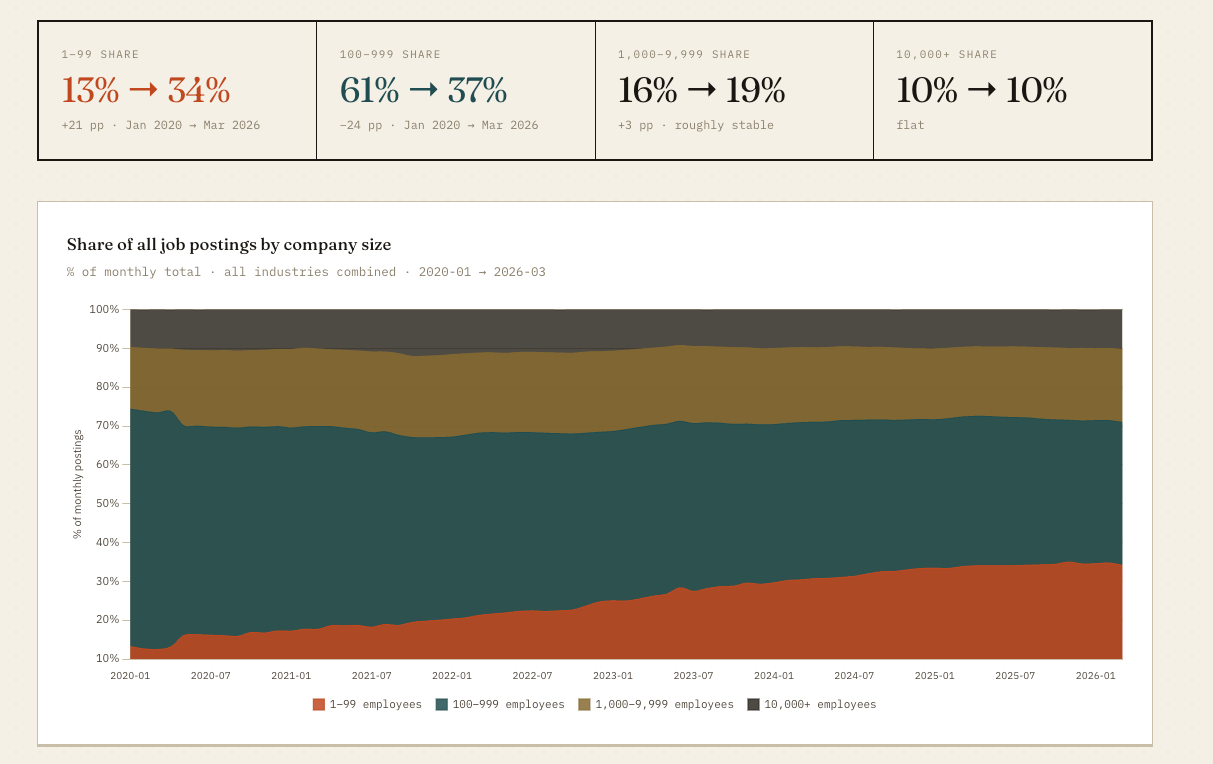
Two possible stories could explain this:
Companies are becoming more entrepreneurial, potentially benefiting from productivity gains driven by AI and automation.
Mid-sized firms are laying off staff and posting fewer jobs, which mechanically lifts the small-firm share without any sector actually ‘winning.’
There could certainly be a combination of these two factors—as well as other, more complex dynamics at play. However, by analyzing the relationship between changes in job posting volume and average salaries, we can gain a clearer sense of the underlying reality. (For instance, a sector benefiting from productivity gains would likely see both job growth and rising salaries, even if those roles are concentrated in smaller companies. )
Crucially, this overall shift reveals significant nuances across different industries. We analyzed 13 major industries that provide the bulk of China’s online job opportunities, examining 75 months of data since 2020 to determine which narrative holds true for each.
Specifically, for each sector, we looked at the following angles:
The share of all job postings by company size: To see whether the broad structural shift holds true for the industry.
Change in total job postings and average salary by company size: Is the pie growing or shrinking?
Employment quality: We use the share of part-time/gig jobs over total jobs as a proxy. While not a 100% accurate representation, an increasing share of part-time employment could indicate that companies are prioritizing cost flexibility, and that employment stability is declining.
Note: Online recruitment platform data may carry a bias toward white-collar roles.
“Charts of the Week” is Baiguan’s series that features key data points to help you quickly grasp the general state of affairs in China in just a few minutes. We handpick the highlights of the data charts from a variety of sources, analyzing and delivering insights trusted by 100+ top institutional and corporate clients worldwide at BigOne Lab. Don’t forget to subscribe before you continue reading!
