


This is a guest writing piece by a longtime friend of Baiguan, who goes by his pseudonym China Engine Room, or CER.
CER is a C-level executive at a top healthcare company in China with a career of more than 2 decades spanning healthcare, internet platforms, and AI in China. CER writes about biotech, advanced manufacturing, and AI in his Substack.
We can’t think of anyone else other than CER who is more capable of commenting on the future of healthcare in China and its implications for the entire world.
We helped CER translate and edit this piece, originally written in Chinese.
China may attain healthcare’s Holy Grail: cracking the “impossible trinity”
The “healthcare Holy Grail" is a global problem.
Every healthcare system in the world is trying to solve the same impossible trinity: affordability, service quality and accessibility.
Few can deliver all three at once. Cheap care can erode quality. High-quality care can narrow access. Broad access can push costs upward. China matters because it is trying to move this global frontier at population scale.
The United Kingdom gets relatively close on universal coverage. NHS patients face low direct payment pressure and can access a high-quality clinical system. Accessibility is the constraint. Triage, referrals and queues turn “free or low cost” into delayed care. Nuffield Trust data show that in January 2026, 11.5% of CT waits in England exceeded six weeks. NHS England treats the six-week diagnostic target as a key prerequisite for the 18-week referral-to-treatment standard. The British model shows the tradeoff clearly: affordability and clinical quality can coexist while time becomes the bottleneck.
The United States sits at the other end. It has the world’s strongest high-end hospitals, specialty care, innovative drugs and medical devices. Affordability is weak, and accessibility depends heavily on insurance coverage, network status and ability to pay. KFF’s 2026 update shows that 36% of U.S. adults skipped or postponed needed care in the past year because of cost; among uninsured adults under 65, the share was 75%. HCCI’s imaging brief shows that in 2022 the average employer-sponsored insurance price for a CT scan was about $1,116, versus about $456 under Medicare. Those figures are not directly comparable to Chinese public prices, yet the order-of-magnitude gap says enough: American medical capability is strong, and so are the bill and the insurance gate.
U.S. friction starts with price and continues through insurance process. After the murder of UnitedHealthcare’s CEO, AP reported a surge of public anger online around insurance delays, denials and “delay, deny, depose” rhetoric. KFF data show that Medicare Advantage plans fully or partially denied 4.1 million prior-authorization requests in 2024; only 11.5% were appealed, and 80.7% of appealed denials were fully or partially overturned. A 2025 Commonwealth Fund survey similarly found that among working-age privately insured adults who had experienced a prior-authorization denial, roughly 40% reported delayed care and 28% said a health problem worsened.

China sits in a third position. National medical insurance, public hospitals and government subsidies let most people enter the system and keep many basic services affordable. The weakness is uneven quality. Good doctors, advanced equipment and better patient experience still concentrate in top-tier public hospitals. Patients can enter the system, but getting the best doctors and services can still mean queues, referrals, personal networks and cross-city travel. China is strong on affordability and basic access. It is still trying to spread high-quality service beyond the top hospitals.
China’s healthcare reform is aimed at the hardest part of the triangle: after making care broadly affordable and reachable, China is now using institutional reset and technological advances to make good care more widely available.
But before I explain in detail how China is dealing with this monumental task, I want to first explain to you why this matters for you.
Why does China’s healthcare matter for the world
Over the years, the Western healthcare system has built a complete referral system, strict prescription controls and a professional gatekeeping structure.
On the surface, this system is defended as patient safety. In practice, it also works as a collusion between medical groups and the state, with commercial insurers adding another payment gate. The result is a system that protects institutions first and squeezes consumers second.
The alignment is visible in the way the system behaves. Government protects system legitimacy. Physician groups protect the professional gate. Insurers protect the payment gate. Each side can justify its position with the language of safety, compliance or cost control, yet patients encounter the same practical result: higher consultation fees, higher premiums, longer waits and more uncertainty before a simple health problem can be solved.
The contradiction is sharper because this system has also failed to protect patients from real harm. Purdue’s opioid marketing, and McKinsey’s infamous consulting advice to Purdue, showed how commercial interests could purchase influence throughout the medical system under the cover of professional legitimacy. That institutional legitimacy helped feed America’s opioid disaster.
For many common, low-risk conditions, the real need is much simpler. A patient can often describe symptoms, search basic information, use AI for navigation, consult a pharmacist or remote doctor, and receive common medicines, including antibiotics when medically appropriate, without turning the whole episode into a high-cost institutional journey. Prescription responsibility still matters. The practical question is why every minor illness should be forced through the most expensive gate in the system.
China has left a gray tolerance zone that the West often refuses to allow. Free or very low-cost internet consultations, pharmacy-linked remote doctors and fast medicine delivery make it much easier to obtain common drugs that can solve immediate problems. Its operating logic is to keep complex judgment inside hospitals and doctors’ hands, while moving simple, frequent and low-risk demand into cheaper, faster fulfillment chains.
Institutional innovation: from hospital center to multi-entry system
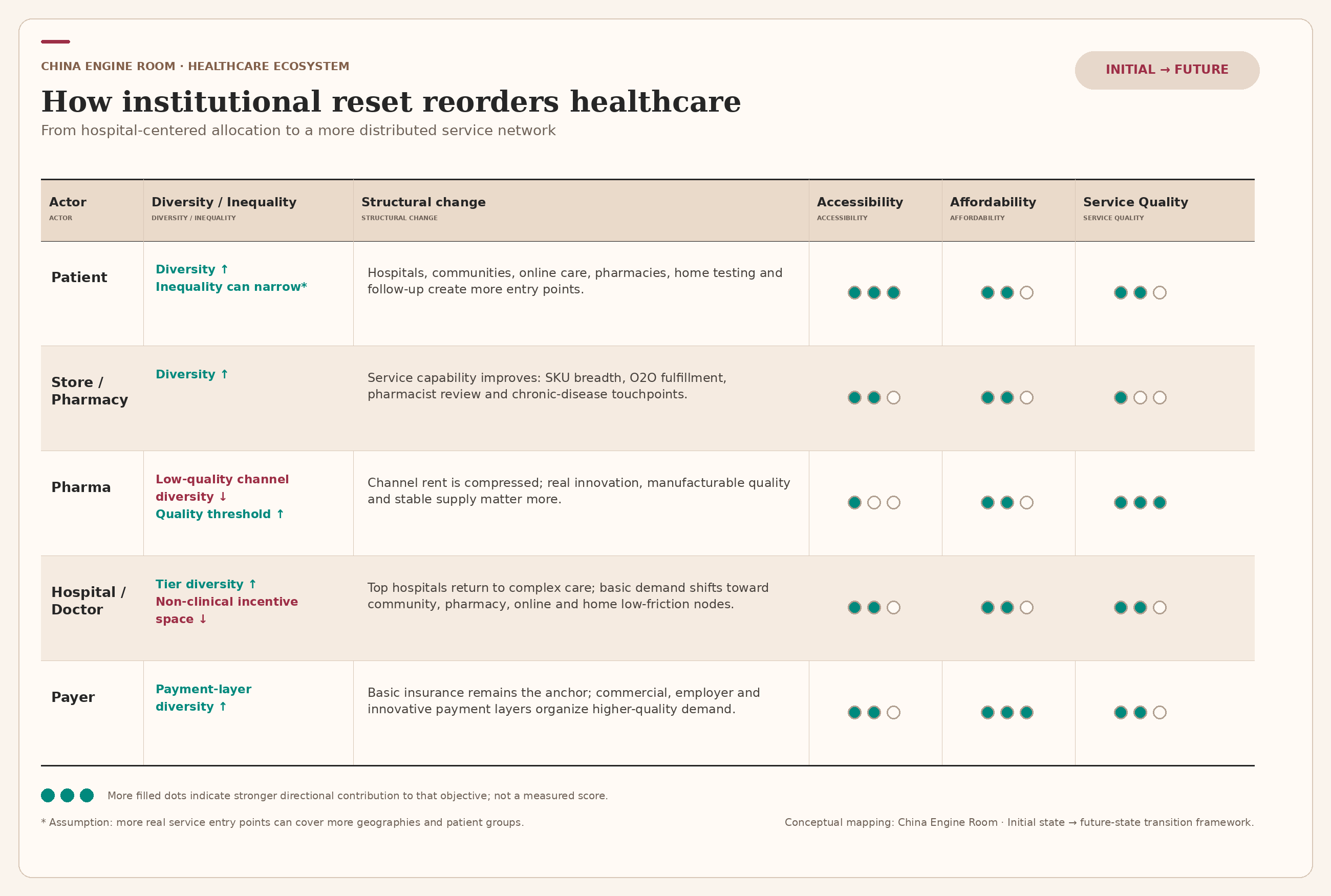
China’s earlier healthcare structure was hospital-centered, especially around high-level public hospitals. Patient entry, doctor resources, drug flows, diagnostic and treatment pathways, payment interpretation and trust all concentrated around the hospital node. This structure can handle complex care and basic coverage, but it also pushes many simple consultations, follow-ups, prescriptions, tests and explanations into high-cost in-hospital workflows.
Over the past several years, anti-corruption, volume-based procurement, DRG/DIP payment reform, sunshine income reform and prescription outflow have all been reorganizing that old structure. The point is less a moral indictment of doctors or pharmaceutical companies than a compression of non-clinical incentives and in-hospital channel rents. Resource-allocation power spills out of a small number of top hospital nodes, while both doctor income and hospital income are pushed toward more transparent structures.
DRG stands for Diagnosis Related Groups. It bundles inpatient cases with similar clinical processes into “payment groups”, so insurers pay by group, leading hospitals to have stronger incentives to control cost and standardize care.
DIP is diagnosis-intervention packet payment, a method closer to China’s own insurance practice: historical real cases and cost data assign point values to diseases or combinations, and settlement happens within a budget.
China’s National Healthcare Security Administration says that by the end of 2023, more than 90% of coordinating regions had launched DRG/DIP payment reform; the 2.0 grouping was built from 53.71 million DRG cases in 78 cities and 47.87 million DIP cases in 91 cities.
The core transition moves from a hospital-centered initial state to a future structure.
In the initial state, care, patients, drugs, channels and payers rotate around hospitals. “Care” means doctors and hospitals; “patients” are the demand side; “drugs” includes drug and device companies; “channels” include pharmacies and out-of-hospital service nodes; “payers” include basic medical insurance, commercial insurance, employers and other payment sources.
The future structure is a multi-entry, multi-payer, multi-channel service network. Hospitals remain the center for complex disease, acute care and difficult diagnosis, while basic entry points diffuse into community care, online care, pharmacies, home testing, home service, internet follow-up and compliant prescription loops.
In the transition map below, the horizontal axis is distribution inequality, similar to a quasi-Gini concept. It describes whether benefits, resources and service interpretation power are concentrated in a few in-hospital nodes, prescription authorities and payment chains. The vertical axis is ecosystem diversity: the richness of healthcare services, payment layers, drugs, devices, internet hospitals, home service, pharmacies and channel nodes.
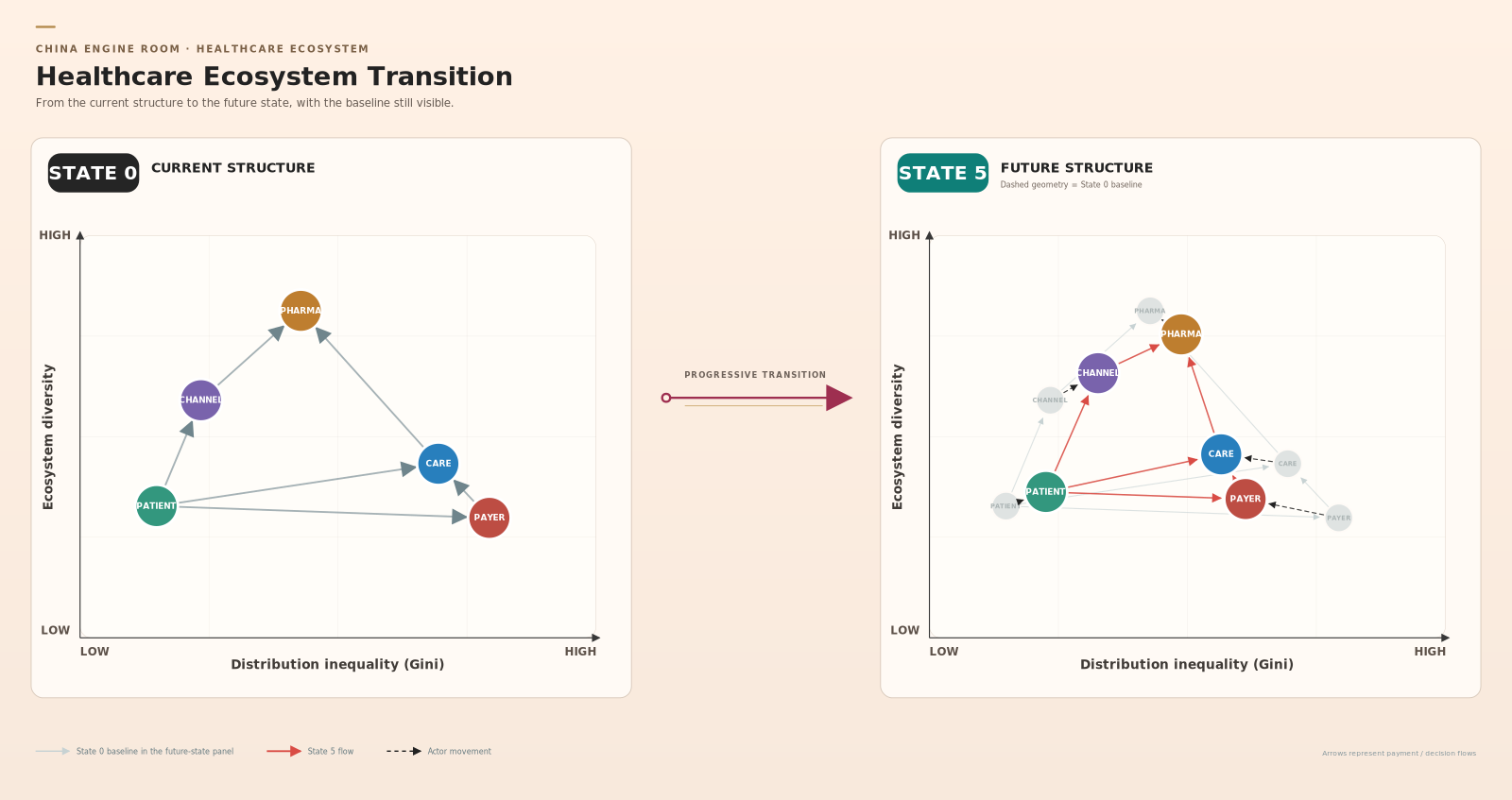
Low diversity and high inequality define the initial state, while higher diversity and lower inequality define the future state. The transition map gives the overall direction: entry, payment and fulfillment nodes spread outward, while hospitals return to complex care and difficult diagnosis. Patient entry points multiply, channel nodes become denser, pharmaceutical companies and hospitals are recalibrated, and payers move from a single basic-insurance anchor toward a more layered organization. What China is essentially doing here is to pursue anti-corruption, payment reform, internet healthcare, drug and device industrialization, and innovation-drug/device capability upgrading at the same time.
Follow the money: who pays for China’s healthcare?
The payment structure shows why institutional reform is necessary. My directional estimate of China’s healthcare payment market reorganizes spending by final payer and risk-pool attributes. Currently, government payment remains the anchor, while patients’ out-of-pocket cash payment is still large. On the other hand, employer payment and commercial insurance are still small.
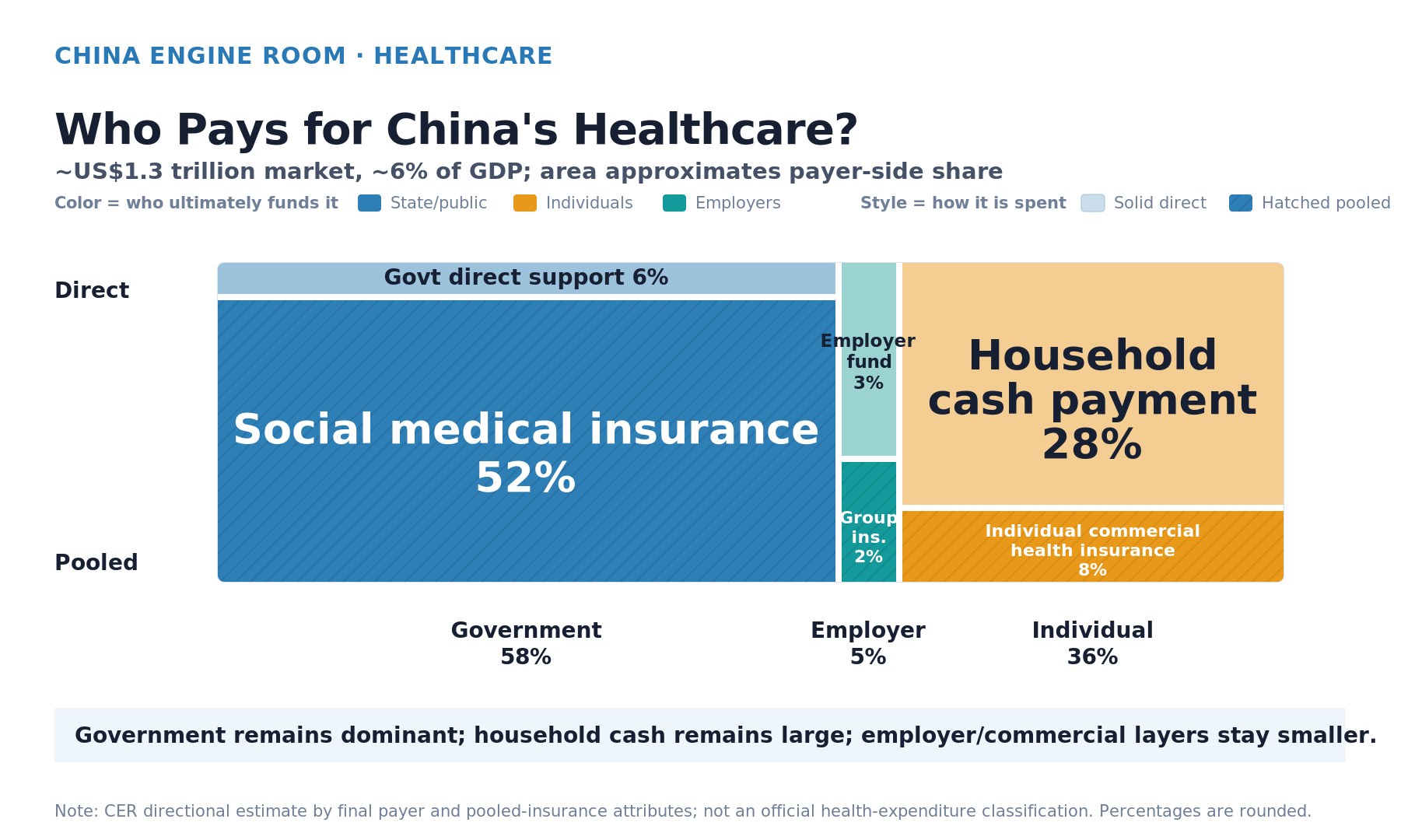
Future change can come from this underbuilt layer. Government policies increasingly frames human capital as an investment, while companies are also rethinking employee health through productivity, ESG and employer-branding lenses.
If commercial insurance, employer benefits and innovative payment can be improved, China’s healthcare system could avoid a narrow choice between basic insurance and household cash payment. Higher-quality services would gain another more stable layer of purchasing power.
Technology: pushing the frontier outward
While institutional reform opens the door, technology and industrialization decide how far the system can move. China’s healthcare story is policy, AI, digital service layers, cheaper equipment, innovative drugs, and dense service networks moving at the same time.
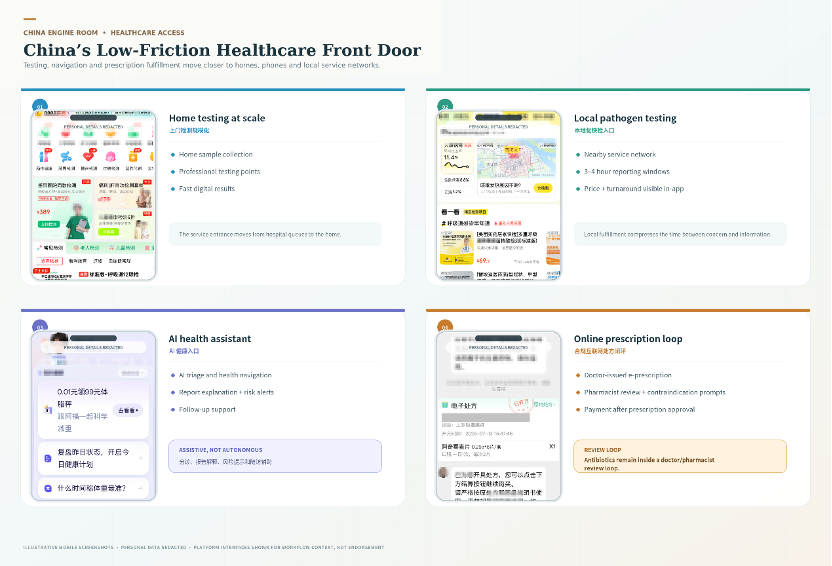
First comes application technology. China is more willing to apply internet healthcare, AI triage, report explanation, risk prompts and follow-up assistance. AI cannot replace physician diagnosis, prescription responsibility, or pharmacist review, but it can take on health navigation, risk stratification, follow-up reminders, report interpretation, and low-risk consultation entry. Many mild consultations, follow-ups, chronic-disease prescription renewals and standardized medication questions can be organized at lower cost.
Second is industrialized cost reduction. China turns many medical devices and testing services into industrial products. CT, MRI, ultrasound, lab tests, home sampling and portable diagnostic equipment can become much cheaper through manufacturing scale and dense services. A 2025 China Daily report on National Healthcare Security Administration pricing guidelines said CT prices in some provinces had fallen to around RMB 200, while MRI prices had fallen to around RMB 500. A 2024 People’s Daily Chengdu case showed CT plain scans falling from RMB 240 to RMB 200 per scan site, with reports available in about two hours. In general, domestic CT equipment costs about one-third of imported equipment, and the lowest ordinary CT scan price was under RMB 50. Lower equipment and service costs are themselves a form of accessibility.
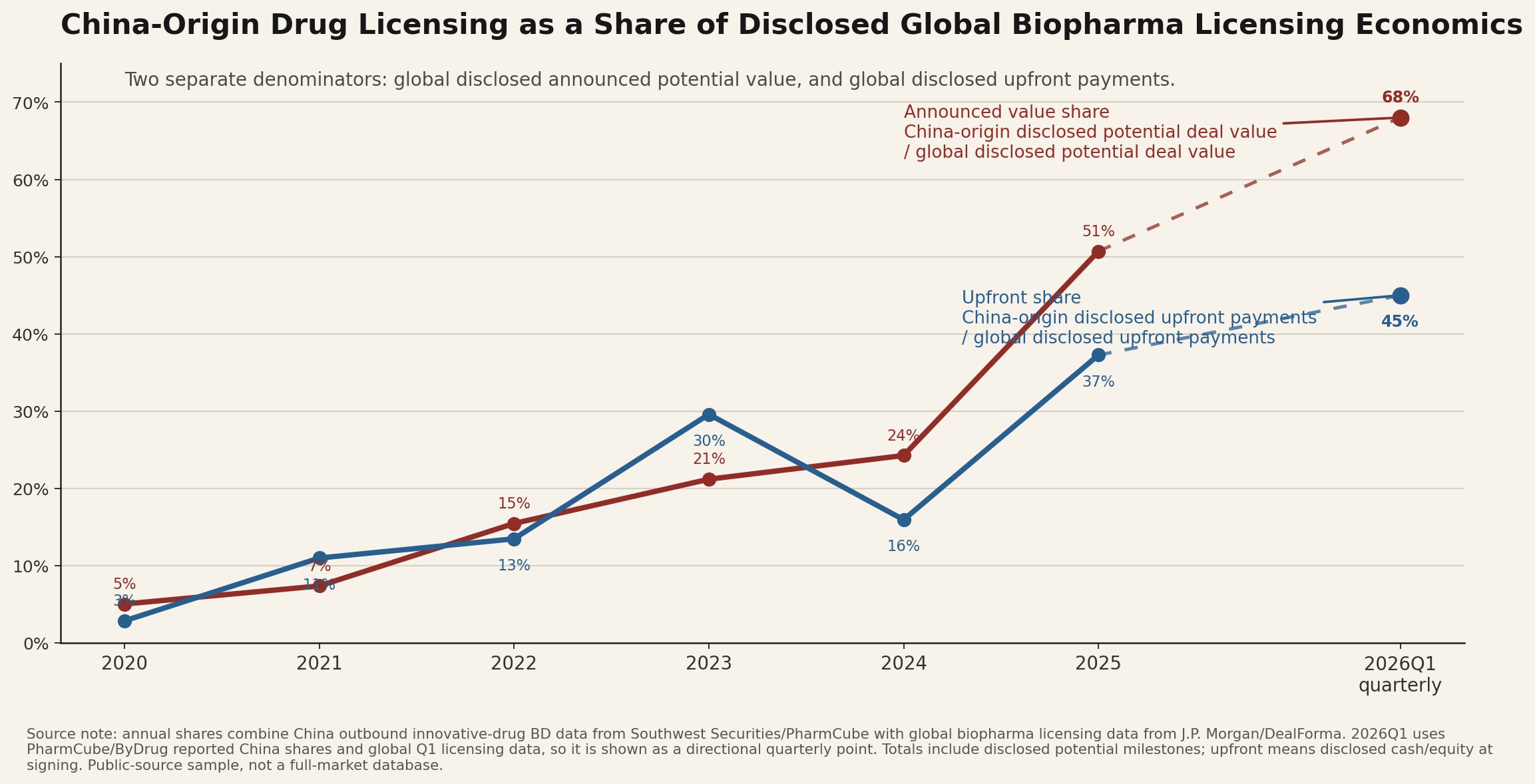
Third is the strengthening of medical-device and new-drug R&D capability. China’s innovation-drug license-out activity has become an important source for the global biopharma industry. Publicly announced cases show that Chinese capability is extending from medical-device manufacturing into innovative drug assets and clinical value itself. For Chinese consumers, the real significance is better drugs, more reliable devices and lower total cost. Overseas revenue is only the external validation of that capability curve.
Fourth is service-network density. China’s population density, logistics and local-service infrastructure make home testing, medicine delivery, internet follow-up, pharmacy O2O and health management easier to build. The low-friction front door is made of homes, pharmacies, online consultation and offline fulfillment. Its value comes from organizing scattered touchpoints into one service network.
Conclusion: the grail is not captured in one move
China is likely to build a hybrid system: government insurance as the base, commercial insurance and employer payment supplementing higher-quality services, out-of-hospital channels handling fulfillment and follow-up, internet healthcare, AI and home service reducing entry friction, and innovative drugs and medical devices lowering cost through industrial capability.
The system has to prove that it can improve all three metrics at the same time: let more people access care, keep basic care affordable, and allow higher-quality services to spill beyond a small number of top public hospitals. Institutional innovation breaks up the old structure. Technology and industrialization lower cost. Dense service networks move capability closer to patients.
The impossible trinity will remain. The more realistic change is that the feasible boundary moves outward. China is trying to break services that used to require high-cost institutions into smaller, cheaper, and denser modules, then reconnect them through compliant payment and service networks. If this route works, overseas readers should pay attention to a healthcare operating system that is cheaper, denser, and easier to scale.
Thanks to Robert and the Baiguan team for publishing this. The real question is not whether China can abolish healthcare’s impossible trinity, but whether a different healthcare operating system—policy reform, industrialized cost reduction, and low-friction service networks—can move the feasible frontier outward at population scale.
The contrast with the U.S. is striking: America has extraordinary medical capability, but too much of it sits behind price, insurance, bureaucracy and administrative friction. China’s opportunity is not simply cheaper care; it is to modularize routine services and build a lower-friction front door, while keeping hospitals focused on complex medicine.