In early 2024, Sam Altman told Reddit co-founder Alexis Ohanian that he and his tech CEO friends had a running bet going — a pool for the year the first one-person billion-dollar company would appear.
Two years later, the bet looks less like Silicon Valley optimism and more like a prophecy already being fulfilled. Matthew Gallagher (and his brother) launched Medvi, a telehealth startup, from his Los Angeles home with $20,000 and no employees, using over a dozen AI tools. In its first full year, Medvi posted $401 million in sales and a 16.2% net profit margin [*]— nearly three times the margin of Hims & Hers, which ran the same business with 2,400 people.
The one-person company (OPC) — a single founder wielding AI as a force multiplier — has gone from thought experiment to a real entrepreneurship path. And now, this concept that first originated in the US has landed with significant cultural and economic force in China.
7.3 million new one-person companies in China
By the end of 2025, nearly 7.32 million OPCs were newly registered in China, surging 42.3% year on year [*]. By mid-2025, China had registered 16 million one-person limited liability companies (一人有限责任公司), representing a quarter of all newly registered market entities nationwide [*].
With numbers like these, local governments began racing to compete for solo founder talent and build dedicated communities.
Beijing made Zhongguancun Science Park the centerpiece of its OPC push, anchoring the initiative around a ¥2 million innovation subsidy for qualifying solo founders, alongside reduced registered capital requirements and priority access to incubator space. Shanghai’s Lingang New Area went further, launching what it calls the “Super Individual 288” policy — a comprehensive package of 288 specific support measures covering tax rebates, co-working allowances, and visa fast-tracks for foreign founders.
Across virtually all cities with OPC-specific policies, AI infrastructure is the most consistently subsidized element. Chongqing, Qingdao, and Shanghai’s Pudong district have all introduced “computing vouchers,“ with Pudong offering to cover computing costs of up to 300,000 yuan ($44,000) for OPCs [*]. Shenzhen released an action plan to build more than 10 OPC communities of over 10,000 square meters each by 2027, pledging to cultivate more than 1,000 high-growth AI startups in the process [*].
This is not a first-tier-city-only phenomenon. In November 2025, Suzhou — a manufacturing and tech hub in the Yangtze River Delta — announced it was reinventing itself as a destination for AI solopreneurs, pledging to build 30 OPC communities and cultivate 1,000 one-person enterprises by 2028 [*].
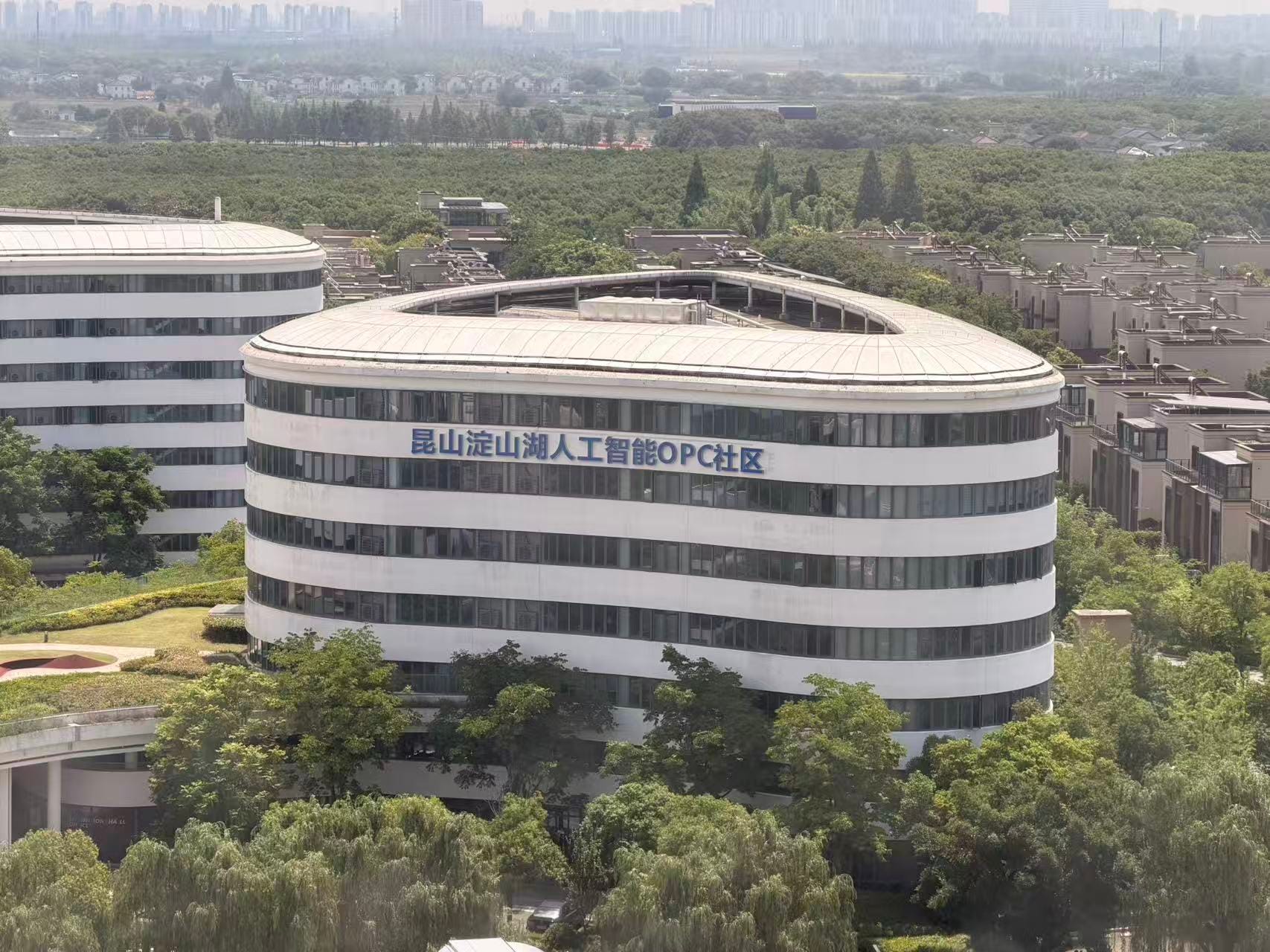
AI OPC community in Kunshan, a county-level city in Suzhou, with Shanghai bordering its eastern border.
Hangzhou has perhaps been the most aggressive of all, having announced an OPC-specific subsidy totaling ¥1 billion. Zhejiang province also introduced a personal bankruptcy insurance product specifically for OPC founders — a genuinely novel instrument designed to address one of the structural fears that have historically kept Chinese entrepreneurs cautious.
By April 2026, more than 20 cities had issued OPC-specific policies.
What are they actually building?
According to the landmark 2026 OPC Insight Report released by Honghub (China’s first dedicated OPC accelerator in Hangzhou), the developer-dominated era is over. 75% of solo founders in China now come from non-technical backgrounds (marketing, product, or traditional industries). AI code generation has completely flipped the script: for every $1 spent on AI tooling, the equivalent human developer labor now costs roughly $72.
From my observation, many solo founders and indie developers are incredibly pragmatic. Most aren’t pitching moonshot ideas to VCs or chasing the “one-person unicorn” narrative (partly because China’s primary venture capital market is far tighter and less speculative than its US counterpart.) Instead, they focus on low-profile, sometimes even “boring” businesses that nevertheless generate good cash flow.
For instance, a massive wave of OPCs has emerged in the AI-generated short drama sector, where solopreneurs use LLMs for scriptwriting and AI video tools to churn out highly commercialized content for global and domestic audiences. Content creation, boutique consulting, online education, and cross-border e-commerce marketing have become the standard playbooks for Chinese OPCs.
What’s unique about China’s OPCs
But there are also more ambitious projects. “AI + Supply Chain” OPCs are emerging as China’s true competitive differentiator. By pairing AI-driven productivity with a physical proximity to manufacturing that cannot be replicated elsewhere, Chinese founders are launching and iterating products at unprecedented speeds—and many are targeting overseas markets from Day 1.
Take Zhang Lei, a recent Shenzhen University graduate based in Shenzhen’s Bao’an district. Working entirely alone, he used AI to design and build an AI smartwatch. He went from initial concept to a physical, working prototype in just 45 days, secured three investment letters of intent within three months, and cut traditional startup costs by 80%. The Bao’an Dagongfang AI Hardware OPC Hub where Zhang is based, has become the poster child for Shenzhen’s new “one-hour AI hardware production circle.“:
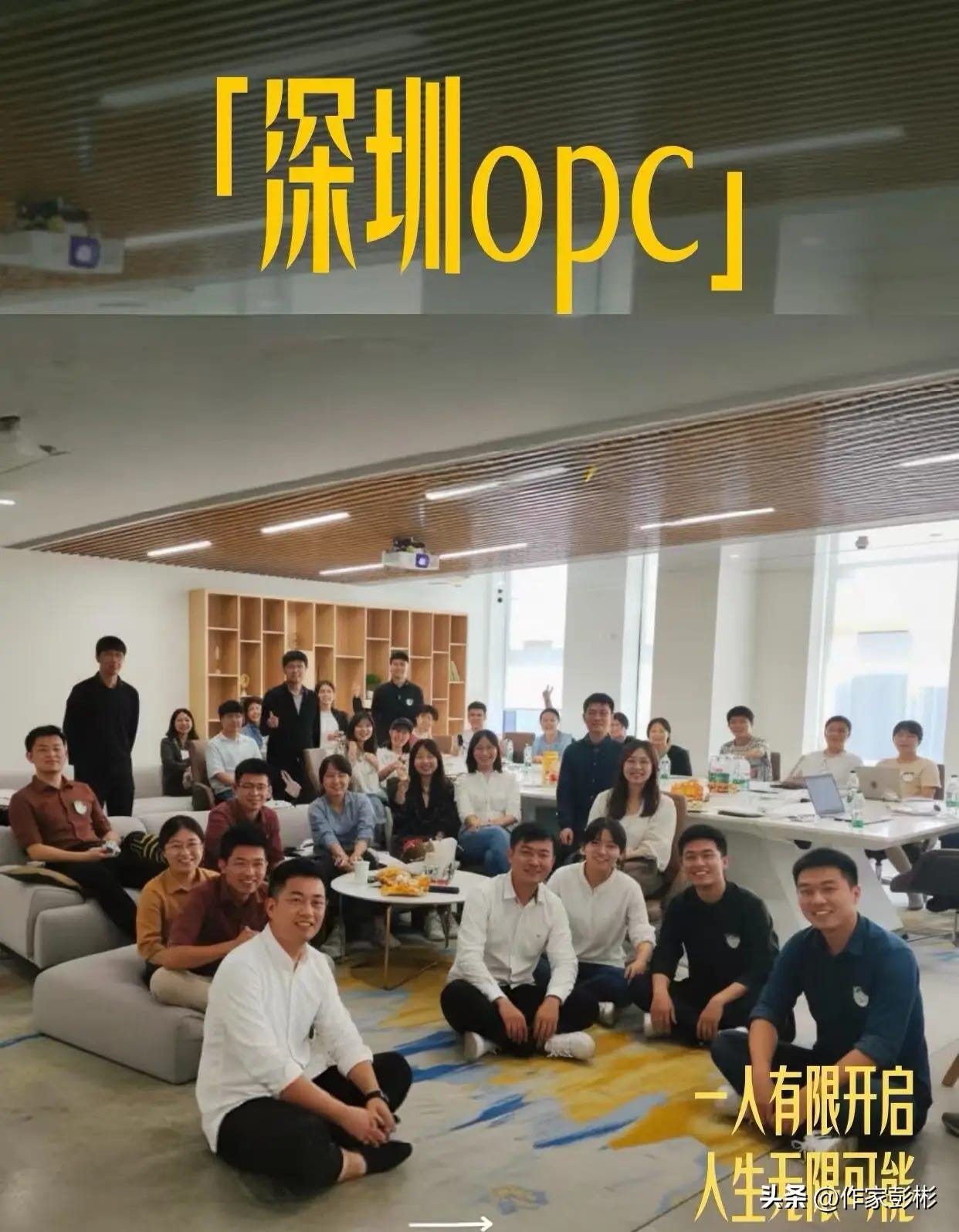
Shenzhen’s ‘OPC communities’ have formed a collaborative network where ‘the next floor down is the next step in the supply chain.’ An AI hardware entrepreneur can easily find an e-commerce company within the same building to help sell their product, while an AIGC creator can partner with a resident content IP studio for marketing. This ‘small yet dense’ ecosystem allows one-person companies to instantly plug into resources and rapidly scale from 1 to 100. [sohu]
OPC community in Shenzhen; Picture from: https://www.sohu.com/a/1031528563_122219753
The new Huaqiangbei: from copycats to 0-1 innovation
For decades, Shenzhen’s famous Huaqiangbei electronics market was known as a massive wholesale hub for cheap components and unbranded copycats. Historically, it was globally notorious for its hyper-efficient shanzhai (copycat) culture, where entrepreneurs could tear down a brand-new iPhone and have a functional, unbranded knockoff selling on the streets within a week. But today, Huaqiangbei is betting on the OPC movement and AI to revive.
In Shenzhen, OPC founders are launching highly innovative products, ranging from automated medical record systems that have been adopted by major hospitals to popular consumer products like ‘AI + pet’ solutions. Armed with the productivity boost of AI, solo founders can now thrive in small, vertical niches that often require highly customized solutions—markets that large enterprises simply don’t have the agility or capacity to drill into.
In a way, it functions much like the classic e-commerce ‘drop-shipping’ model, but with a massive upgrade: instead of just trading existing goods, solopreneurs can now drive genuine 0-1 product innovation with a small team and a laptop.
By leveraging the industrial proximity, integrated design support, and ultra-fast manufacturing networks perfected over the last thirty years, today’s solo innovators aren’t churning out knockoffs. They are using the exact same ecosystem that once built the world’s electronics to turn highly sophisticated, original concepts into mass-produced global products at lightning speed.
China’s story is, characteristically, more layered. It’s not just builders with laptops and API keys in the tech hub like Shenzhen or Silicon Valley. It’s also recently laid-off engineers from ByteDance and Alibaba who have nowhere else to go. It’s a 28-year-old in Yiwu who figured out that AI can write product listings in 36 languages. It’s a woman in Beijing whose editorial consulting practice runs entirely from her phone. And it’s increasingly happening far outside first-tier cities; it’s showing up in villages too.
The productivity boost gave rural China an alternative, and young founders a way to afford their passion with significantly lower costs compared to high-pressure hubs like Beijing or Shanghai.
Digital nomad community in Laotian Village, Anhui; Picture from: https://www.sohu.com/a/1033233568_121106832
Building a company, or just surviving?
But let’s talk about the elephant in the room. Anyone following China’s economy over the past few years has likely heard about the bruising labor market, especially for young college graduates.
According to official data, more than 200 million people in China are now engaged in what the government calls “flexible employment.” That means roughly one in four workers is part of the gig economy. This raises an uncomfortable question: Is the surge in Chinese OPCs a genuine entrepreneurial revolution, or is it just unemployment in disguise?
Walk through Beijing’s commercial districts on a Tuesday morning, and something will strike you: the cafés are packed. Not with retirees or tourists, but with people in their 20s and 30s—laptops open, headphones on, intensely focused.
For the young Chinese freelancer or solo founder, the café-as-office has become normalized in a way that would have seemed alien even a decade ago. But this is the visible face of China’s new freelance and digital nomad culture, a cohort that doesn’t neatly fit into traditional categories of “employed” or “unemployed.”
A café in Beijing on a Thursday afternoon
Some are true OPC founders. Some are freelancers serving domestic or international clients. Some are building side projects alongside part-time gigs. And some, frankly, are just trying to figure it out. I cannot help but wonder: how many of these people are genuinely building sustainable, independent careers, and how many are simply struggling to stay afloat? Starting a profitable business is inherently risky and not a path that fits everyone’s skill set.
The OPC wave in China feels both new and familiar.
On Chinese social media, netizens often cut through the hype with blunt sarcasm: “Stop using fancy acronyms. OPC founders are just 个体户 Getihu.”
The term Getihu has no perfect English translation. “Individual business owner” is functional, but it misses the historical weight. In China’s cultural memory, the Getihu were the street vendors who first dared to sell merchandise in the late 1980s as Deng Xiaoping began loosening the centrally planned economy. They were the earliest entrepreneurs of the Reform Era, symbols of opening up, selling food, clothing, and household goods from makeshift stalls.
Yet, for a long time, calling someone a Getihu was far from a compliment. It carried a certain distinct social stigma. To be a Getihu implied that you were doing unstable, low-status manual work because you couldn’t land a “real” job—meaning a secure position in a state-owned enterprise, a government office, or a big multinational corporation. Decades later, the freelancers and OPC founders sitting in cafés on workday morning face a remarkably similar societal skepticism.
Is China’s OPC wave a genuine entrepreneurial revolution, or an elaborate coping mechanism for a labor market under stress?
The long shadow of the small business founder
Continue reading this post for free, courtesy of Baiguan.