


We are hosting an upcoming China Tour from November 2 to 6 in Shanghai, Suzhou, and Hangzhou, focused on China’s energy transition. Highlights include visits covering frontier nuclear fusion technology, EV infrastructure, local government state-capital ecosystems, and AI-driven electricity demand.
Interested readers can view the full itinerary and sign up here:

When an economy slows, a specific investment strategy emerges: focus on what is still being built and identify sectors backed by genuine demand and order over the next few years.
In China right now, the reality check is straightforward. Property is still finding the bottom. Consumer stimulus is real but small. Local government balance sheets are in repair mode. In our last monthly view of Chinese equities, we noted that, given the macro, we approach Chinese equities less as a broad market allocation and more as a targeted bet on a handful of resilient sectors.
In today’s issue, we explore one such example: the power grid. Unlike many other policy-driven themes that quickly became speculative trades, this one comes with greater certainty: target numbers in the 15th Five-Year Plan, a national commitment to grid infrastructure buildout, and transparent bidding data you can check every month.
The context: what’s in the 15th Five-Year Plan
On 15 January 2026, State Grid Corporation of China announced that fixed-asset investment over the 15th Five-Year Plan (2026–2030) would reach RMB 4 trillion, up roughly 40% from the 14th FYP — about RMB 800bn a year. China Southern Power Grid followed with RMB 180bn for 2026 alone and roughly RMB 1tn over the plan period. Together, the two biggest utilities point to close to RMB 5 trillion, compared with RMB 2.85tn actually spent in the 14th FYP and RMB 2.64tn in the 13th.
Within that, State Grid has committed to commissioning 15 UHV DC projects, lifting inter-provincial transfer capacity by 35%, and supporting no less than 200GW of new renewable interconnection annually.
We think this is particularly important because historically, inclusion in China’s Five-Year Plan signifies a strategic direction that has been thoroughly vetted and backed by strong central consensus—especially when accompanied by explicit numeric targets. For investors, this provides crucial visibility: we know the power grid will benefit from guaranteed orders and sustained capital expenditure across the supply chain for at least the next five years.
This is not fiscal spending committed by the central government. So it is legally required to be in anyone’s budget. Rather, the 4 trillion fixed asset investment is done through SOEs’ corporate capex, funded by “the enterprise’s own capital (100%) or finance-lease funds. (State Grid, for example, carries an AAA credit rating and generates sufficient cash flow to fund these commitments.)
That distinction matters in both directions. Because funding doesn’t rely on NPC approval, it remains insulated from national deficit constraints. But it is also governed by return-on-capital logic rather than political will — which, as we’ll see, means not every company across the supply chain offers the same structural growth opportunity.
Why State Grid wants to spend RMB 4 trillion
China regulates transmission and distribution the way most developed markets do, through a permitted revenue framework. Stripped to its essentials, the National Development and Reform Commission (NDRC)’s pricing rules — revised in late 2025 and effective for ten years from January 2026 — say this:
Permitted return = effective assets × permitted return rate
The return rate is set by the regulator. State Grid cannot move it. Which leaves exactly one lever for growing profit: make the asset base bigger. At a 5% permitted return, every additional trillion renminbi of invested assets is worth roughly RMB 50bn a year.
This is not a Chinese peculiarity — it’s why every rate-regulated utility on earth, America’s included, is currently announcing record capex. State Grid’s RMB 4 trillion is first and foremost a commercial decision. The policy alignment is real, but the incentive would exist without it.
The other half of the formula works in the opposite direction. Permitted cost is not a pass-through of whatever State Grid spends. The regulator sets ceilings on materials, repairs and other operating costs, and anything above the ceiling cannot be recovered in tariffs. Savings, meanwhile, are split evenly between the utility and its customers.
Put simply, spend above the ceiling, and State Grid absorbs all of it. Spend below, and it keeps half. The only way to improve that arithmetic is to pay less for what it buys.
So the rational strategy is to build as many projects as possible and pay as little as possible per unit of equipment. Volume is structurally supported. Price is structurally suppressed.
Two more misconceptions could lead to an overly optimistic view of the project’s scale.
Misconception 1: “It’s in the Five-Year Plan, so it will happen”
A Five-Year Plan target is an expectation, not a statutory obligation. State Grid’s RMB 4tn is a corporate announcement with multiple audiences — suppliers, bondholders, the regulator, the market.
The 14th FYP planned 24 AC and 14 DC UHV lines. It delivered a fraction of that. For investors, this mismatch creates a real risk: beneficiary companies often trade at elevated valuations on high expectations, leaving them vulnerable to sharp corrections when targets slip. For instance, when approvals for the “3 AC, 9 DC” package slipped in 2025, revenue growth at core suppliers like XD Electric and Pinggao decelerated starting in Q3 2025.
The correct adjustment is to treat “written into the plan” as moving probability from roughly 40% to roughly 70%. Not to 100%.
Misconception 2: “AI data centers are driving Chinese power demand”
This one is worth killing carefully, because it is doing a lot of work in the current narrative.
China’s H1 2026 electricity data, from the National Energy Administration:
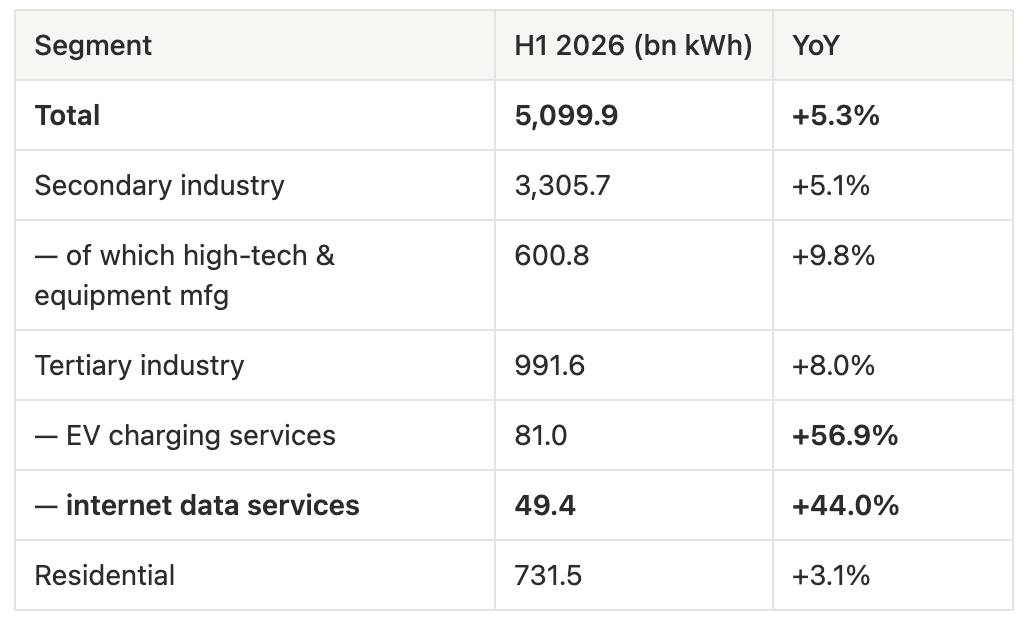
Internet data services grew rapidly at 44%, but they only represent 0.97% of national consumption. At that base, even 44% growth contributes roughly 0.3–0.4 percentage points to a 5.3% headline.
The real load-bearing wall is the 65% of consumption in secondary industry—that is, manufacturing and export (as current strong exports are also largely supported by high-tech products driven by the global AIDC build-out and AI supercycle).
Over the 14th FYP, electricity consumption grew at a 6.6% CAGR against 5.4% GDP growth — an elasticity above 1.2, driven by electrification substituting for oil and coal in transport, heating and industrial process heat. That continues even if GDP slows, because it’s a substitution, not a function of growth.
The real worry is demand-side weakness. Residential consumption grew just 3.1% in H1. AIDC build-out won’t materially save it if demand keeps slowing.
To sum it up so far: While China’s power grid expansion is a rare area of reliable structural growth—backed by explicit national targets and clear commercial alignment for major utilities like State Grid—the core operational incentive is to maximize equipment volume while squeezing pricing. As a result, benefits will not accrue equally across the supply chain.
Furthermore, with residential electricity consumption on a decelerating trend and AI Data Centers (AIDCs) unlikely to materially alter national power demand structure in the near term—despite all the capital market narrative and hype—slowing demand remains a very real risk.
We must be highly selective on sub-sectors.
What we are selecting for
Filter one: we want to look at segments where the buyer cannot squeeze or has relatively higher margins. State Grid is a monopsonist — one buyer facing hundreds of sellers — with a regulatory mandate that incentivizes cutting its procurement bill. In most of the supply chain it wins that fight easily. In 2025, a single batch of ordinary substation equipment produced 272 winning bidders; a 2024 batch split RMB 15.3bn across 579 lots among 283 companies, averaging RMB 26.7m per lot. That is not a market with pricing power.
One meaningful exception is ultra-high-voltage (UHV). In UHV main equipment, only three to five suppliers qualify. Across the first four UHV equipment tenders of 2026, thirteen brands took 87.2% of RMB 29.26bn.
Filter two: we want to look at segments whose growth is relatively insulated from electricity consumption growth. Most grid equipment demand depends on load. If consumption decelerates — and the residential numbers suggest it might — that demand decelerates with it.
But one category of spending is driven by something else entirely: the physical difficulty of absorbing renewable generation that has already been built. This demand depends on installed capacity, not consumption (at least for the next couple of years).
The absorption problem
At the end of 2025, China’s wind and solar capacity reached 1,842GW — overtaking thermal for the first time. Renewables hit 2,337GW, or 60.1% of total capacity. By mid-2026 wind and solar were around 1,950GW, over 48% of everything installed.
The grid cannot absorb it. The utilization rate of the solar and wind capacity has declined for the third consecutive year.
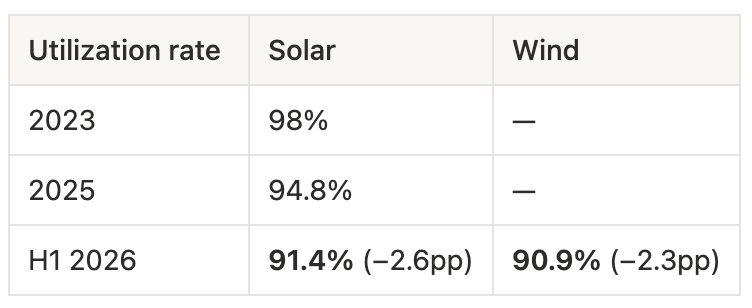
Provincially, it is worse: in Jan–Feb 2026, solar utilization ran at 60.8% in Tibet, 78.7% in Qinghai, 82.5% in Gansu and 85.6% in Xinjiang. These are sparsely populated regions characterized by amplified seasonality, where local markets cannot absorb the massive excess of renewable generation, nor can it be exported to high-demand load centers in eastern China.
Two things follow.
First, this is an economic problem with powerful owners. Each percentage point of curtailment costs a renewable project roughly 0.8–1.2 points of IRR. Several trillion renminbi of installed assets — owned by the Big Five gencos, local governments and their lending banks — are watching returns erode.
Second, the problem breaks down cleanly into two engineering questions, and the State Grid Energy Research Institute has quantified both. By 2030, roughly 80% of curtailment in State Grid’s territory will sit in the “Three Norths” (China’s wind- and solar-rich northern regions); within the year, 74% will fall in spring and autumn; within the day, 74% at midday.
Spatial mismatch — generated in the northwest, consumed in the east. Addressed by transmission.
Temporal mismatch — generated at noon, consumed at night. Addressed by storage.
That gives us our two themes: ultra-high voltage is where the supply chain retains pricing power. Storage and grid-forming are where demand is mandated. The rest of this piece works through each.
Note: Our objective is to establish a clear framework that tracks and expresses this trend, rather than relying on stock-picking to generate alpha. In other words, a company can stay on our list as long as its core operations align closely with the underlying thesis, even if the business is currently struggling or shows suboptimal financials.