


In our last newsletter, “The Service-Led Future of China’s Economy“, we explored a thesis: China is crossing a critical threshold ($14,000 GDP per capita) where the economy must pivot from manufacturing-led growth to service-led consumption.
Today, I want to show you what that shift looks like on the ground for two key demographic groups where the upgrade in services is already obvious: pregnant mothers and the elderly.
(Disclaimer: not sponsored by any company mentioned.)
The Maternity Market: Less Quantity, More Quality
We are witnessing a fascinating paradox in China’s demographic data. You have likely read the headlines: China’s birth rate is declining. According to the National Bureau of Statistics, the number of newborns dropped from 17.86 million in 2016 to just 9.02 million in 2023—the lowest since 1949.
Logic dictates that the maternity market should be shrinking. Yet, the opposite is happening at the premium end. While the quantity of consumers (babies) is dropping, the quality of consumption (spending per birth) is rising, at least for families who still choose to have children.
This trend is best exemplified by a uniquely Chinese industry: the Postpartum Confinement Center (月子中心).
The Upgrade of the “Postpartum Confinement Period”
For centuries, Chinese culture has dictated that a mother must rest for a full month after giving birth—a practice known as the “postpartum confinement period.“ Traditionally, the new mother’s own family (typically her mother or mother-in-law) would provide care during this time. However, while most families offer unconditional love, this often doesn’t translate to a smooth and stress-free period, as they frequently lack professional knowledge.
For instance, many older generations would dictate rigorous, sometimes unscientific advice to their daughters, involving superstitions like not washing hair, avoiding cold water, staying indoors, or eating endless amounts of pig trotters (an example of overly nutritional food seen as beneficial for postpartum recovery), and even avoiding air conditioning in hot summer.
Many Chinese women born in my mom’s generation (the 1960s) experienced that confinement period culture to some degree. But decades later, the mindset of modern urban Chinese women has profoundly shifted. In China’s fast-paced urban environment, professional women need to recover quickly and effectively to return to the workforce. A stress-free, scientific, and professional postpartum recovery period has become a necessity for many.
Moreover, Chinese mothers increasingly prioritize “loving themselves” over traditional duty. They no longer want to be seen as only responsible for giving birth; the pregnancy experience must also be a meaningful, self-fulfilling journey for the mother. Once the child is born, they no longer accept that all focus should be on the baby. The new mother herself now demands professional nutritionists and nurses, not just her mom or mother-in-law’s pig trotter soup.
This demand created the Postpartum Care Center—a high-end, hotel-like experience where all needs are managed by a professional postpartum team. Services include health checks, hair washing, scientifically designed recovery workouts and nutritional recipes, and, in more luxury centers, even programs to support mental health, such as yoga and meditation.
During our inaugural China Tour in late October, we took a cohort of investors to visit Saint Bella (HKG: 2508), a market leader in the premium postpartum care space.
Saint Bella mostly caters to affluent families—celebrities, KOLs, business owners, etc. A 28-day stay can cost from RMB 160,000 ($21,000 USD) to as high as 760,000 ($105,000 USD). The group has taken the confinement experience to the next level by offering stays in 5-star hotels and luxury programs, such as SPA treatments.
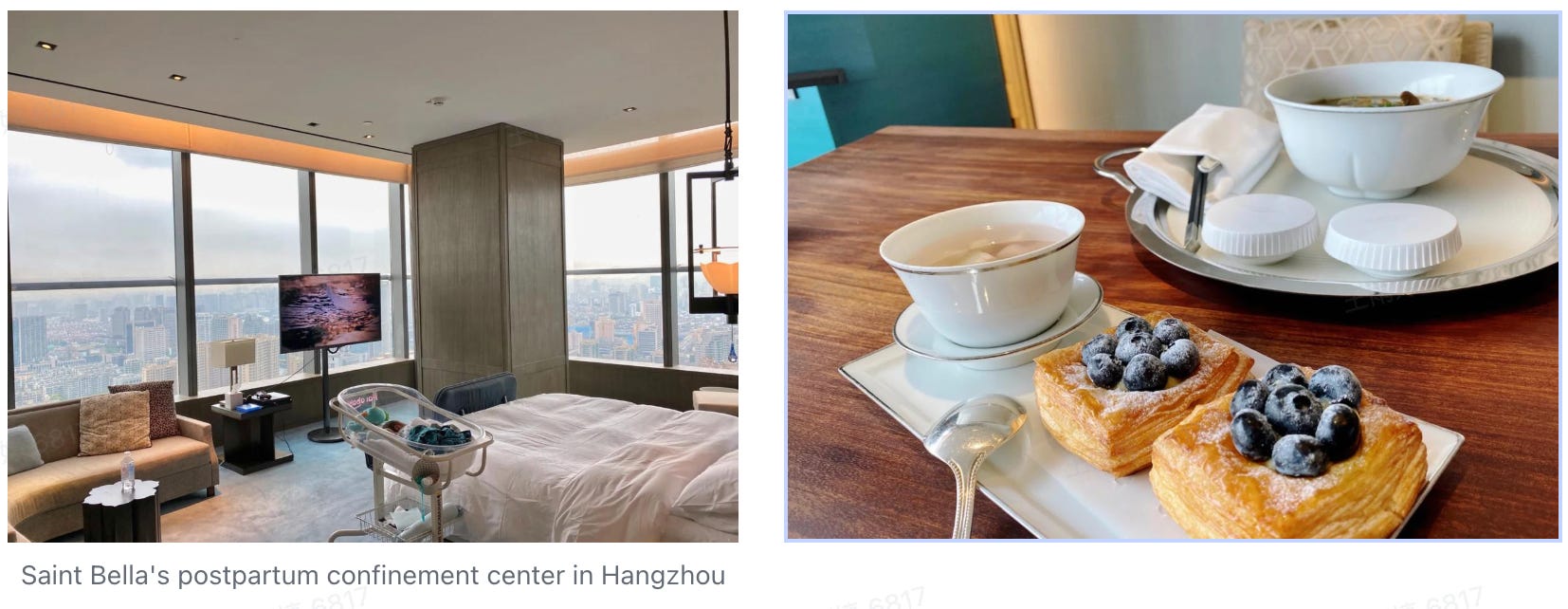
What justifies this premium? It isn’t just the luxury accommodation; it is the standardization and “philosophy” of service. For instance, one memorable takeaway was the founder explaining that the father is required to join the postpartum journey at their center—a level of engagement sometimes missing in Chinese families in the past. These are small but significant signs that the service industry in China is upgrading its values toward what counts as “good service.”

Interestingly, they are even “exporting” this model. They are taking the Chinese cultural concept of the “postpartum confinement period,” rebranding it as a “Baby Honeymoon,” and expanding into global markets. This is a rare instance of China exporting a high-end lifestyle service, rather than the mass-market manufactured goods that the global market traditionally associates with “Made in China.”
The company already has a presence in Asia, where a similar confinement period culture exists, including Singapore and Hong Kong, and is debuting in the U.S. this year with locations at Waldorf Astoria Monarch Beach Resort (California) and Baccarat Hotel New York.
Why the Mindset Is Changing: From One-Child Policy to “Better Births, Better Upbringing”
To understand why young parents spend differently, we need to rewind to the one-child policy era.
Starting in the 1980s, the government promoted the idea of “优生优育”, or “better births, better upbringing.” Urban families absorbed this message deeply. Parents were encouraged to invest heavily in their only child’s health, education, and overall development.
Today’s childbearing-age adults—mostly born in the late 80s and 90s—grew up as only children in households where virtually every resource was spent on them. They internalized this intensive investment as the norm. This means that the emergence of services like the postpartum confinement center isn’t just a natural result of the country’s rising per-capita GDP.
The reality of modern life also makes it a necessity rather than a luxury for many young parents: this generation faces a more intense work environment, with many being dual-income households. Not every family can afford the same luxury service offered by places like Saint Bella, but securing basic but professional help at a confinement center has become a new consumption trend among young mothers, so they can properly recover and return to the workplace.
This trend is not unique to metropolitan urban families; it has permeated into even small towns and lower-tier cities. For instance, the last time I visited my grandma in a small town in Sichuan province (only 3 million people—small by Chinese standards), one of the landmark buildings in the city center had been turned into a confinement center with clear signage and advertisements, making it much more noticeable than other empty office buildings nearby.
Combined, these factors produce a new mindset: for the families that still want to have kids, they want to do it right—and they are willing to pay for it.
According to Yuwa Population Research, a Chinese think tank led by renowned demographer Liang Jianzhang (a co-founder of Ctrip), the average cost of raising a child in China from birth to age 17 is about 538,000 yuan; to the age of college graduation, it rises to around 680,000 yuan.
In relative terms, the cost corresponds to about 6.3 times China’s per-capita GDP—making China among the highest worldwide for raising a child. Costs are much higher in top-tier cities: for instance, raising a child in Shanghai costs around 1.01 million yuan and in Beijing about 936,000 yuan.
Elderly Care: An Even Bigger Market for Service Upgrade
Apart from postpartum care, the elderly care industry sees a similar, if not bigger, opportunity.
