


Two years ago, on September 24, 2024, China’s capital markets entered a period of dramatic repricing—what later became widely known as the “9/24 rally.” Two years on, the more important question is no longer simply how much the market has risen. It is this: if China had truly entered a traditional, broad-based economic recovery after 9/24, which sectors should have been the biggest winners?
The answer seems obvious. Real estate should have been one of them. Consumer sectors should have been another. For the past two decades, the most familiar Chinese growth cycle has looked something like this: rising property prices increase household wealth, stronger household wealth supports consumption, and improving consumption then feeds back into credit growth and investment. Yet two years later, the capital markets have delivered almost exactly the opposite answer.
In A-shares, Communication Services rose by about 125% and Information Technology by about 124%, while Real Estate gained only around 4% and Consumer Staples actually fell by nearly 7%. Hong Kong tells a similar story: Materials rose by about 97% and Health Care by around 74%, while Consumer Staples barely moved and Consumer Discretionary still posted a negative return.
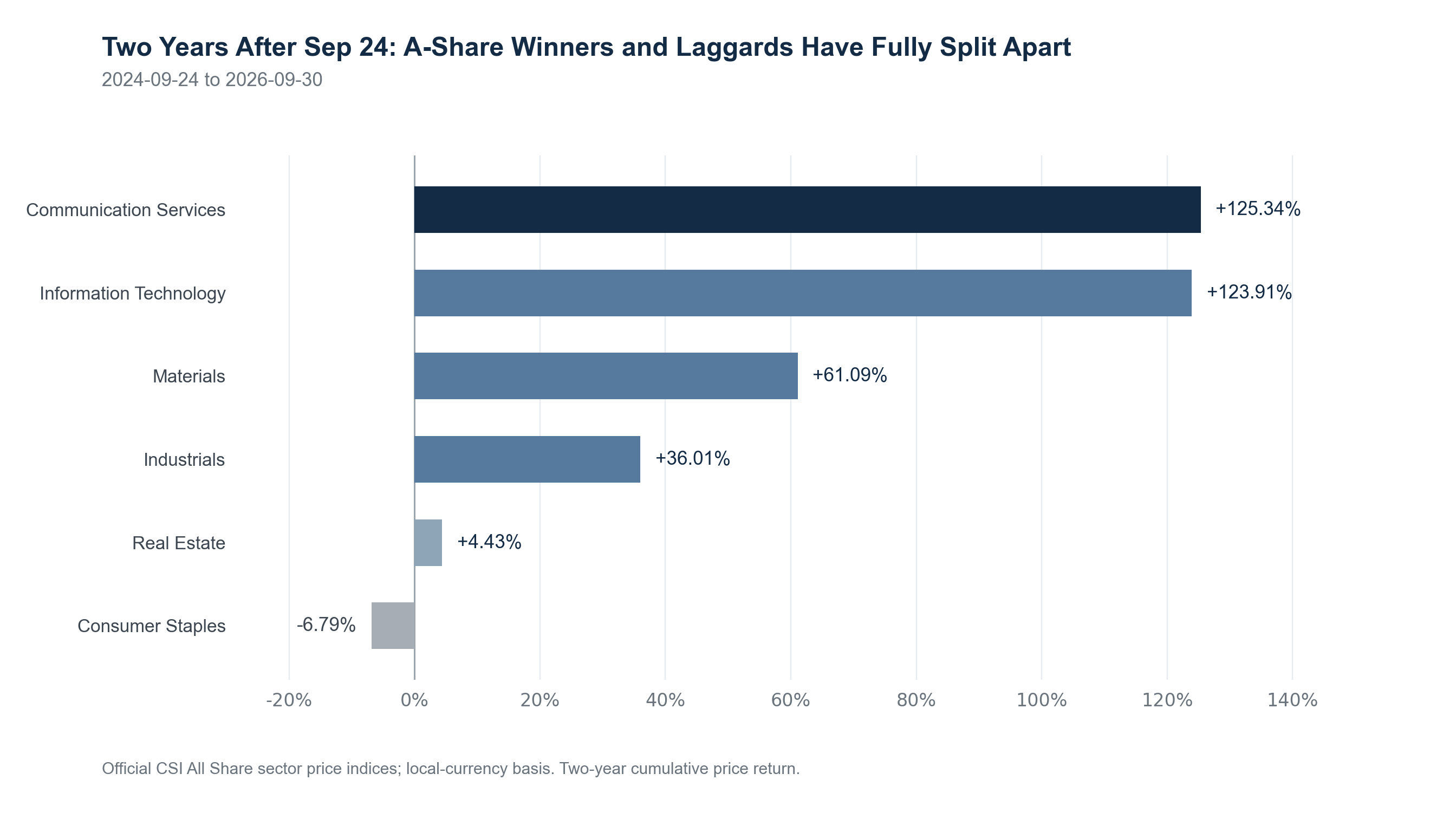
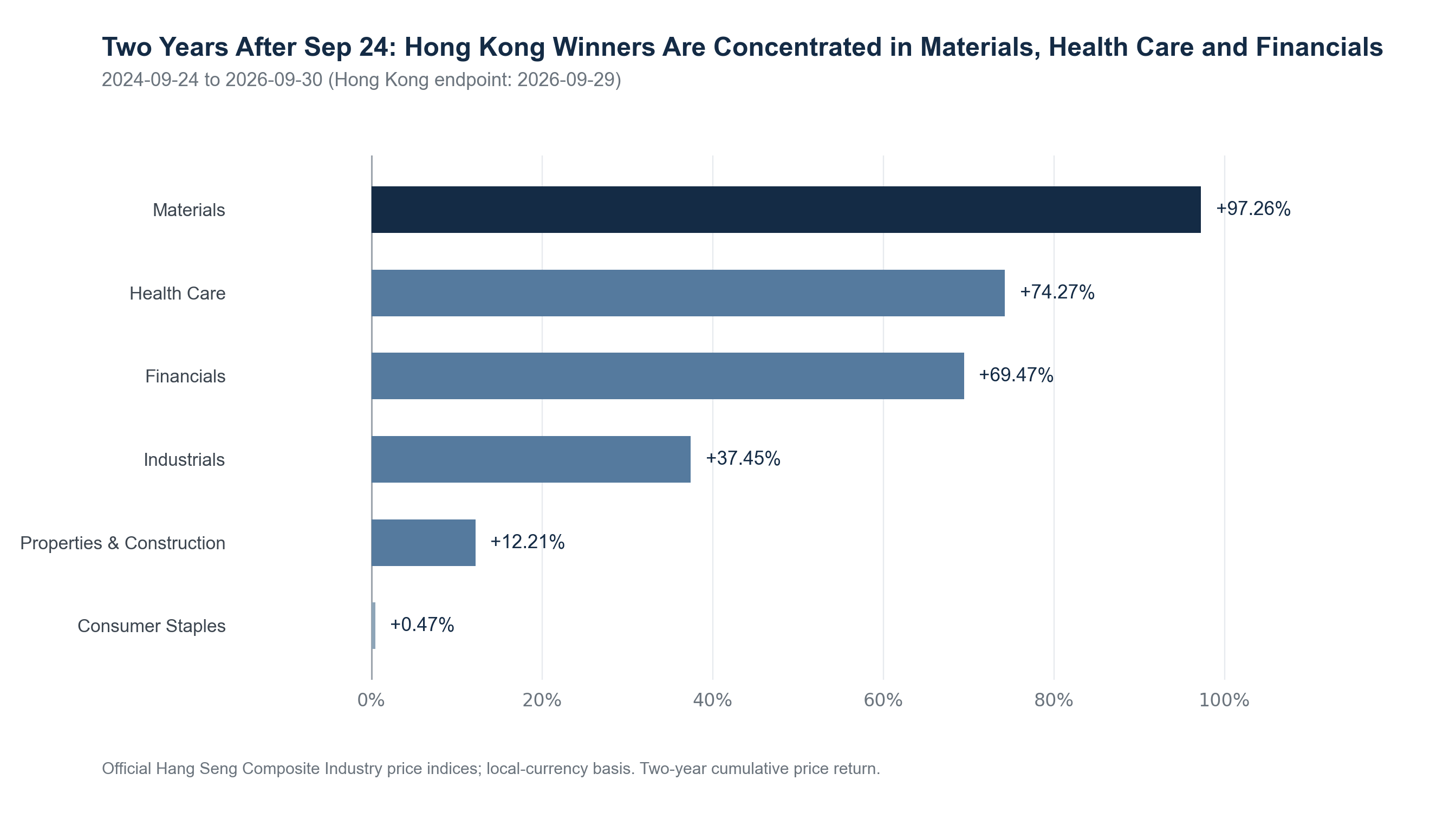
So the bull market was real. But what went up was not what many people thought would go up two years ago. If we think of the capital market as one giant prediction market, then prices are the votes investors cast with real money. Money is not always right, but it is often more honest than slogans. Over the past two years, what the market has really repriced is not a “full recovery of the Chinese economy,” but something else entirely: where will China’s future growth actually come from?
Before going further, it is worth briefly explaining what “9/24” refers to. The term generally refers to a concentrated shift in Chinese financial policy on September 24, 2024. On that day, the People’s Bank of China, the National Financial Regulatory Administration and the China Securities Regulatory Commission jointly announced a package of measures, including reserve-requirement cuts, interest-rate cuts, reductions in existing mortgage costs, lower minimum down-payment requirements for second homes, and new tools to support the capital markets. 9/24 later became the starting point for this round of repricing in Chinese assets.
I. It Took the Market Two Years to Go from “Buy China” to “Buy Only the Winners”
If we break down the market since 9/24, the story is actually not very complicated. There were roughly three stages. The first was a broad-based rally, when investors simply bought China. The second was divergence, when the market began to choose between sectors. The third was concentration, when capital ultimately chased only those winners that had already proved they could grow.
Stage One: Don’t Ask About Earnings—Just Buy China
The first stage ran from September 24 to October 8, 2024—barely two weeks. What the market first traded after 9/24 was not an improvement in the fundamentals of any specific industry. It was a much simpler judgment: Chinese assets had been priced far too pessimistically.