


A few weeks ago, a phrase kept appearing in my social feeds: “姥姥经济” — literally, “Grandma Economy.“ The term, circulating across Xiaohongshu and Weibo, describes something I’ve been noticing for a while but hadn’t seen named so precisely: Chinese consumers, particularly younger ones, are increasingly projecting their nostalgia for grandmothers — the warmth, the slowness, the handmade everything — onto the brands they buy, the content they consume, and the creators they follow.
The Chinese word 姥姥 (lǎolao) refers specifically to one’s maternal grandmother in northern dialect— a figure who, in many Chinese’s memory, evokes a particular constellation of associations: rural village life, wood-fired stoves, handmade textiles, pickled vegetables, and an unhurried rhythm of existence that feels increasingly alien in China’s hyper-accelerated urban centers.
“Digital grandmas & grandpas”: China’s hottest KOLs
Of course, today’s grandmas & grandpas are hardly confined to the countryside. Following the explosion of short-video platforms, a new breed of senior KOLs has taken the Chinese internet by storm—some rocking streetwear and high fashion even trendier (潮) than Gen Z. A generation of young Chinese are openly describing their favorite elderly content creators as their “digital relatives/cyber ancestors“ (电子亲人/赛博祖辈).
On Douyin, at least 77 silver-haired influencers have surpassed one million followers as of June 2025. Twenty of them have exceeded four million. The top “grandma” accounts command audiences that dwarf most celebrity accounts — and their fans are overwhelmingly young.
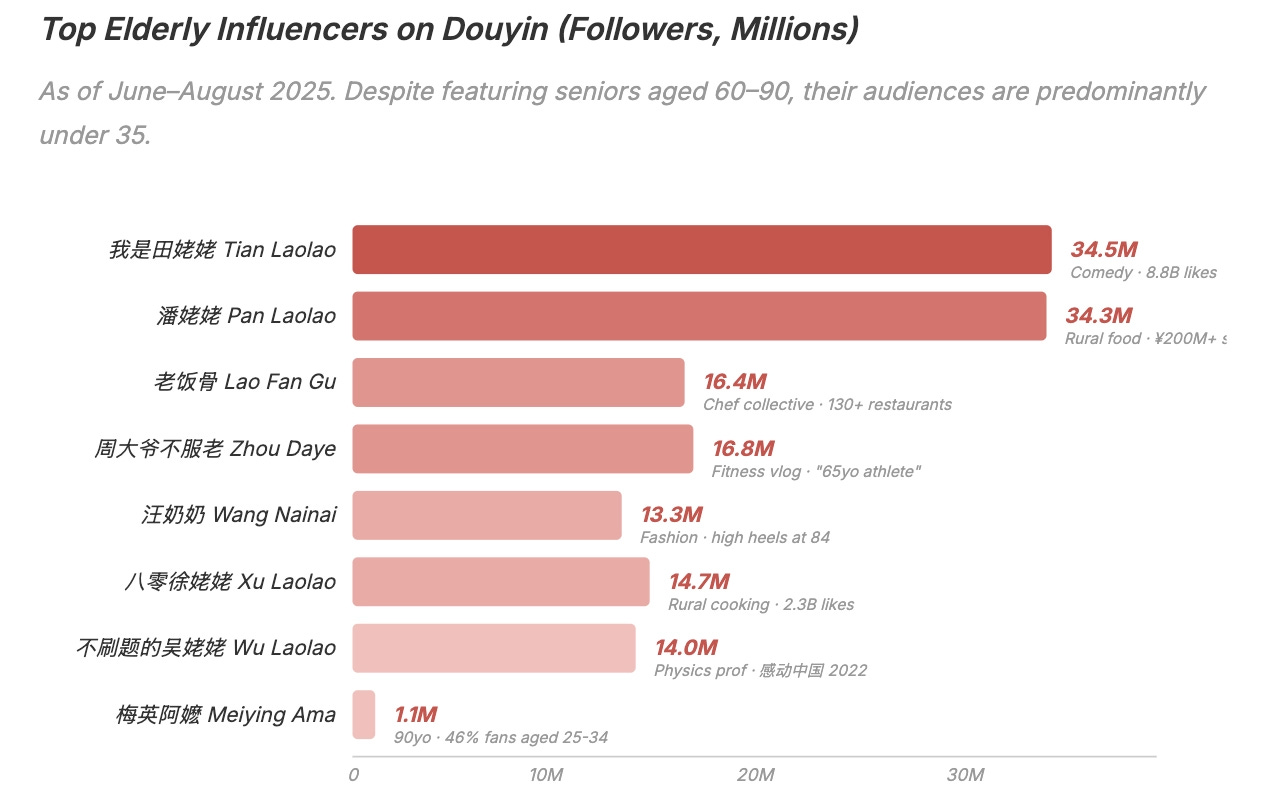
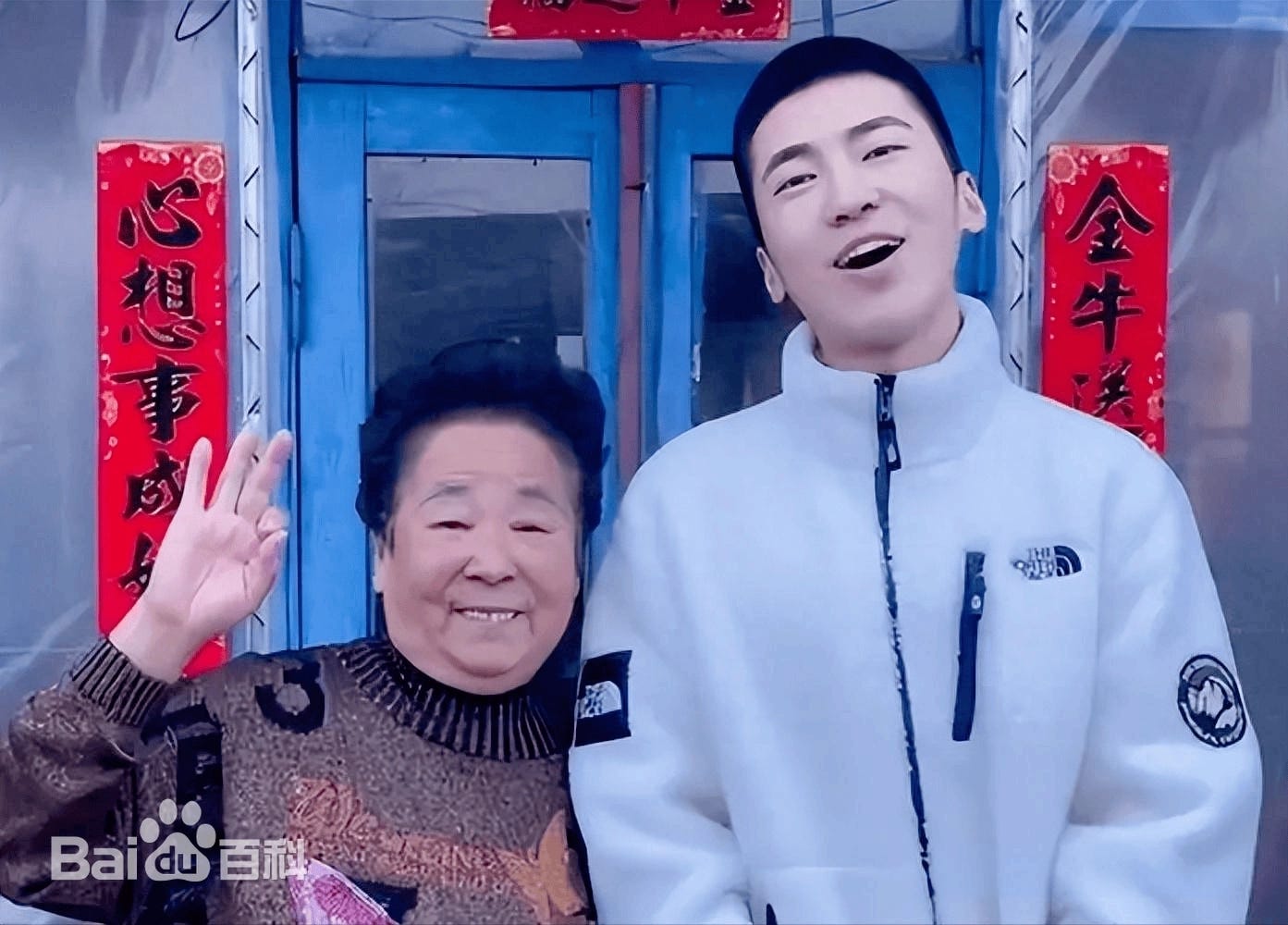
Tian Laolao (我是田姥姥), a 77-year-old from Anshan, Liaoning province, is the most-followed elderly creator on Douyin, with 34.5 million followers and 8.8 billion likes. Her content feels very unfiltered, mostly just her grandson filming her rapid-fire Northeastern dialect rants, but her funny comedy-style content has made millions of young netizens call her "National Grandma".
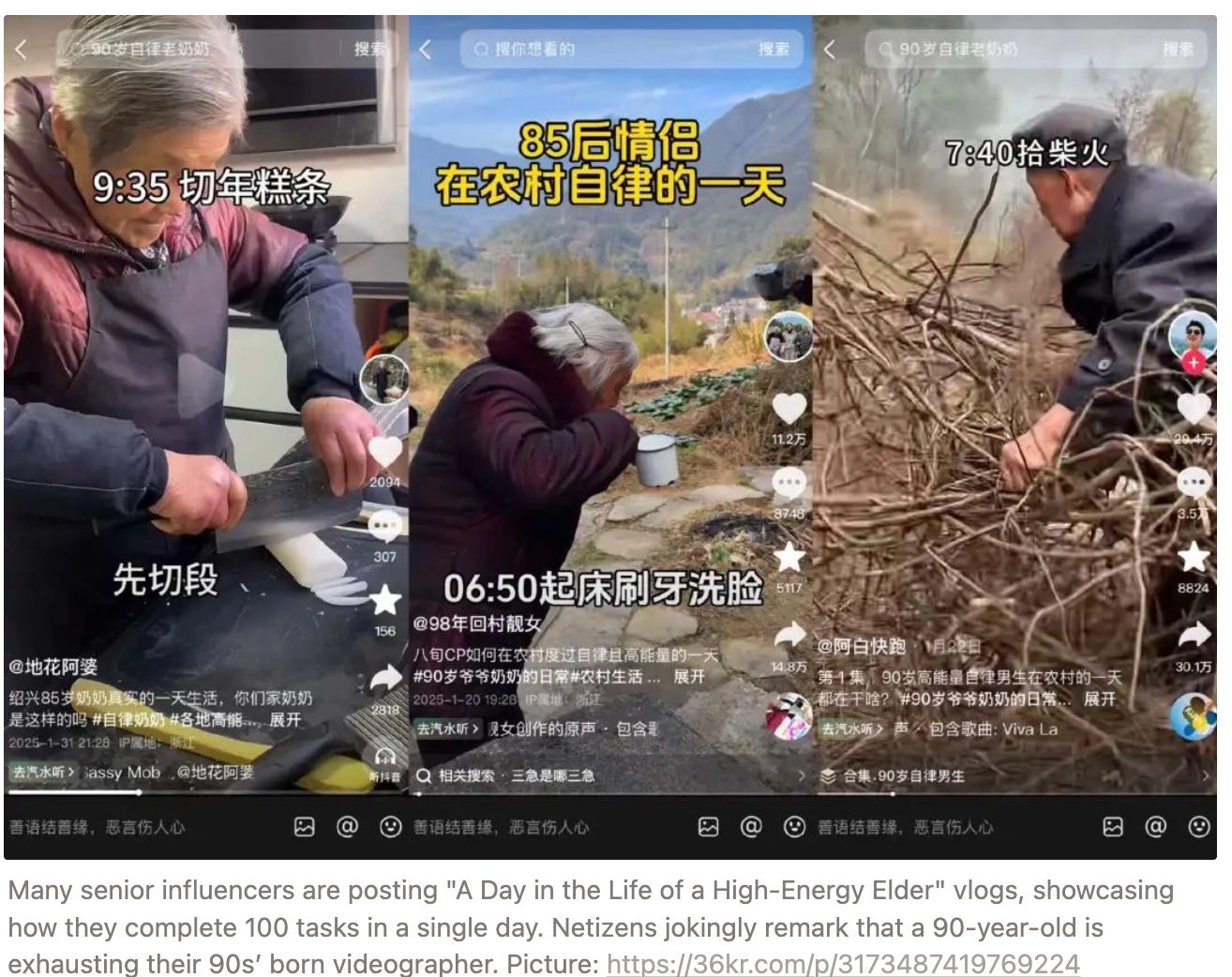
There are also many who break every stereotype of how an elderly person should live. The “high-energy nonagenarian” wave has become a real eye-catcher. Since late 2024, sped-up day-in-the-life videos of seniors who wake at 6 AM and don't stop until midnight have become a viral subgenre. The breakout star is Meiying Ama (梅英阿嬷), a 90-year-old in Fujian who grew to 1.13 million Douyin followers within months, with 46% of her fans aged 25–34.
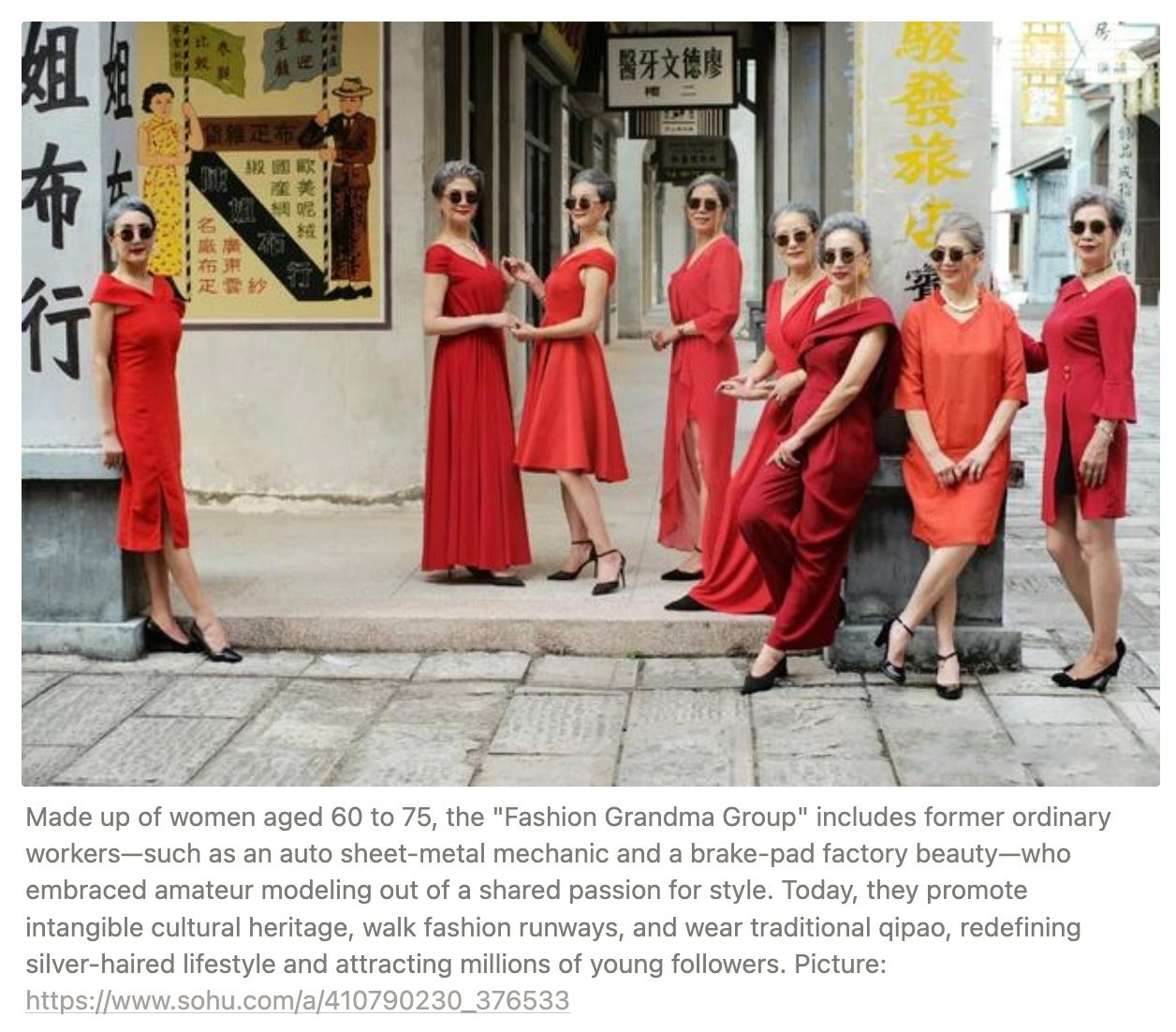
In contrast to the stereotype of elderly Chinese people as frugal minimalists, some senior KOLs take the liberty to express their fashion statement even more loudly than the youth. For instance, the Fashion Grandma Group (时尚奶奶团), an MCN founded in 2019, boasts over 15 million followers and 2,000 members nationwide, attracting a predominantly young female audience.
“Cyber ancestors”: when the shorts feed becomes family
The hashtags “cyber ancestors” and “digital relatives” have become increasingly popular on Chinese social media.
Many young viewers simply marvel at these creators’ health and fitness after a long workday, leaving comments like, “I’m a 20-year-old watching a 65-year-old athlete’s day.” This reflects their burnout from fast-paced city life, using these videos to vicariously experience the high-energy lifestyle they wish they had.
For others, these creators are a reminder of a simpler time—when spending a slow afternoon in the countryside was completely fine. Unfiltered clips of seniors speaking in local dialects and eating homegrown fruit offer a welcome break from daily stress.
In the comments, young followers often share major life updates, writing things like, “Grandma, I got into grad school!” and treating the influencers as stand-in grandparents.
China’s rapid urbanization pulled hundreds of millions of young people from villages into cities. The geographic separation is compounded by a communication gap: young people talk about workplace drama and internet culture that their grandparents don’t understand; grandparents repeat concerns about eating and sleeping that young people find tedious.
The “cyber-ancestors” fill this void — they speak in a language young people can engage with, on platforms they already inhabit, without the guilt of a real family phone call. The emotional transfer is real.
