While going through recent earnings from a few Chinese consumer companies, I noticed something that felt slightly off: instant noodles are still selling, and average selling prices are even rising.
Tingyi, better known as Master Kong and the clear industry leader in China’s instant noodles, is a useful example. Noodle volume has stayed soft, but shoppers have been trading into better packs, and Tingyi’s noodle-segment margins have kept climbing.
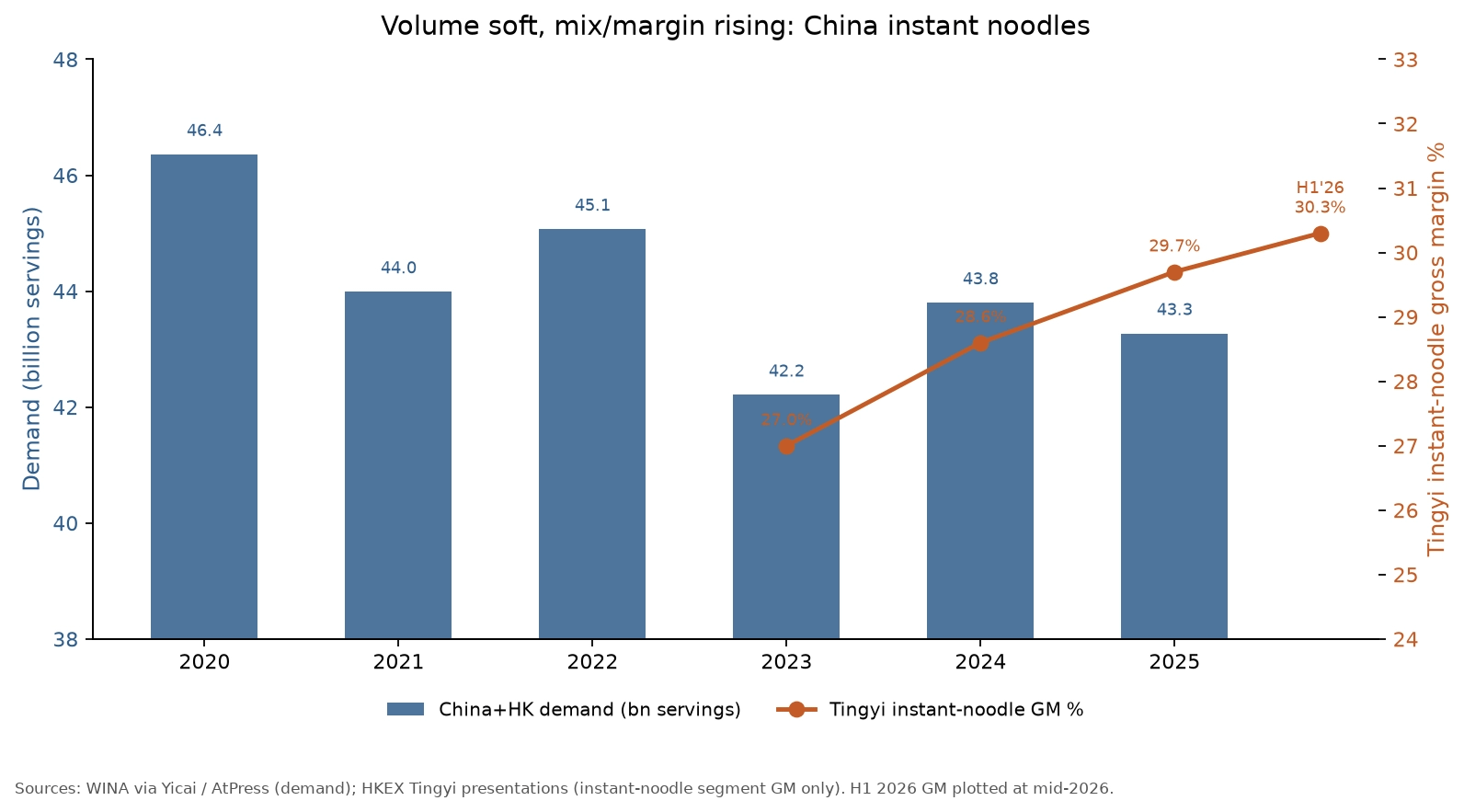
That felt counterintuitive to me. In China’s deflationary environment, I would expect premiumization to be hard unless your customers are wealthy households mostly insulated from the macro. It’s hard to see an obvious path for the selling price of instant noodles, a daily staple, to rise, yet industry leaders managed to increase their gross margins (something even many ‘new productive forces’ companies failed to do in this hyper-competitive market).
The other detail that stuck with me is more cultural than financial. Instant noodles with a grilled sausage is a classic late-night or affordable one-person meal combo almost every Chinese person recognizes. It is just a mundane comfort food meant purely to satisfy hunger—not some viral trend cooked up on social media.
Put those two observations together, and a quiet but interesting consumer pattern starts to show: despite a nationwide preference for freshly made food over factory-processed alternatives, cheap, tasty, and transparently labeled industrial brands are actually becoming a go-to choice in China.
I’ve been thinking of this pattern as something I call Honest Industrial Meals: factory-made food people still choose, as long as the price is fair and the brand is clear about what they are buying.
Food delivery was a necessity born from overtime work
For many young, working Chinese, home cooking stopped being the default years ago. Long overtime, tiny kitchens, and delivery apps made ordering dinner feel more rational than chopping vegetables after 9 pm. That’s how Meituan and Eleme turned takeout into infrastructure.
Delivery solved efficiency. But it did not permanently solve trust.
Over time, delivery-only kitchens have spread across the country. These ghost kitchens have no dine-in space and are often squeezed into residential corridors or office buildings, targeting busy urban workers who want cheap, fast meals. Naturally, they rely on factory-made, pre-processed food that can be microwaved and ready to go in under a minute.
Whole floors of office buildings have been rented out as delivery-only food halls: no dine-in, just racks for couriers, and hygiene that is often worrying. In a market where customers increasingly want food fast and cheap, restaurants have had little choice but to cut costs. Skipping a street-front shop for a cheaper office-building kitchen saves rent, and many office workers never planned to eat in the restaurant anyway.
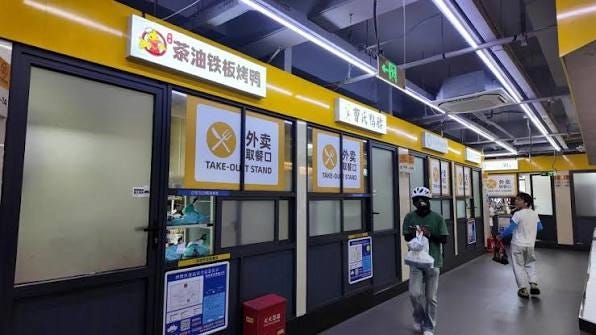
Even big casual-dining brands have joined in. Tai Er Sour Fish, the flagship brand under Jiumaojiu (09922.HK), is one example: it opened dozens of small delivery-only “satellite stores,” roughly 40–60 square meters with no dine-in seats, and partnered with Meituan to roll out about 50 of them in 2024. Consumers still see the bright mall storefront on the app; the bowl often comes from a corridor kitchen upstairs.
By late 2025, ghost kitchens had become a massive, underground industry. State media began reporting on borrowed licenses, opaque sourcing, and storefront photos that did not match the actual stalls behind the app icons. Much takeout food has since become notoriously associated with heavily processed industrial meals packed with chemical preservatives.
While delivery platforms like Meituan and Eleme still expand aggressively, many consumers are pausing to question what this efficiency actually brings them, and what they are putting on their tables.
“Prepared dishes” gradually picked up a stigma.
When prepared food showed up at restaurant prices
That stigma sits on top of a Chinese food idea that does not translate cleanly: guoqi (锅气). In everyday Chinese, guoqi is the smoky, just-off-the-flame taste that tells you a dish was stir-fried for you in a hot wok. It became shorthand for authenticity. Factory food became shorthand for something cold and corporate.
But restaurant chains complicate that folklore. Many use central kitchens for consistency, cost, and food safety. Consumers still use “prepared dishes” loosely for anything that feels factory-finished rather than wok-finished.
That gap between kitchen reality and customer expectation exploded in September 2025 around a brand almost every Chinese family knows.
Xibei is a household northwest-style casual dining chain: oats, hand-pulled noodles, lamb, family tables, the kind of place people take parents or kids for a reliable sit-down meal. Its founder, Jia Guolong, built that national familiarity over decades and is a familiar, outspoken face in Chinese restaurant media. When a brand that sold itself on home-style cooking looks industrial, the backlash is sharper than it would be for an anonymous delivery stall.
On September 10, entrepreneur and influencer Luo Yonghao posted that a Xibei meal was “almost all prepared dishes, and so expensive.” Xibei pushed back, citing the national definition of prepared dishes, claiming its food wasn’t entirely pre-made, and opening its kitchens to the public. However, this move backfired, revealing to millions of netizens that the food was indeed cooked in central kitchens and sealed in vacuum packaging. As traffic took a hit, Xibei apologized by September 15 and pledged to bring several dishes back to in-store cooking.
The anger was about opacity, restaurant-level prices for industrial dishes, and the feeling of paying for a guoqi promise while receiving a heat-and-serve plate.
But the juxtaposition of the two problems somehow created an interesting overlap. On one hand, ghost kitchens are pushing young consumers toward chains and big brands for food safety and transparent nutrition labels. The worse the food-safety problem spreads in the takeout industry, the more demand there is for a transparent, honest industrial meal.
On the other hand, they simply do not want to pay a guoqi premium for industrial food. If they know they are just paying for a quick, convenient workday meal, it is better to buy from a trustworthy chain at a reasonable price than from some unknown ghost kitchen in a neighborhood corner using packaged prepared food that cannot guarantee what is inside.
I believe this is a structural demand: many urban workers are not going back to home kitchens anytime soon, given how busy work life is. That is exactly what makes labeled noodles, sausages, and retail prepared packs look rational next to a takeout order.
Instant noodles happen to sit at the sweet spot. Even after selling prices rose, absolute prices still stay low. A bag or cup plus a sausage often costs less than a ghost-kitchen meal, but it is backed by a big brand’s reputation and comes with a clear nutrition table.
Mid- and high-price bags have been taking share. Industry research cited in trade press puts mid/high-end noodle growth well ahead of low-end over 2020–2026, with the ≥5 RMB band approaching roughly half of the mix. Uni-President’s Soup Daren, Qiehuang, and Manhan Dacan lines have been part of that premium push. Korean Samyang spicy noodles also entered the competition and now rank among China’s top five brands by market share. Dry noodles and regional formats such as Akuan have widened the one-person dinner aisle beyond soup cups.
Even among my friends and colleagues, I have heard people say they genuinely like the taste of instant noodles nowadays. Many of them aren’t price-sensitive; they simply think instant noodles plus some protein and vegetables make a quick but decent meal.
Over the years, the shelf has indeed gotten better. It is no longer just the classic salty, red-braised beef cup. Brands have gotten creative with flavors (sometimes too creative, perhaps; China’s shelves now carry plenty of adventurous packs).
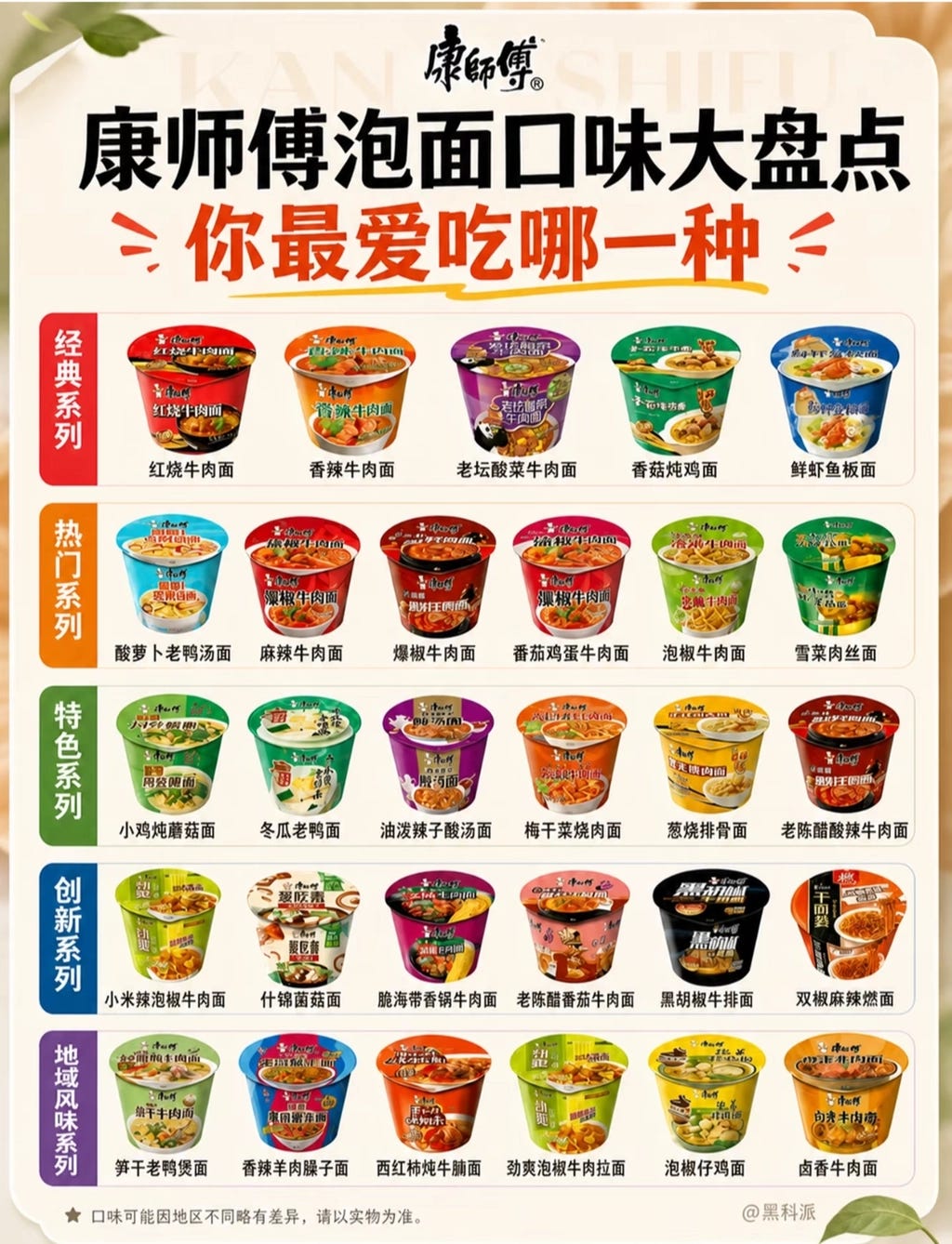
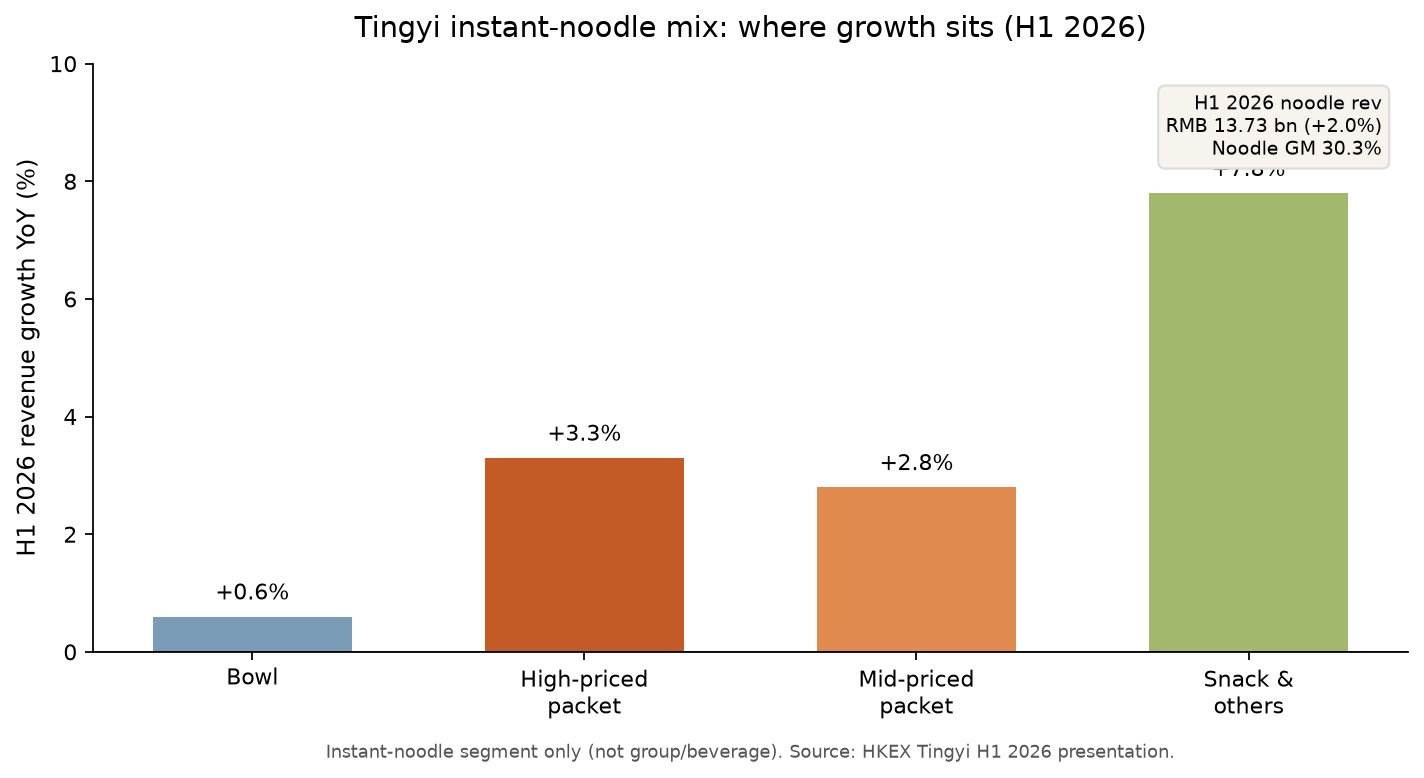
Tingyi’s instant-noodle segment lines up with that pattern: FY2025 noodle revenue was essentially flat, but noodle gross margin rose to 29.7%. In H1 2026, high-priced packets rose 3.3%, mid-priced packets rose 2.8%, and snack noodles (with flavor varieties) rose 7.8%.