Regulatory risk is one of the biggest concerns for investors in China. Pandawatch, friend of Baiguan and long term investor in China, recently gave a presentation on this topic discussing common patterns across precedents, with the goal of offering a practical framework for spotting danger in a portfolio.
He also looks at the opportunity side: can the correction that follows regulatory action create good entry points? Moutai’s share price rose 10x in the six years after the Eight-point regulation triggered a sector-wide correction. This can be relevant for investors looking at names like Futu, Trip.com, and other listed companies going through regulatory scrutiny.
Pandawatch‘s real name is Enrique Becerra, a Hong Kong–based investor who has managed his own capital full-time since 2017 with a focus on China A-shares and Hong Kong-listed equities. He is the author of the monthly letter “Investing in China” and tweets as @pandawatch88. Based in Hong Kong since 2007, he spent 16 years as an investment banker at Citi and Bank of America Merrill Lynch.
What follows are his slides and speaking notes.
Enjoy!
My topic today is the impact of regulatory episodes on stock prices.
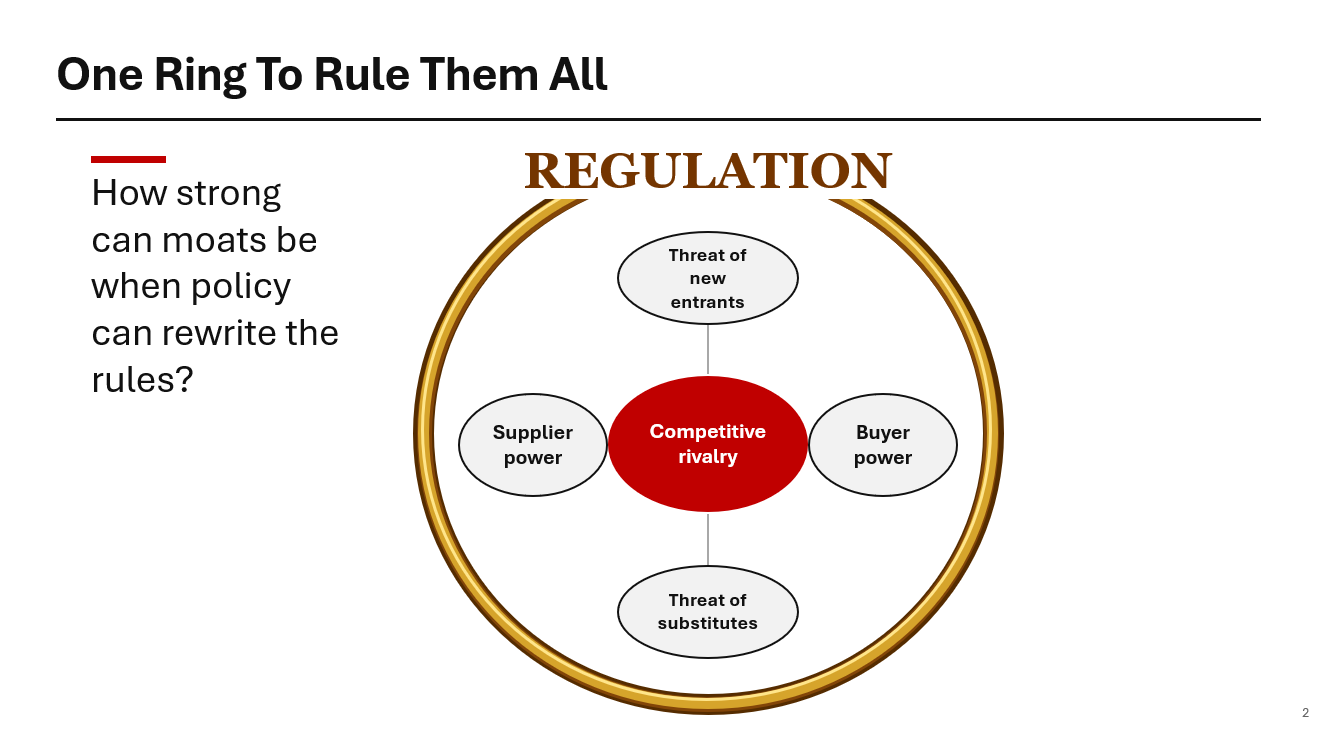
Many things define a company: the product, the competition, growth, pricing power. As investors, we spend a lot of time evaluating these.
Regulation sits above all of them. Watching. And has the power to make our very thorough analysis irrelevant in a single day.
When regulation hits a company’s moat, the valuation can change a lot.
LETS PLAY A GAME.
Here are 3 examples of regulators targeting listed companies.
You have to guess the country:
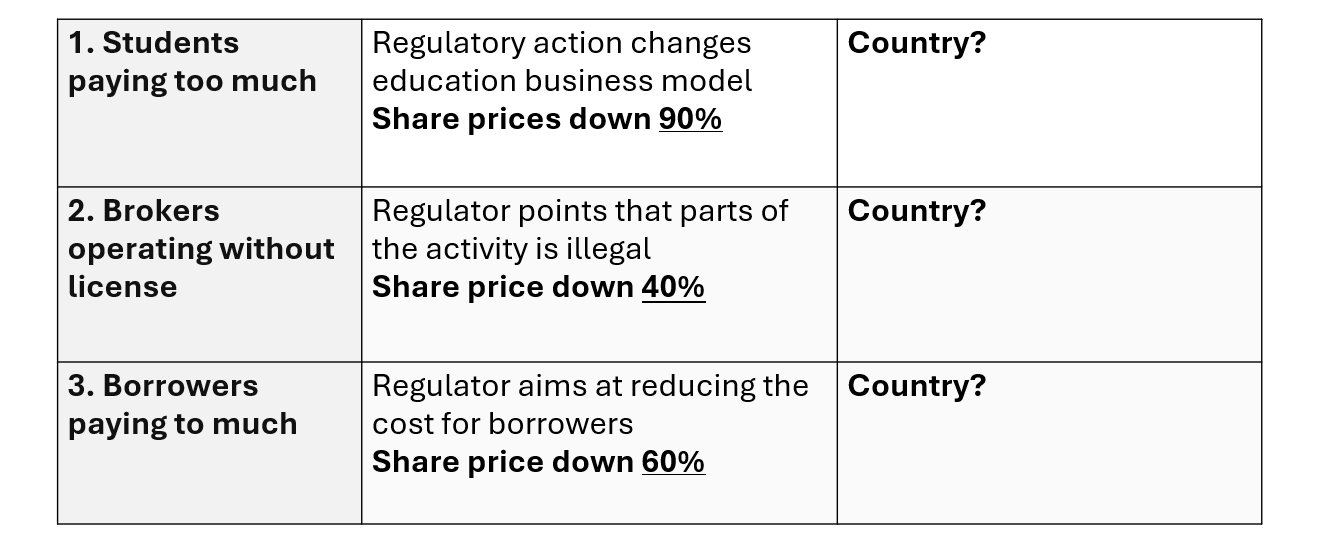
The left column tells you the policy concern behind each regulatory action.
First row: education stocks fall 90%. The regulator decides schools are squeezing too much money out of students and families, and forces a change in the business model. Sounds familiar? Where could this be?
Second row: online broker stocks drop 40% after the regulator calls them out for operating in grey areas without a license.
Third row: the regulator is concerned about the high costs associated with consumer loans, and takes action. Share prices fall 60%.
Guessed the country yet?
China, you say? Did someone say the US?
…
…
And the answer is…
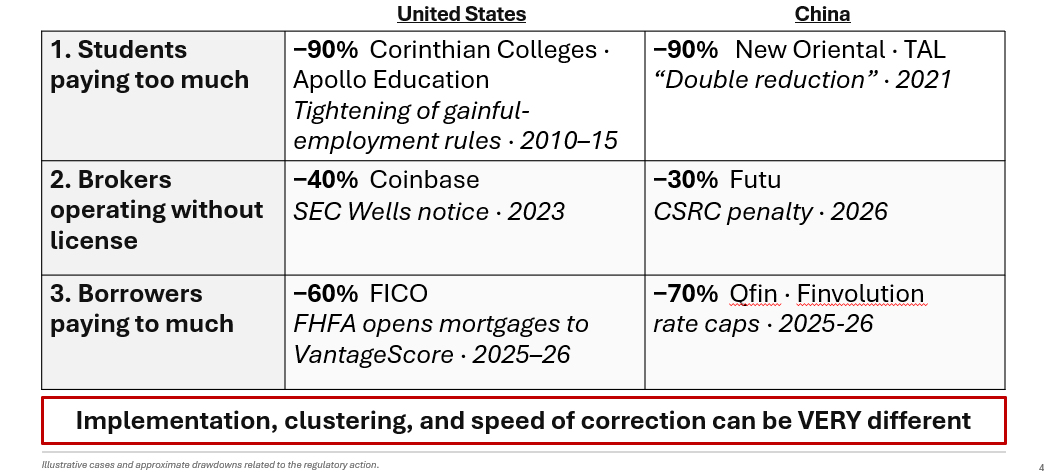
Good news! The answer is both, US and China. Everyone’s a winner.
Similar policy concerns, similar damage to share prices from regulatory action.
Education: In 2010, the US administration went after for-profit colleges. The sector collapsed, stocks fell 90%, bankruptcies followed. In China, the 2021 measures against after-school tutoring have since been widely cited as proof that China is “uninvestable” (conveniently forgetting what happened in the US a decade earlier).
Online brokers: Coinbase and Futu both dropped 30-40% after regulatory action. The SEC accused Coinbase of operating as an unregistered securities exchange and broker. The CSRC fined Futu for serving mainland residents without a domestic license.
Consumer lending: FICO is a long-time favorite of US quality investors, widely considered to have a deep moat. Then one day, the new head of the Federal Housing Finance Agency decided it was time for some competition in credit scoring. The stock is down 60% since. In China, fee and rate caps on online lenders, also aimed at cutting cost of borrowing for consumers, have produced a collapse in the share prices of online consumer lenders over the past year.
One lesson here is beware of using national flags to underwrite your comfort level.
But there is an important difference: implementation speed. The US goes one company at a time, keeping the blast radius contained. China can do everything, everywhere, all at once. In the US, a full drawdown can take 2-3 years. In China, it can take a week. China speed is called.
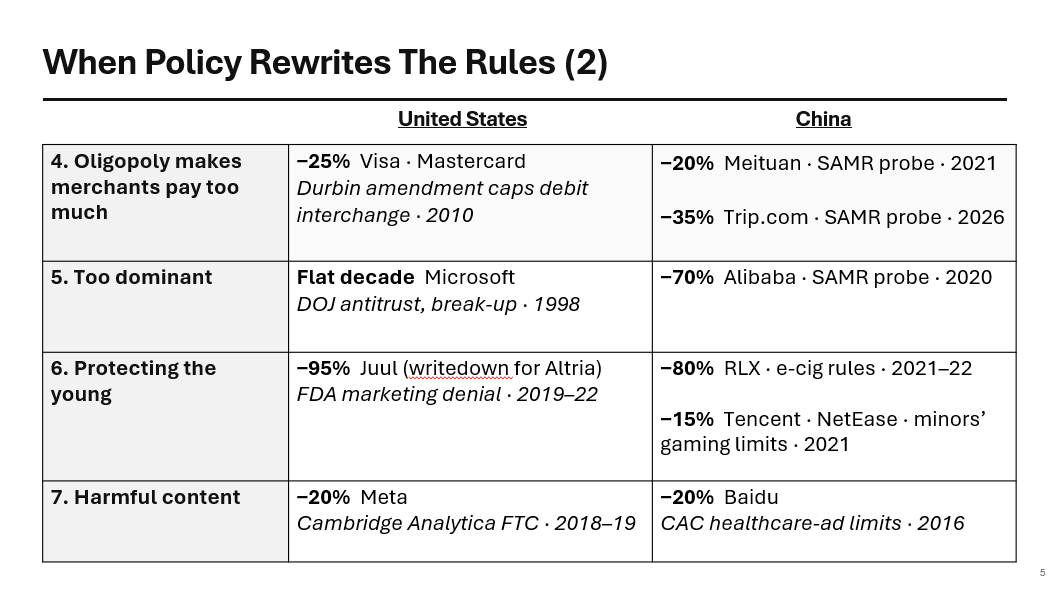
An interesting finding across 25 examples: two different countries, one ocean apart, yet the policy concerns behind their regulatory actions, and the impact on share prices, are remarkably similar.
Take the first row, duopolies squeezing fees from merchants. The Durbin Amendment sent Visa and Mastercard down 25% in 2010. Meituan and Trip.com fell 20-35% when SAMR launched its unfair competition probes.
I wont walk through every row, the tables speak for themselves.
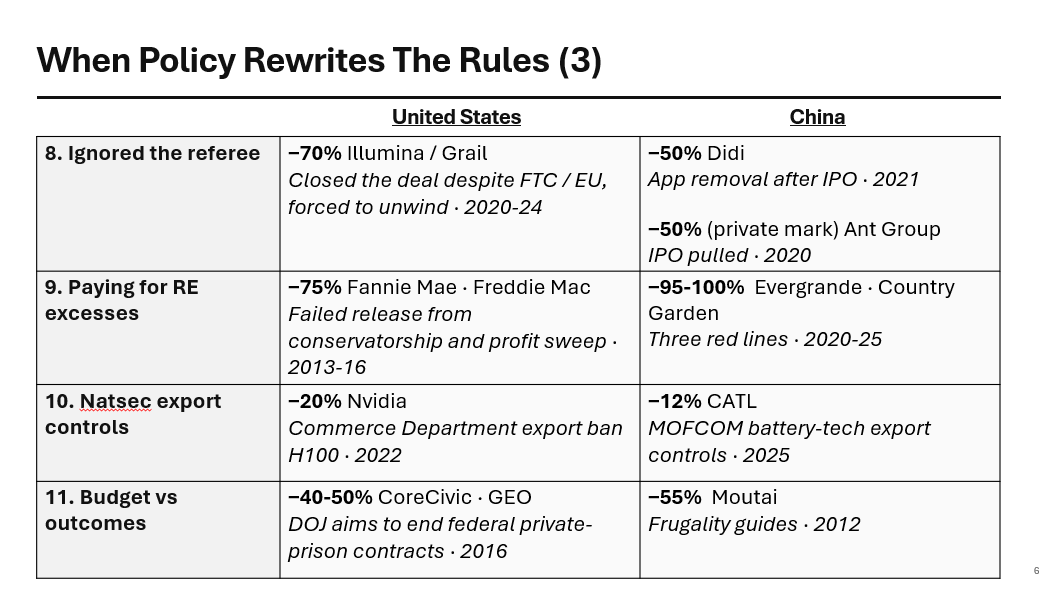
Another example: in the first row we have companies that ignored the referee and pushed ahead with a deal. These can get reversed in both the US and China, and stocks tank.
So, given these patterns, can we use them to predict who is at risk?
I ran all the examples through AI models: Fable, Astra. Civilizations of agents worked on them. And what they found is…
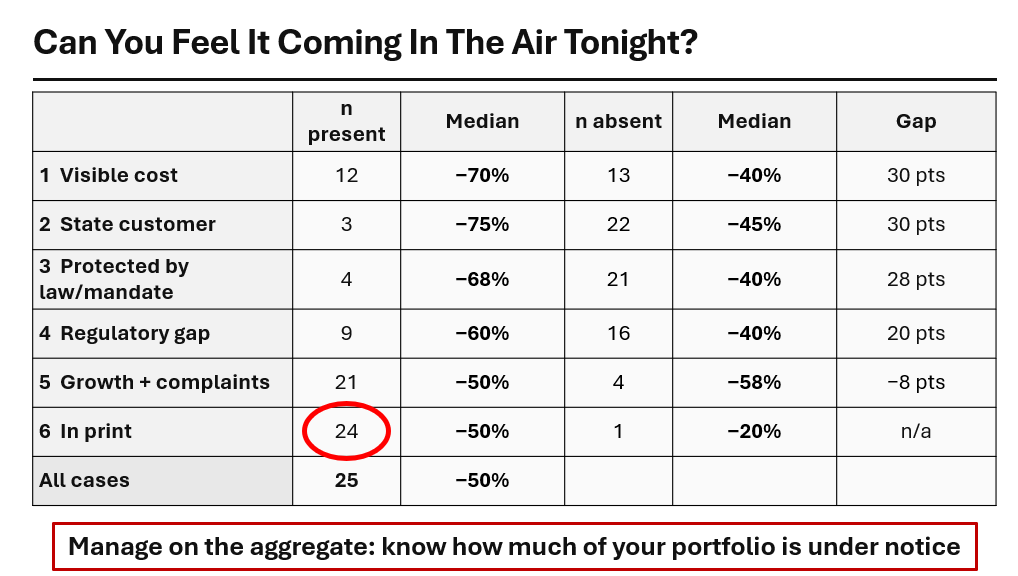
What they found is six flags, listed in the left column. These flags are the conditions that were in place before the regulatory action hit. The second column shows how many of the 25 examples had each flag.
The flag in row #6 was present in 24 out of 25 cases: “The narrative is already in print.” Government leaders and regulators had already flagged the policy concern repeatedly in speeches and op-eds before acting. Let’s look at an example:
China’s after-school tutoring sector went through 3 years of warnings until it was eventually dismantled
The sector had been first singled out around the NPC/Two Sessions in 2018 and 2019 as a source of excessive academic pressure on students and rising financial burden on families.
In the run-up to 2021, regulators and state media frequently criticized aggressive marketing and pricing abuses. Investors paid little attention and stocks kept rising to as much as 90x PE.
Less than two months before the “double reduction” regulation, regulators fined 15 tutoring firms for false advertising and price-related violations.
Not every criticism leads to action, of course. Those cases wouldn’t be in this table. But the reverse, action with no prior criticism, barely seems to happen.
The second most common flag is row #5: “companies doing very well, but people complaining about it.” Present in 21 out of 25 cases. Good news for some: if parts of your portfolio are underperforming, relax, nobody regulates the companies nobody cares about.
So is the conclusion to avoid all these flags?
No. Avoid everything with regulatory risk and you’ll miss some great returns. Visa and Mastercard have done 20x-100x since IPO despite constant regulatory overhang. Meta has gone up 4x since Cambridge Analytica opened the floodgates of persistent regulatory scrutiny on social media.
What we can do is manage on the aggregate:
Know how much of your portfolio is under notice. Count the flags and put a risk budget on the exposure. Make sure the reward compensates for the risk. Assume these names can fall 50%. Means you need to see 2-3x upside to be interested.
Balance the portfolio with lower-risk names. Companies not on notice, companies that don’t add to the cost of prosperity, companies the regulator actually wants to accelerate, regional SOEs, etc. Don’t just own the MSCI China.
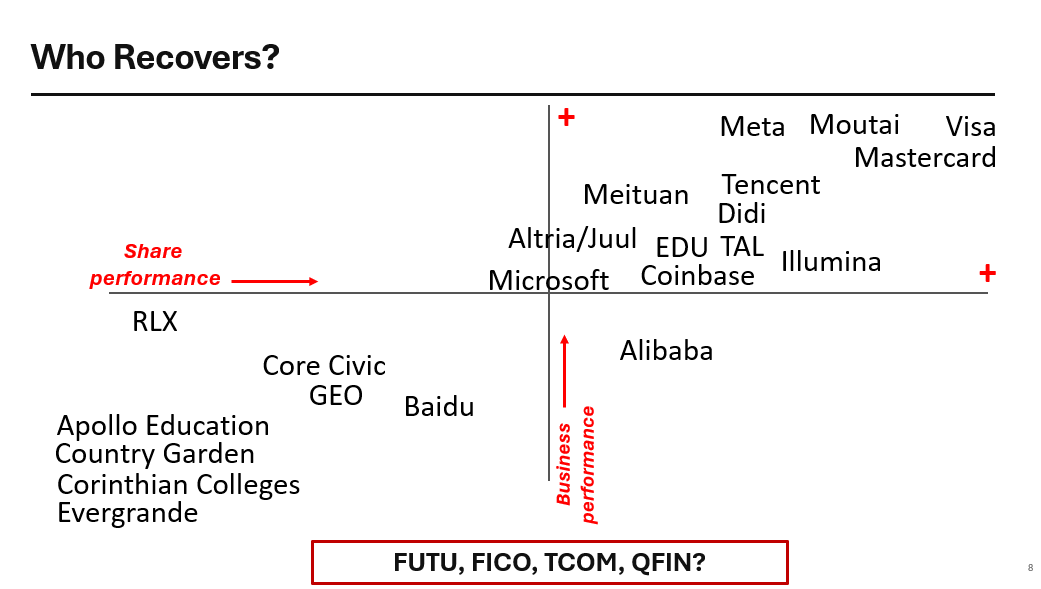
Last slide. Who recovers from a regulatory storm?
The x-axis shows share price performance from the bottom. The right half contains companies that fully recovered as well as those where buying on the news made money even without a full recovery.
The y-axis shows business performance. The bottom half contains companies whose businesses never fully came back.
The contrast between the strongest and weakest performers shows what to look for:
Moutai was a 10x after the 2012 regulatory action. The core value is in the product (people love it) and the regulator didn’t touch that. The regulator went after the system around it (banquets, official gifts). The product eventually found new routes to its fans.
Visa and Master also 10x’d after the 2010 action. Their core value is in the system (the oligopoly) and the regulator left that untouched, targeting only part of the product (debit fees). The system remained in place.
Companies where the core value itself got hit end up in the bottom left. Bank financing was part of the core value of Chinese real estate developers. Government financing and bank support were part of the core value of for-profit colleges in the US, and of private prison operators. They disappear or never fully come back.
In the middle are companies where the blow isn’t fatal to the core value, but competitors can take advantage while management sits in the penalty box. Many argue this happened to Microsoft in the 2000s, a lost decade for the share price while management focused on preventing a break-up. Alibaba lost significant share to PDD and Bytedance during its period under regulatory scrutiny.
What about the current cases?
FICO: their core value is in the system (the mandated nature of credit scoring and its monopolistic position), not in the product (nobody would pay for it if it weren’t required). The system is what got hit. This could be bottom-half territory.
Futu: their core value is both system and product. Users like the product. But the company was also exploiting the system by serving mainland residents without a license. That part is gone. But two-thirds of the business remain untouched. The valuation down by 1/3 seems to reflect this already (simplistic approach, there’s nuance of course).
Trip.com (TCOM): also a mix. System in the form of a dominant market position that forces terms on merchants, but also product as users genuinely like the app. What got hit is the system. How much damage that does depends on competitors. TCOM can go the way of Meituan if competitors fail to show up (SAMR’s probe barely dented the business, EBIT went up and shares recovered), or the way of Alibaba if they do. That’s what I’m watching. And just this week, SAMR summoned TCOM’s competitors over unfair competition concerns, which is probably a relief for TCOM management.
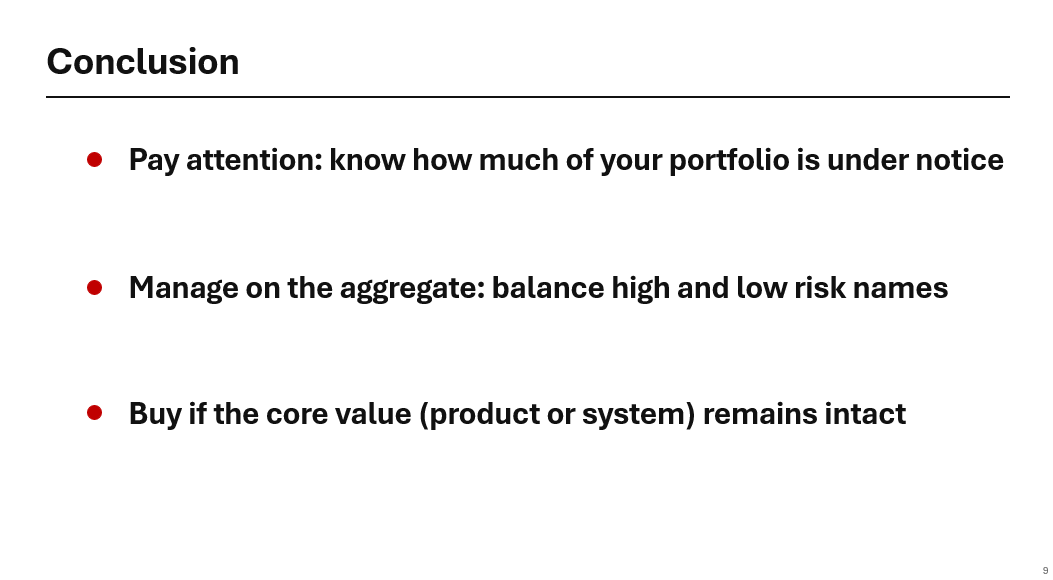
To wrap up, three takeaways:
Pay attention. Know how much of your portfolio is under notice.
Manage on the aggregate. Make sure risk-reward is attractive. Balance the portfolio with lower-risk names.
After regulatory action hits, identify the core value. Only buy if the regulator has left it untouched.
fin