


This is a guest post by ReadChina, who is a senior analyst based in China. ReadChina tracks and interprets the country’s macro economy, tech policies, investment opportunities, and risks - cutting through the noise to spotlight what truly matters. The views expressed here are his own.
If you also wish to share your writings with the 12,000+ Baiguan subscribers, please send us an email at baiguan@bigonelab.com
Is CXMT’s IPO a Black Swan Moment for the DRAM Giants?
The last few months saw a historic rally across the global memory-chip industry. Each of the three largest DRAM producers — Samsung, Micron Technology, and SK hynix (the “Big Three”), surpassed $1 trillion in market value, one after another.
Since 2025, the AI boom has driven a surge in demand for high-performance computing and storage equipment. As a result, global memory-chip companies have seen explosive growth in both earnings and share prices, becoming major beneficiaries of the AI rally.
It’s within this context that Chinese memory-chip maker CXMT comes under the spotlight of the capital market. On May 27, its STAR Market IPO application was officially approved by the Shanghai Stock Exchange. The company plans to raise around 29.5 billion yuan ($4.2 billion), making it potentially the largest IPO in China since 2022. Once listed, it could be valued at more than 2 trillion yuan.
Founded in 2016 and headquartered in Hefei, Anhui Province, CXMT is currently the only Chinese DRAM company to have achieved large-scale mass production. In 2025, it ranked fourth globally, with a market share of 7.67%.
2024-2025 Output of DRAM Memory Chips (thousand wafers per month) Source: TrendForce
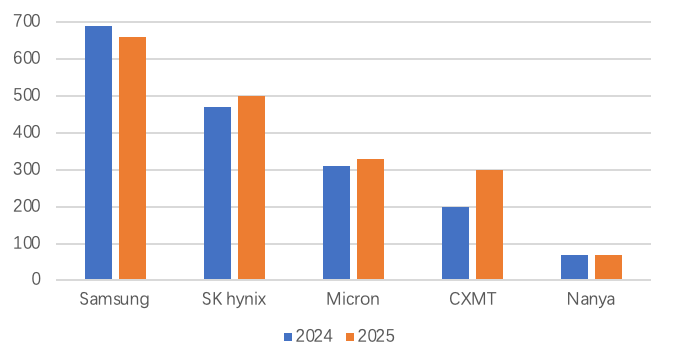
DRAM is one of the most concentrated segments in the semiconductor industry and has long been dominated by the Big Three. For latecomers, huge capital expenditure is only the starting point. They also need years of accumulated expertise in process technology, yield improvement, patents, equipment, customer certification, and supply-chain management. The fact that CXMT has joined the big league is itself a major breakthrough for China’s semiconductor industry.
As of 2026, CXMT has completed the mass-production transition from its first- to fourth-generation process platforms, with products covering DDR4, DDR5, LPDDR4X, and LPDDR5/5X. The company has also built 12-inch DRAM wafer fabs in Hefei and Beijing. Its monthly capacity is expected to continue rising, further expanding CXMT’s presence in the global DRAM market.
Here is an overall timeline for CXMT:
2016: The CXMT was launched.
2017: Construction of the first-phase fab began.
2019: CXMT began production of 8Gb DDR4 products using a 19nm process, marking the first time a Chinese company achieved mass-production capability for mainstream DRAM products.
2021: The company made further progress with its 17nm process.
2023: CXMT launched China’s first domestically developed LPDDR5 product and entered the smartphone supply chains.
2024: CXMT achieved mass production of DDR5.
After 2025: The company continued to advance DDR5, LPDDR5X, and selected server-side products, while HBM-related R&D also began.
The Hefei Model
Behind CXMT’s rise is a broader story: “Hefei Model.” Named after the city that nurtures display maker BOE, electric vehicle NIO, and CXMT, the Hefei Model is a Chinese-style approach to industrial policy. In effect, it functions as a form of state-guided venture capital: local authorities identify industries with long-term strategic value, take equity stakes to fund promising companies, and later sell their shares for massive profits once the companies scale.
In recent years, Hefei has been dubbed “China’s best venture-capital city.” Its state-owned capital does not simply hand out subsidies. Instead, it participates deeply in the development of strategic emerging industries through industrial funds, equity investment, land resources, industrial coordination, and long-term policy support. This approach has helped a once relatively poor provincial capital climb sharply in China’s urban income rankings.
According to CXMT’s prospectus, the company is backed by a broad base of long-term state and private capital, including the second phase of the National Integrated Circuit Industry Investment Fund (Big Fund II), state-owned capital from Anhui Province and Hefei, Alibaba Cloud, financial asset investment companies under state-owned banks, and insurance funds. These investment capitals are:
patient. DRAM is a capital-intensive, cyclical industry that often requires years of losses before scale and competitiveness emerge. Without long-term capital support, it would be difficult for any company to survive the long process of R&D, capacity ramp-up, and industry downcycles.
closely aligned with industrial policy. China wants to improve the self-reliance of its semiconductor supply chain, and DRAM is one of the few critical segments still dominated by global oligopolies. CXMT, therefore, has strategic significance.
helping create an industrial cluster. Memory-chip production is not just about a single fab. It requires wafer manufacturing, equipment and materials, packaging, and testing. Through local state capital and industrial policy, Hefei has embedded CXMT within a broader ecosystem.
This is what makes CXMT different from many other semiconductor startups. Its growth is not driven purely by venture-capital logic. It is a long-term industrial project jointly supported by local governments, national industrial funds, financial institutions, and strategic clients. From this perspective, CXMT’s IPO is not the finish line, but a new capital base for the next phase of capacity expansion and technological catch-up.
Strong Market Demand
That capital base matters because CXMT is attracting attention not because it is simply another “domestic alternative” in China, but because it addresses real market demand. In the consumer DRAM market, its 1a-node DDR5 and LPDDR5X products are beginning to serve a broad range of PC, smartphone, and consumer electronics customers. While CXMT’s process technology still trails the Big Three, its products are already commercially viable for mainstream consumer applications.
At home, CXMT’s memory chips have already been adopted by domestic customers. Its DDR5 products are being supplied to PC makers such as Lenovo, while its server-side products are undergoing validation with internet firms including Tencent and ByteDance. Xiaomi’s use of CXMT’s LPDDR5X chips in high-end smartphones also suggests that domestically produced mobile DRAM is moving beyond low- and mid-range devices and into premium handset supply chains.
This shift toward domestic substitution is not driven solely by government policy or supply-chain security concerns. Instead, it reflects a genuine supply-demand imbalance. As the Big Three allocate more capacity to high-margin HBM (high bandwidth memory) and server DRAM, the supply of consumer DRAM used in PCs and smartphones has tightened. CXMT is well-positioned to fill that gap.
That also helps explain why CXMT’s appearance in global consumer-electronics supply chains. Recently, Corsair’s Vengeance DDR5 16GB memory modules have used DRAM chips from CXMT rather than from the Big Three. This is not an isolated case: HP reportedly placed a large LPDDR5 order with CXMT in January; Qualcomm began working with the company on customized DRAM in April; and Dell, ASUS, and Acer have also reportedly been in contact with CXMT.
When the Big Three are constrained by tight capacity, elevated prices, and longer delivery times, DDR5 and LPDDR5X chips from Chinese suppliers become a practical alternative. In other words, CXMT’s impact on global DRAM market is likely to be felt first in consumer-grade DDR5, LPDDR5X, and other standardized DRAM products.
