


On Jul 2, 2026, the Suzhou Intermediate People’s Court ruled that Molly Tea (茉莉奶白), a Shenzhen-based tea chain with roughly 2,500 stores, infringed seven of Louis Vuitton’s quatrefoil graphic trademarks.
The court ordered Molly Tea to pay RMB 10.3 million ($1.5 million), stop using the motif, and publish remediation statements across six platforms. Molly Tea’s founder, Zhang Bocheng, appealed. Overnight, the brand swapped its black logo for a colored variant.
Legally, the case was clean. LV’s quatrefoil marks were registered in China as early as the 1980s. Molly Tea had actually tried to register its own four-petal flower mark in 2024 — and was rejected by China’s IP office. The brand rolled out the design anyway. The court found willful infringement.
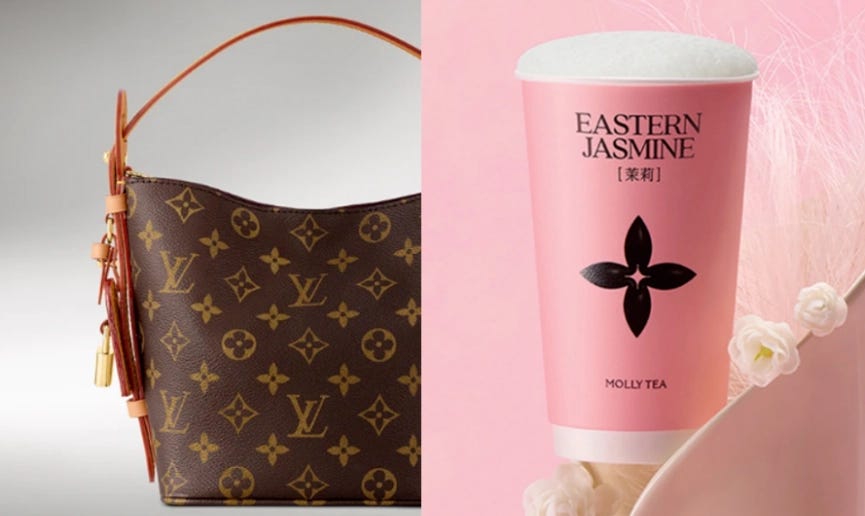
LV won.
However, within 48 hours, a Weibo hashtag started trending: “LV你身后空无一人” — “LV, there is no one standing behind you.”
Very few Chinese netizens came to LV’s defense. Scroll through the comments, and you’d struggle to find a single netizen backing LV’s position.
Why nobody sided with Louis Vuitton?
Many Chinese netizens claimed that LV was effectively culturally appropriating traditional Chinese motifs.
The quatrefoil pattern has always been a cultural symbol in Chinese history. The pattern’s closest East Asian ancestor is the Baoxiang Flower (宝相花), a symmetrical four-petal motif that appears throughout Tang Dynasty art — Dunhuang murals, silk textiles, bronze mirrors, and was later adopted by the Japanese through Tang diplomatic missions.
An even earlier version: the persimmon-calyx pattern (柿蒂纹) from the Han Dynasty, pointing to the four cardinal directions and carrying the auspicious homophone shi (事, “things going as one wishes”).、
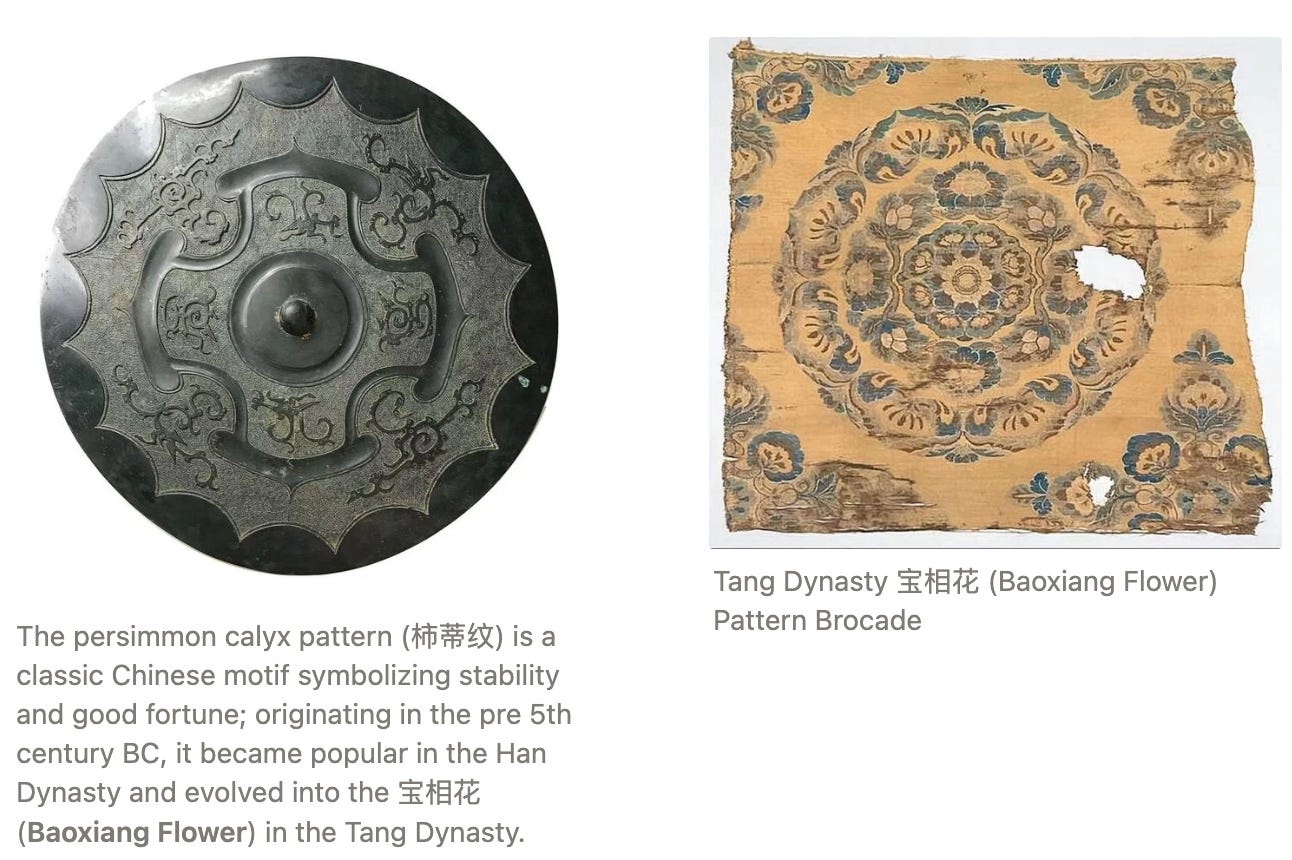
In many Chinese netizens’ eyes, the absurdity of the trademark lawsuit was brutal in its simplicity: LV was suing a Chinese brand for using an ancestral Chinese pattern
And then netizens went further. They dug up LV’s track record in other jurisdictions. In Japan, courts ruled against LV on similar motif disputes in 2021 [*]. The EU canceled LV’s checkerboard trademark for being too generic [*]. But in China, LV walked away with a ten-million-yuan verdict.
The “toilet bag”
Other consumers simply dismissed the originality of LV’s logo as being too generic.
For instance, many netizens pointed out that the quatrefoil pattern is actually ubiquitous in traditional yuanlin (garden) architecture across southern China—and that it is ultimately just a generic motif drawn from nature.

Some netizens even posted pictures of ventilation grilles on old toilets in mainland China, which are commonly carved with four-petaled, symmetrical flowers nearly identical to the LV quatrefoil. More pictures quickly followed: vintage courtyard walls, village window vents, 1980s floor tiles, and kitchen backsplashes, until users across Xiaohongshu, Weibo, and Douyin mockingly began referring to LV tote bags as “toilet tile bags.”
Side-by-side comparisons of LV totes and restroom walls rapidly became a viral meme on Chinese social media:
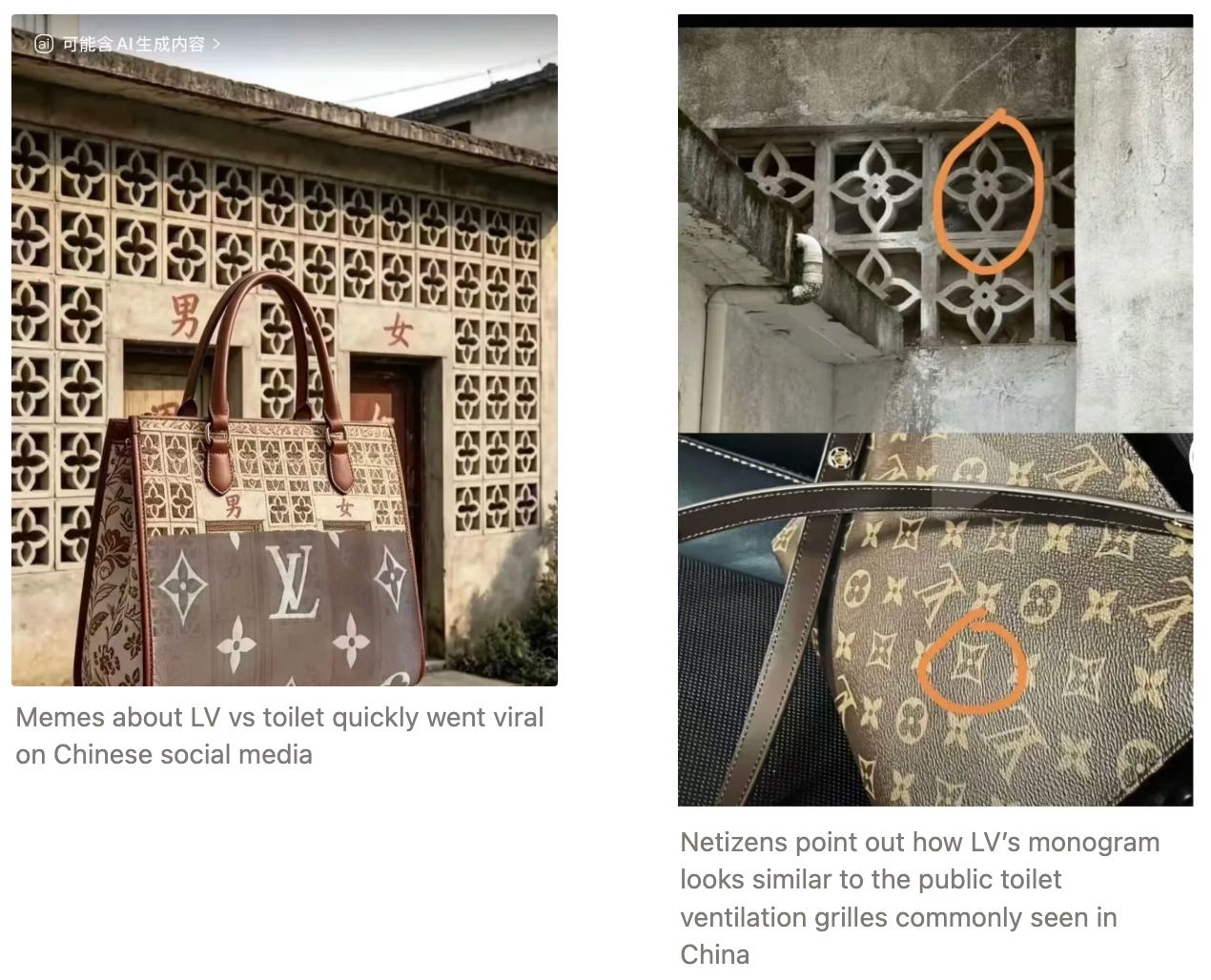
Many netizens admitted they only realized the visual similarity between Molly Tea’s logo and LV’s pattern after the lawsuit went viral on the internet.
Legal wins are not PR wins. Despite winning the case, this is certainly not a good move for LV.
In my observation, Chinese consumers tend to have a short memory when it comes to standard copyright disputes, so the immediate impact on sales rarely lasts. However, LV’s signature logo—which has long served as social currency for status and a fashion icon in China—is now associated with the “toilet.” That synthetic association poses a far longer-term threat.
This is not the first time
This misstep was certainly not the first, nor was it simply a matter of Chinese consumers boycotting foreign culture.
Many other brands have stumbled across China’s cultural landscape before. The most recent example was Lululemon’s yoga festival on the Great Wall, where the brand featured a Japanese Taiko drum performance while branding it as a traditional Chinese drum display.

Prior to this, other PR crises had emerged as well. In 2024, Fendi attributed a handbag knot resembling a traditional Chinese knot to “Korean craftsmanship.” In 2022, Dior marketed a $3,800 skirt as a “hallmark Dior silhouette,” even though structurally it was a Chinese Mamianqun (马面裙) dating back to the Ming Dynasty.
Of course, this is not to say that the criticism over copyright and design originality is limited to foreign brands—domestic chains like Chagee, for instance, have been repeatedly criticized by netizens for copying Dior’s signature aesthetic.
What set the LV backlash apart was not the dispute over logo design originality: the misstep happened at a time when the rising Guochao (国潮) trend has fostered a highly discerning consumer base—one that is developing a genuine, intellectual interest in reclaiming its cultural roots rather than simply paying for a superficial “vibe” manufactured by global brands.
Some Chinese netizens even discussed on Red Note about turning to Gucci as an alternative. They dug up the history of Kering (Gucci’s parent company) executive management purchasing looted bronze zodiac heads (the rat and rabbit heads from the Old Summer Palace) and returning them to China in 2013. Whether this leads to a real lift in sales remains to be seen, but it shows that Chinese consumers care increasingly less about just the logo, looking instead at the track record and values of the management behind it.
Is this hitting LVMH’s sales?
This controversy doesn’t land in a vacuum. Luxury in China was already soft in Q2 2026, as we covered in our June Data Update.
Behind the paywall, I’ll brief you on the initial impact on LV’s sales and the consumer reaction across major social media platforms. These are data insights from our team at BigOne Lab, parent company of Baiguan.
We also do monthly data updates for secondary market investors in our Baiguan Pro tier. If you wish to continue monitoring the development of LVMH following the aftermath, we strongly encourage you to get a paid subscription. We are offering a free upgrade to the Baiguan Pro tier for all existing paid subscribers at Baiguan until the end of July.
The sentiment
BigOne Lab analyzed 58,000 raw posts across major Chinese platforms:
