


The decline in Chinese tech stocks in August was not simply another case of “foreign investors fleeing China.” Rather, the market shifted from macro rerating back toward earnings revisions and capital discipline. The second quarter was not actually that bad; what deteriorated was the outlook for the next two quarters. More subtly, Chinese internet companies began ramping up AI investment just as investors stopped rewarding CapEx and started asking about returns.
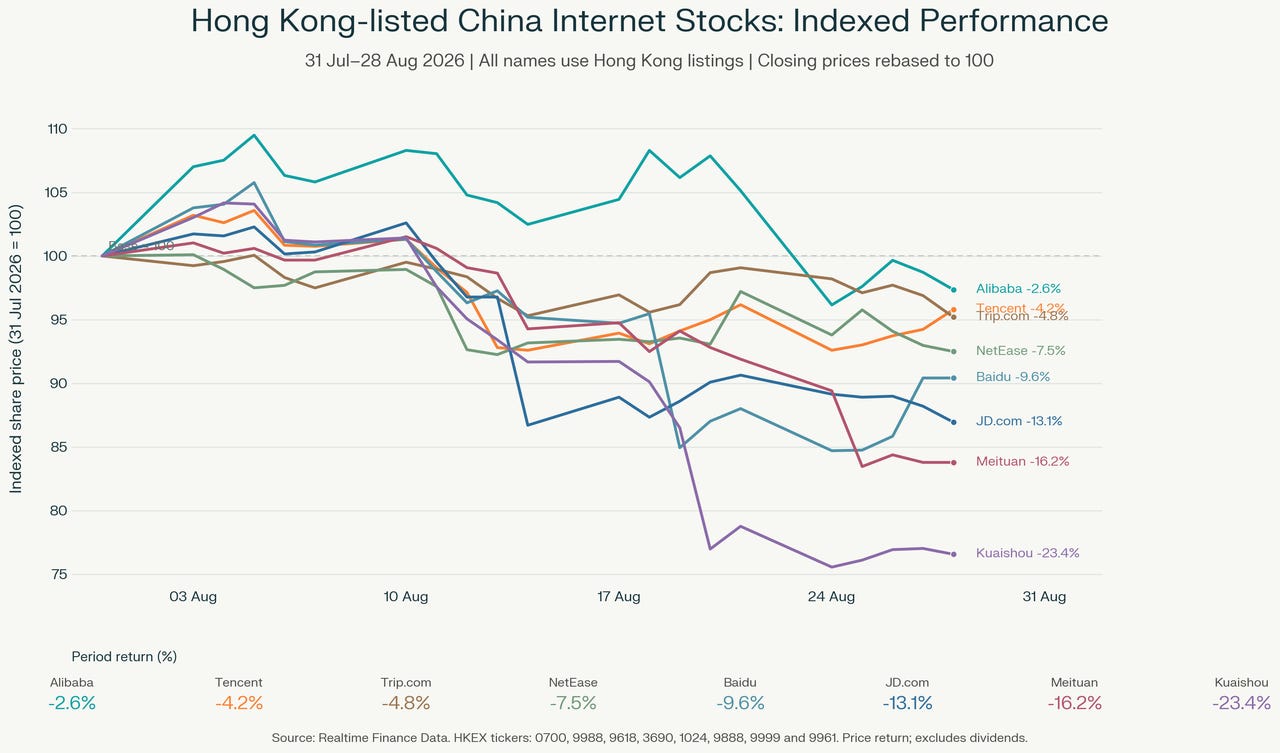
1.The August decline was not simply about “foreign capital leaving China”
There is a common view that China’s capital markets and other emerging markets have a seesaw relationship, especially with tech-heavy markets such as South Korea and Taiwan. When those markets fall, capital rotates into China; when they rebound, capital flows back out. This is also one reason why indices such as EMXC (Emerging Markets ex-China) exist.
Why? Some argue that it comes down to AI exposure versus a lack of AI exposure—in other words, that Chinese companies do not have enough AI. I also think this conclusion is wrong, and I will come back to that later.
The reality, however, is that genuine foreign inflows into China’s A-share market have already become very limited, while incremental capital in Hong Kong has mainly come from mainland China through southbound flows. Even in July, I did not see strong interest among foreign investors in increasing their China exposure. If anything, they continued to stay underweight. Based on my conversations with institutional investors, the two investor bases may overlap far less than people assume. Put simply, many investors are just not interested in China and are not paying much attention to it.
If they never really came back, they could hardly be “leaving” again.
The pessimism in August was not mainly about investors focused on the US, Japan, South Korea, and Taiwan suddenly turning bearish on China again. In my view, the reasons were much more specific to Chinese companies themselves than to the external environment or global sentiment. I will focus mainly on Chinese companies listed in Hong Kong and the US, because they illustrate the point more clearly. After all, foreign investors still face certain barriers when investing directly in A-shares.
2. Chinese companies’ second-quarter results were actually not that bad
Looking at the second quarter alone, many companies broadly met expectations. They were not strong; they were simply in line with already-low expectations. Tencent, Alibaba, Meituan, Xiaomi, Kuaishou, and others broadly maintained the trends seen in the first quarter, and their core businesses did not collapse. Because China’s consumer and e-commerce activity is extensively tracked by third-party data providers, the market already knew that the second quarter would be fairly weak. There was therefore no major rebound in expectations; companies were simply grinding forward against a low-expectation backdrop.
Some companies even came in slightly above expectations:
Take JD.com. As spending on food delivery declined and losses narrowed, the rebound in profit was clear. Adjusted net profit rose 21% year on year to nearly RMB 9 billion.
Take Meituan. The market had originally expected the company to remain loss-making throughout 2026, with the food-delivery business not reaching a quarterly profitability inflection point until 2027. But in reality, the food-delivery business had already turned profitable in the second quarter this year. The company as a whole reported more than RMB 2 billion in adjusted net profit in Q2—it made money. It is also expected to remain profitable in the third quarter, meaning the inflection point arrived roughly six months earlier than the market had generally expected.
Take Xiaomi. In investor communications, the company explicitly mentioned that “the rise in memory-chip prices is slowing,” which matters because memory has been one of its biggest sources of cost pressure. In addition, according to my channel checks, smartphone makers including Xiaomi and OPPO rejected Samsung’s request for a substantial increase in memory prices. Why did they have the confidence to push back? Because they now have a backup plan: China’s ChangXin Memory Technologies has already become the world’s fourth-largest memory-chip supplier.
There are many other examples like these. Taken together, they suggest that the financial condition of Chinese companies in the second quarter was broadly stable.