


Last Thursday, Nvidia announced that Jensen Huang had resigned as president, chief executive, and a director, effective immediately. The board had accepted the resignation the day before, on 11 November. Colette Kress, Nvidia’s chief financial officer since 2013, was appointed interim CEO, and will keep the finance job while the board searches for a permanent successor.
Rumors aside, for Baiguan readers, the crucial China question sits next to it and simply cannot be avoided.
Jensen was also the most powerful lobbyist against tighter US controls on Chinese access to advanced chips. He was the person who held together the open-source and CUDA ecosystem that Chinese labs have trained and shipped on. SemiAnalysis, in Nvidia and the World Without Jensen, called it “an open secret” that Nvidia works directly with Chinese labs on open source and GPU optimization, and that these labs use Blackwell GPUs.
But how does that actually affect Chinese AI models, and the ecosystem around them? Does it change the narrative that China can keep catching up with closed US models? Can Chinese open-weight models still shrink the gap as quickly as the market assumed?
Will Nvidia be the same without Jensen?
A lot of people treat CUDA as Nvidia’s moat. But I think the founder is.
A founder’s charisma and the soul they give a company are unquantifiable, but they matter. After a founder leaves, management often still runs on inertia. A successor may not even realize that the company’s smooth operation was built on what the founder left behind. This is a boiling-frog problem for Nvidia.
Nvidia is also an extremely flat company. At its peak, more than 60 people reported directly to Jensen. In an organization like that, any CEO change will leave the company taking a serious hit for years. Executives could either start forming factions or “lie flat” and live off past glory. Neither is good for Nvidia.
How does that “company built around one person” show up in practice?
First, Jensen’s departure would limit Nvidia’s long-term potential for technological innovation. CUDA itself was born because of Jensen’s foresight and push, despite being a low-ROI project at the time. He has said himself that putting CUDA on every GeForce card raised costs by about 50%, which wiped out the company’s entire gross margin, but he still insisted. CUDA took a decade to pay back, but became the moat of Nvidia and the platform that all open-source models now depend on.
If you put any professional manager in charge (or worse, a non-tech/finance-background team), it will probably become pure ROI: cut the unprofitable but ecosystem-critical parts, buy back stock to steady confidence. The near-term financials may not even look bad. But over the long term, that is what would actually turn Nvidia into a mediocre company.
Especially now that Nvidia has already been a company worth more than $4 trillion: without a decisive founder who can also command real respect, this is almost impossible to pull off. Other than Jensen, there is no one else for this job.
Secondly, the supply chain is Nvidia’s moat, and Jensen is the whole supply chain.
He could clearly push chip margins higher. Today’s Nvidia could absolutely charge a margin of more than 80% if it wanted to. But he has repeatedly said you have to leave something on the table for the supply chain, so partners can make money too.
Deglobalization is still hard despite all the “decoupling” narratives. The semiconductor supply chain still largely depends on Asia. No country can make chips alone. You need US design, TSMC in Taiwan, ASML in the Netherlands, and equipment, materials, and memory from China, Japan, and Korea.
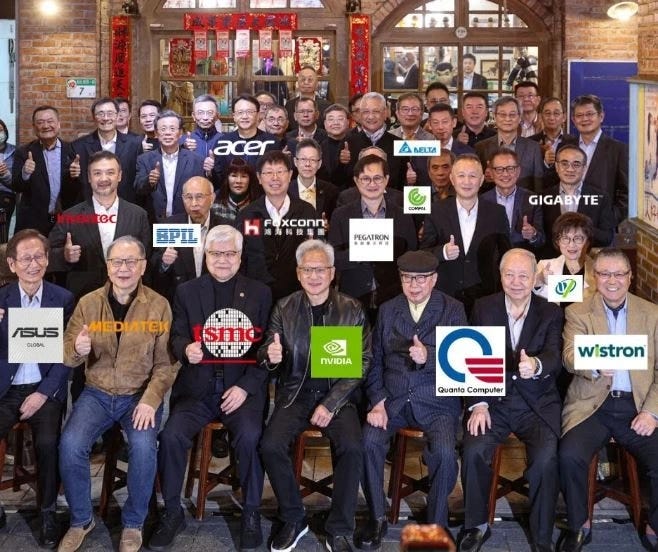
I find it hard to imagine a new management team doing what Jensen does with upstream and downstream partners, especially the core foundries and systems companies (many of them led by Chinese), drinking and calling each other brothers at a night market. On the surface, it looks like a show. In reality, it is a key reason Nvidia can lock in capacity, secure clean-room slots when the world is short of them, and get better prices than peers.
One example is TSMC. Jensen has said that Nvidia and TSMC have worked together for three decades, doing “tens, hundreds of billions of dollars of business,” and “we don’t have a contract.” That kind of relationship sits with the person, not with a legal file.
This does not just affect Chinese models. It also affects the US. Nvidia also backed neoclouds and startups in the open-source ecosystem, so they can get investment-grade funding. And Jensen’s personal credit plays a huge role behind all of this.
So I think Nvidia will not be the same without Jensen.
Thoughts on implications for Chinese equities
For Chinese companies, tighter GPU export controls are likely coming and will become a headache. But a sharper risk is being cut off from the open-source system that now sits on CUDA and Nvidia.
The outcome of Jensen’s departure will take time to investigate and reach a verdict, but the direction is already clear.
Treasury Secretary Scott Bessent said on 15 November that the more important question is whether Nvidia had a “culture of compliance” around US export restrictions, and whether the company used shell companies as a workaround.
This means that what started as one person’s resignation is turning into tighter scrutiny of Nvidia as a company, and of US-China geopolitics around advanced chips.
For Chinese labs and the AI industry, I have four specific thoughts:
1/ In the short term, the gap between open-weight and closed models may widen further
Some research outlets argued in September that the low-cost catch-up of open-weight models is unlikely to last, as distillation gets harder. For instance, FundaAI expects the lead to widen again to roughly six to twelve months, as it did after DeepSeek R1 in 2025.
Jensen’s departure adds further pressure. Chinese labs may get less access not only to Nvidia chips, but also to the CUDA software those models are built around.
The Remote Access Security Act (RASA), which would treat remote or cloud use of controlled GPUs as an export, already passed the House 369-22 in January and has sat in the Senate Banking Committee since then. If RASA passes, it would further restrict Chinese labs’ ability to train overseas, and their access to CUDA software.
Chinese labs still rely on CUDA software to train and iterate their models. In the worst case, a complete cutoff from the CUDA system would restrict the engineering flywheel at Chinese labs. An ecosystem like CUDA cannot be stood up overnight. If Chinese labs are pushed off that iteration path, the wait itself will widen the gap in the short term.
But the implications are not just for Chinese labs. The global (that means, US) open-source model ecosystem as a whole will be hit hard in the worst case. Nvidia’s own open-weight models, including Nemotron 3.5 and the still-unreleased Nemotron 4, plus the planned $12.9 billion purchase of Hugging Face, are now harder to take for granted.
Open-weight models are now almost dominated by Chinese models. In The Token Export in July, I wrote that Chinese open-weight models had gone from under 1.2% of tokens on OpenRouter in late 2024 to a majority by June 2026, while the US share had fallen from roughly 70% to about 30%.
On the one hand, Chinese labs had no other path if they wanted to take their models abroad. But at the same time, their engineering innovations have also fed back into the open stack, which is an important reason open models had a chance to catch the closed frontier. That means a setback for Chinese open models is a setback for the US open-source community as well.
SemiAnalysis has a similar view: because a significant amount of open-source innovation comes from Chinese labs, if those labs stop publishing CUDA-tuned kernels and keep the Nvidia software internal, that hurts the open ecosystem and US startups, and helps closed labs. To quote them:
This is fundamentally bad that innovations from China won’t be shared across the NVIDIA ecosystem & the general ML ecosystem anymore. It is positive for closed AI labs but bad for startups.
A manager lead company could depriortize underperforming Nemotron, With many models going closed source at the frontier labs in the U.S., Nvidia was single-handedly propping up the other American open source models with its efforts by investing in firms like Reflection, Thinking Machines, Poolside, and the Hugging Face acquisition.
Today’s Nvidia is not just a hardware company. It is now the main financial backer of American open-weight models. In March, WIRED reported that a 2025 filing showed the company planning to spend $26 billion over five years to build these models. Besides Hugging Face, it has also backed other US open-model firms, including a reported $500 million lead investment in Reflection and a $1 billion investment in Poolside. (By comparison, the open-source fund at the IBM and Meta-led AI Alliance has a long-term target of $100 million, which is not in the same order of magnitude.)
I think Jensen leaving is a loss not just for Chinese models, but for the open-source community overall.
