


Last week, the Baiguan team successfully concluded our second-ever China Tour, focusing on the AI and robotics ecosystem in Shanghai.
19 investors, family offices, and entrepreneurs from the US, Germany, South Korea, Malaysia, and Australia (including one returnee from our first tour) joined us for a 2.5-day, event-packed tour that included conversations with founders and C-suite of:
Minimax (0100.HK), one of China’s leading AI players
Black Lake Technologies, China’s leading manufacturing AI company (a day before they officially announced their Unicorn-status Series-D fundraise)
Fourier Robotics, a leading robotic maker with roots in healthcare exoskeleton
A conversation about the future of autonomous driving with an angel investor of Pony.ai, one of China’s leading L4 robotaxi companies, followed by a test ride
A frank presentation by Baiguan’s tech lead on the pros and cons of various domestic and foreign AI models from a user’s perspective.
A visit to the Shanghai Foundational Model Center (SMC), a leading incubator of Chinese AI startups, with presentations by Cyber Partner (robotics implementation specialist), IO-AI Tech (robotics data collection), Nieta (AI-native virtual characters), and Investmate (AI-native personal finance tool)
There are many takeaways from our participants. Here are the top 5 common ones I find.
#1 A new generation of entrepreneurs and local talents has finally arrived
Most of the participants are very impressed by the startup founders we have met. One participant, who used to work as a senior executive at a Mag7 firm, told me this cohort of Chinese founders was very different from what he was used to.
One unique feature this time was that every founder we met this time spoke fluent English, so we didn’t even bother with translation software or hiring a translator. Perhaps this was because we limited this tour to Shanghai, China’s most cosmopolitan city, but I promise this was not by design.
Being English-speaking does not mean China is relying more on overseas talents, though. One participant was concerned that recent US restrictions on foreign college students would stifle innovation in China, only to find that, in fact, most of the talent (and founders) in China’s leading AI companies (Minimax, Moonshot, DeepSeek, and Zhipu, etc.) are locally educated and trained.
Therefore, speaking English or not is not the real differentiator of this generation of talents. A senior executive from Minimax commented that the unique feature of this new generation of founders is their self-confidence, which stems from their having read and studied the same things at the same pace as their global peers.
#2 Autonomous driving: technology is ready, but policymakers are balancing the medium and long-term
We invited an early investor of Pony.ai and received a comprehensive review of the past and future of autonomous driving in China. The core conclusion was the same as ours 2 weeks ago: the technology is ready, yet Beijing is juggling between the short-term policy pressure arising from unemployment and the long-term necessity coming from a rapidly aging population.
As a result, Beijing is adopting a “do but don’t shout” approach, encouraging localities to keep rolling out pilot zones, preserving an overall supportive environment for the industry while also deliberately putting a lid on mass media coverage and debates.
Some US guests found this conclusion counterintuitive. One private investor who came from Miami, where Waymo already had a big presence, expected China to be pursuing robotaxis aggressively and was thus surprised by the apparent conservative attitude.
This conclusion was also corroborated by our own test ride experience.
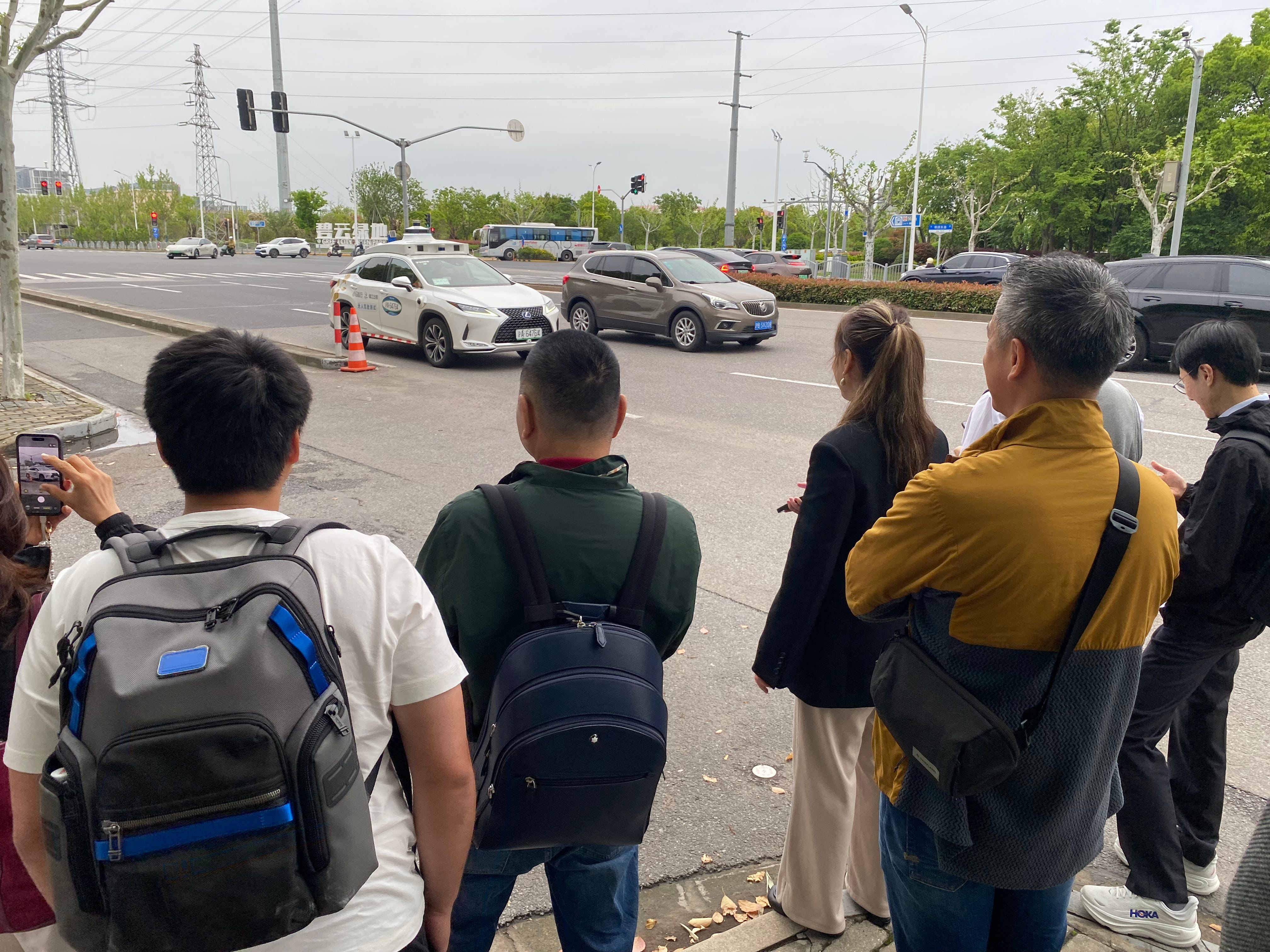
In a slightly laughable episode, our group started hailing robotaxis at a location that was too remote and too sparsely populated. Consequently, on average, we waited around 10 minutes for a robotaxi, which took another 15-20 minutes to arrive and pick us up.
This was a major embarrassment for the us the organizers, but our wonderful participants, laughing and lively chatting with each other while standing by the roadside, found it an informative footnote to the authentic state of robotaxis in China.
#3 Robotics: solving the data bottleneck
By now, it’s common knowledge that despite the hype about humanoids in China, we haven’t really solved the “big brain” problem yet. The robots can perform specific, pre-designed tasks, but their capabilities are not sufficiently generalized.
In short, the body has outpaced the brain.
A key bottleneck to achieving the “big brain” problem is the lack of training data, and a “bottleneck”, in the context of today, represents opportunities.
That’s why we were amazed by a presentation by IO-AI Tech, a startup that’s laser-focused on collecting human-centric data for its clients.
Moreover, at the data collection center in one of the robotics firms, where we were not allowed to take photos, we saw an army of engineers physically train robots to do housework (such as picking up fruits and closing wardrobes) by repeating the action over and over again using remote grippers. We debated among ourselves whether this type of training is efficient and whether simulated training is obviously a better way to collect data.
On the other hand, we also wondered whether this inefficiency can actually be “good,” and whether human trainers for robots are the present-day assembly line workers, providing a crucial employment cushion.
#4 Manufacturing is China’s key strength
If data is the key to achieving the big robotics brain, then China, with its strong manufacturing base, clearly has an advantage in mass-producing robots to collect more data.
A key highlight of this trip was our visit to Black Lake Technologies, which specializes in cloud-based manufacturing execution systems and collaborative platforms for the manufacturing sector. Founded in 2016 and headquartered in Shanghai, the company is often cited as a pioneer in bringing “consumer-grade” internet technology to the traditional factory floor.
The company was co-founded by Yuxiang Zhou, a former Wall Street banker. His leadership story is well-known in the Chinese tech scene. After an initial startup failure, he famously spent time working on factory floors to understand the real-world pain points of manufacturing workers before launching Black Lake.
Last year, Yuxiang became one of the very few CEOs of a medium-sized company to attend Premier Li Qiang’s symposiums. To be sure, Black Lake is not Xiaomi or BYD, and there are tens of thousands of startups of a similar size in China, so its presence at such a high-profile symposium is living proof of the importance of manufacturing to China’s decision-makers.
#5 A new private-public partnership is emerging
This brings us to the role of the state, a subject no tour to China can bypass.
The relationship between the private and government sectors is an implicit theme in this tour.
On one hand, as seen in the autonomous driving sector, shrewd and conservative regulatory policies have acted as a bottleneck for mass commercialization.
On the other hand, the state-run SMC incubator in Shanghai demonstrated an aggressive pro-growth stance, providing free rent, subsidized AI compute tokens, and streamlined regulatory 'concierge' services.
As the economic engine pivots from a government-centric real estate model toward private-sector-led innovation, we are witnessing a 'new normal' for governance: the most successful local authorities will be those that act as support platform providers rather than central planners that meddle.
Future tours
After two successful tours, we at Baiguan are now confident in our ability to deliver in-depth, highly memorable business-themed study tours for a global audience.
In the future, we plan to partner with more vertical experts and host more specialized theme tours across sectors such as biotech, energy, manufacturing, and high-end consumption.
Our ultimate vision for this is that whenever you come to China for something else (such as a business conference), you would consider checking Baiguan’s event calendar to see whether you can fit an enriching tour into your itinerary.
Stay tuned!