


*On April 1, we officially launched Baiguan Pro, our professional-tier subscription designed for investors seeking deeper, more specific coverage of Chinese equities. Baiguan Pro delivers the Baiguan team’s monthly outlook on overall Chinese equity assets, our quarterly focus on themes and sectors, richer company-level analysis, and follow-ups on the ideas and companies previously presented in the newsletter.*
Before today’s post — a quick note. Applications are open for the 2026 Autumn Baiguan China Tour, a month-long “marathon” of modular expeditions across October and November: Robotics & AI in Beijing, advanced manufacturing from Foshan to Shenzhen, the next energy cycle across Shanghai–Suzhou–Hangzhou, and premium consumption in Shanghai — plus weekend immersions in Datong, Yiwu and Nanjing. Early-bird pricing through September 13.

Please feel free to contact us at Baiguan_ChinaTour@bigonelab.com with any questions.
In Today’s Data Update
China’s two-speed economy continues. In H1, goods sales rose just 1.1% while services rose 5.3%. Exports and industry have held up; the household wallet has not. July brought further pressure, as a historic run of typhoons disrupted foot traffic and an equity market in deep correction weighed on sentiment among consumers who were already cautious.
In today’s Data Update, we look at the most recent data to see how consumer brands are holding up in a softer domestic consumption environment. In particular, we examine LV’s July sales — the first full month after its trademark lawsuit against local tea brand Molly Tea won in court but lost the Chinese public.

With BigOne Lab’s proprietary offline payment data as of July 2026, we cover:
Luxury goods: which brands kept growing through a soft July and which did not — and whether the split is better explained by the overall economy or specific brands.
Gold & jewelry: Laopu’s July print, set against a choppy gold price and a thin promotional calendar outside SKP. We also read the secondhand market, where transaction volumes and premiums say something about who still believes in the price.
Tea & coffee: delivery platforms are pulling back their subsidies. We look at what that meant for third-party delivery sales in July, normally the peak summer month, and at how brands funding their own in-store discounts, such as Luckin and Guming, fared against those that are not.
Pop Mart: we update July’s year-on-year growth and what the collab-heavy 2026 slate means for Pop Mart’s IP concentration risk.
Sportswear & footwear: a traditional low season with no holiday catalyst, and typhoons disrupting outdoor demand. We look at brand-by-brand performance, particularly whether Lululemon’s completed fiscal Q2 (May–July) supports management’s mid-to-high-teens China guidance after the Great Wall drum scandal.
At BigOne Lab, we curate data highlights, analyze them, and deliver insights trusted by 100+ top institutional and corporate clients worldwide.
🔒 The following content is available to Baiguan Pro subscribers.
1. Luxury brands
Bottom line: luxury sales in July were broadly weak and worse than June for most categories. Accessible-luxury and American brands kept compounding; European megabrands mostly fell back, with LV the sharpest drop.
Still compounding: Coach grew primarily through higher prices, with average spend per transaction up 23% and unit volume up 7%, showing that new product lines are attracting customers. Ralph Lauren saw the opposite pattern, driving growth through volume, which rose 54%.
Hermès, Zegna, and Brunello Cucinelli remained positive but slowed down sharply. This suggests that while recent economic jolts had an impact, their core high-net-worth customer base remains strong.
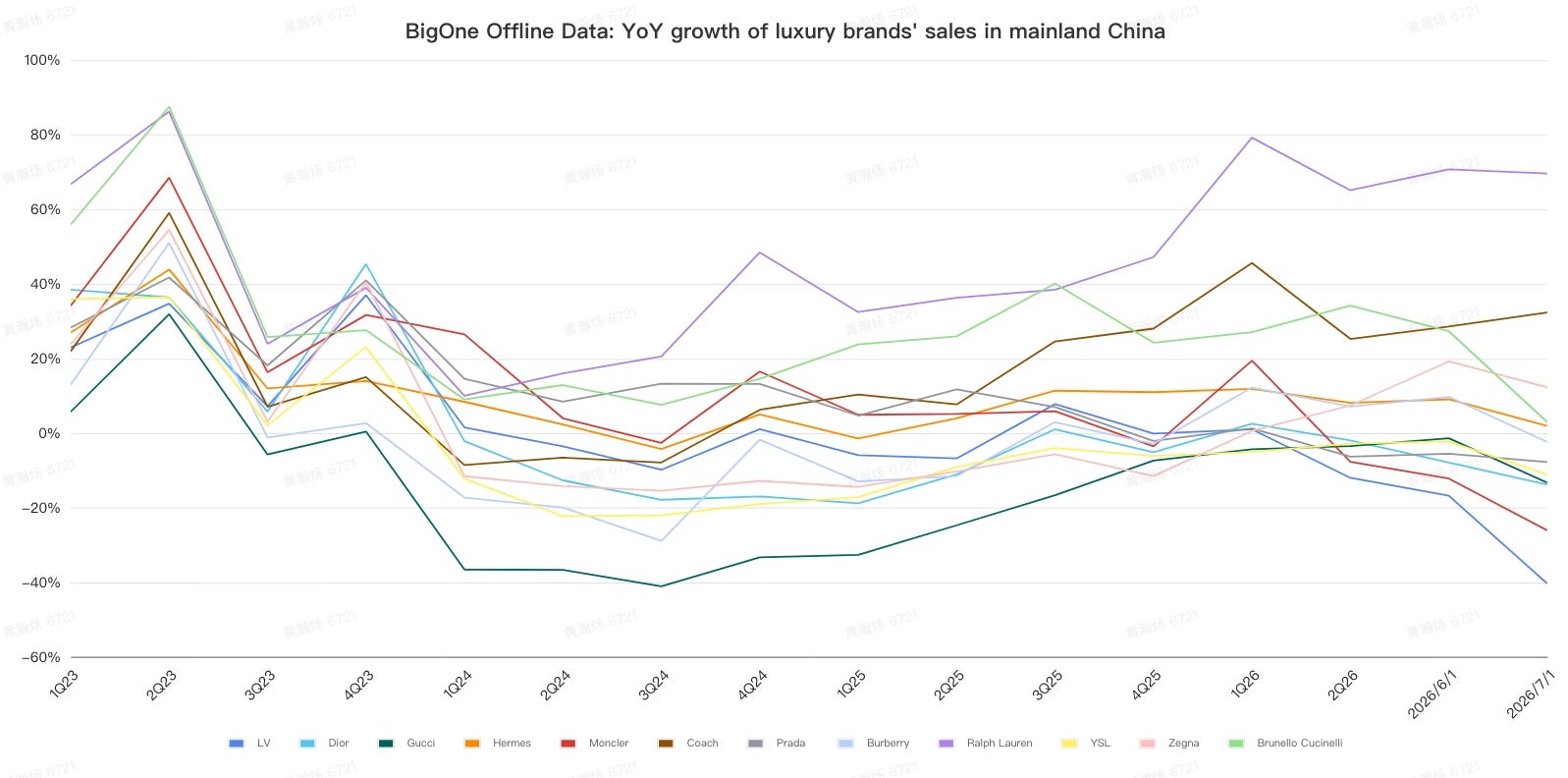
Louis Vuitton: Offline sales plunged from -17% in June to -40% in July. This drop far outpaced peers, whose performance worsened by 2 to 14 percentage points over the same period (e.g., Gucci fell to -13% from -1%, Moncler to -26% from -12%, and Dior to -14% from -8%).
The decline was volume-led (unit volume -37%), showing that fewer customers visited rather than existing shoppers trading down. Coming right after the Molly Tea verdict and the viral “toilet bag” meme, this provides clear evidence of a direct reputational hit in China.
2. Gold & jewelry
Bottom line: Laopu’s sales drop worsened significantly—driven by a drop in unit volume, not lower average spend. The rest of the jewelry market also softened, pulling aggregate growth for the top four brands down to zero. Gold price volatility, the July equity drawdown and typhoon-disrupted foot traffic all contributed to the weak sentiment.
Laopu Gold. We estimate July mainland store sales (ex-SKP, region-adjusted) fell 51% year-on-year, a wider decline than both June and Q2.
Two drivers:
Fewer buyers. Customer count -52%, units -54% — both worse than June.
A thin promotional calendar outside SKP stores. Beyond the Shanghai Xintiandi store relaunch and the Hangzhou MixC summer offers, non-SKP stores ran few discounts in July.
The secondhand market read: July transaction volume for Laopu pure-gold pieces fell noticeably month on month. The average realized price was RMB 1,115/gram, a 26% premium to the spot gold price in the transaction week — narrower than June’s RMB 1,219/gram and 29% premium.
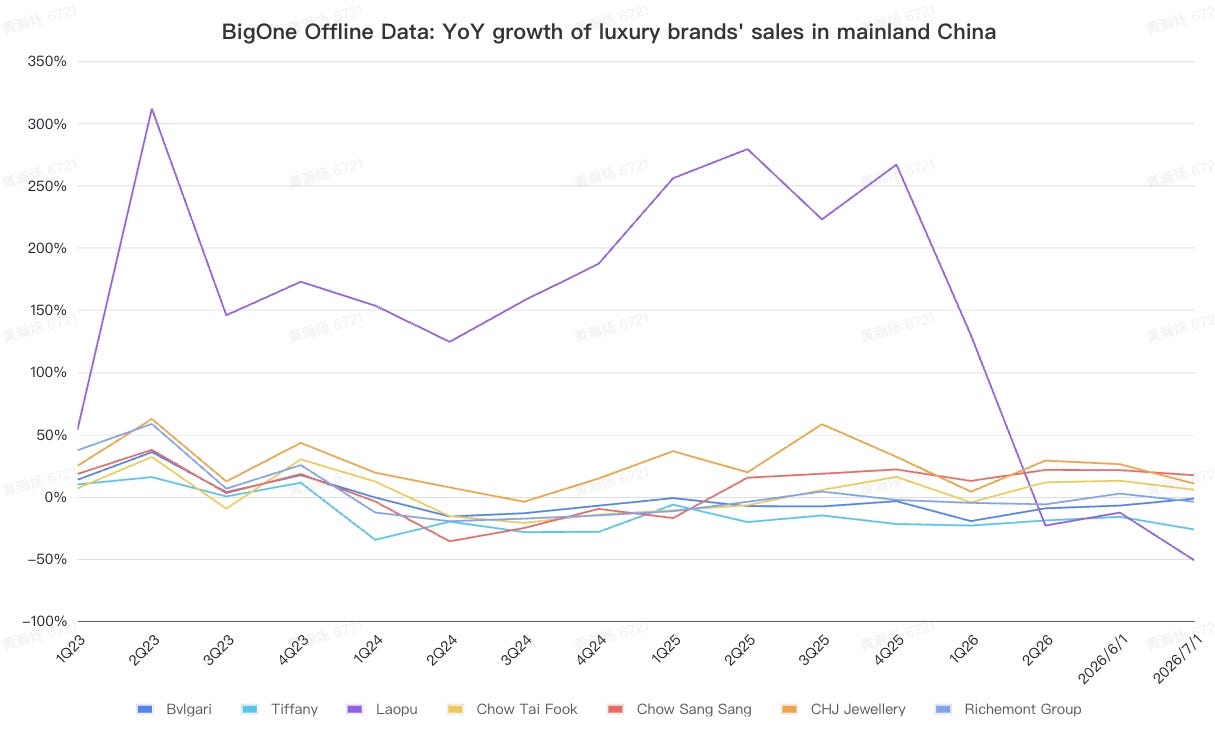
The rest of the category decelerated too: The four-brand aggregate (Laopu, Chow Tai Fook, Chow Sang Sang, Chao Hong Ji) fell from +12% to roughly flat. High-end jewelry stayed under pressure.
3. Tea & coffee
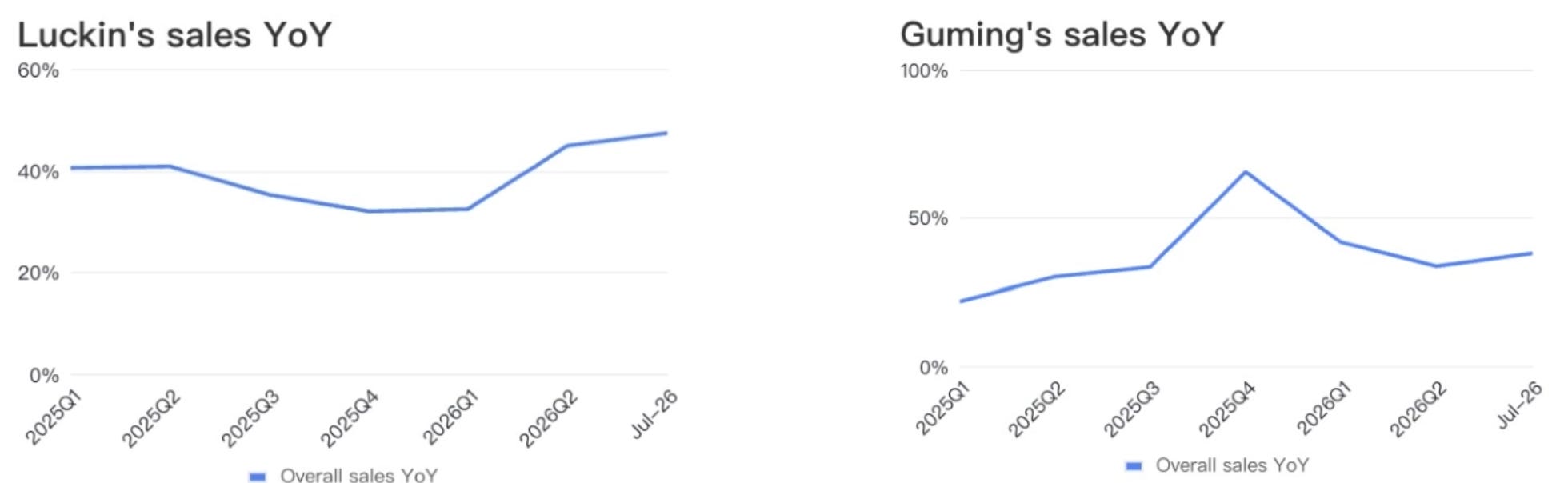
Bottom line: Industry growth slowed in July, driven entirely by a drag in third-party delivery as subsidies faded. While in-store sales held up well, competition intensified: aggressive brands like Luckin and Guming accelerated growth (up 73% and 61% YoY) by funding their own store-level discounts, while non-discounting brands lost market share.
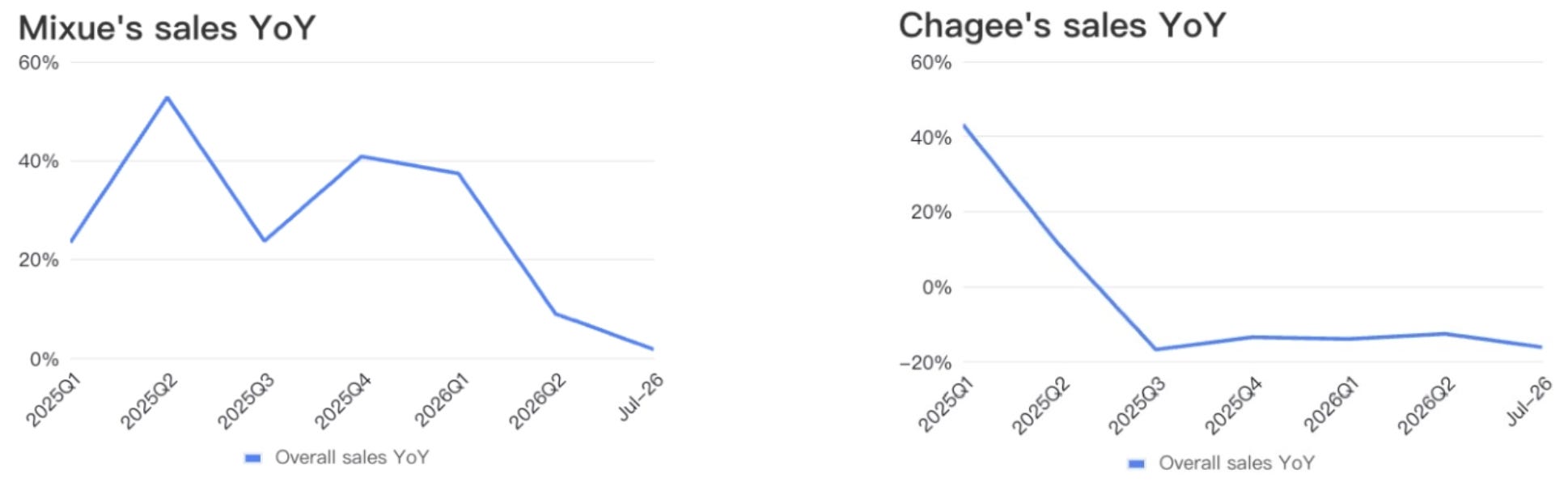
Mixue's sales growth slowed in July (2% YoY vs. +9% in Q2), weighed down by both in-store and third-party delivery. Similarly, Chagee's overall performance remained weak in July (-16% YoY vs Q2’s -13%), due to a lack of in-store recovery and decelerating delivery sales.
4. Pop Mart
Bottom line: July offline sales grew +35% YoY (up from +13% in June), but the jump is a base effect rather than a recovery. June 2025 was the peak of LABUBU’s global breakout, and July 2025 cooled from there.
New Product Performance: The DIMOO × PIXAR release sold steadily into the summer. While its launch-day peak was Pop Mart’s highest in two months, it did not reach the hype of the Twinkle Twinkle × McDonald’s Children’s Day drop.
At the same time, the Twinkle Twinkle IP is losing momentum and may be losing market share to Miniso’s in-house IP, YOYO. Miniso hosted a six-city YOYO pop-up tour from July to August and expanded into ice cream and desserts, directly copying the strategy Pop Mart built around Twinkle Twinkle.
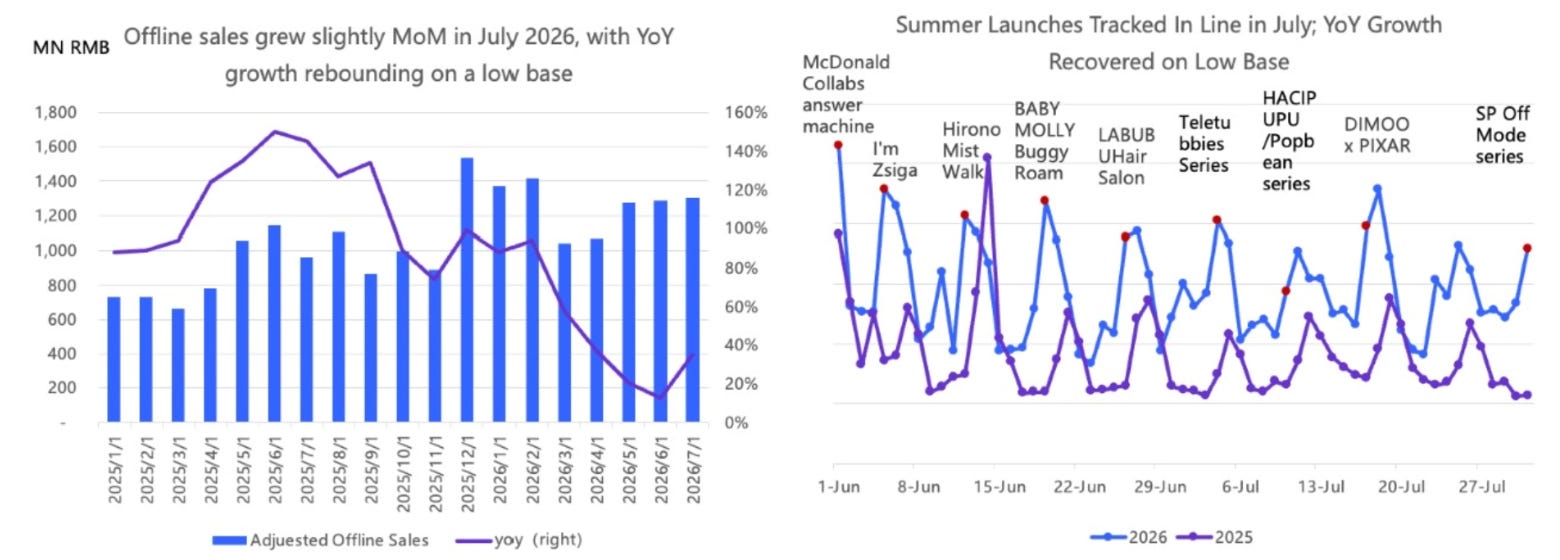
The acceleration in collaborations is the most notable shift in 2026. Nine proprietary-IP × external-IP collaboration series launched in the first seven months (vs. three in the same period of 2025), with the licensing matrix expanding from Disney, One Piece and Crayon Shin-chan to Sanrio, FIFA, PIXAR and My Little Pony, alongside the addition of celebrity IP (Aespa, Leah Dou, YUQI).
This is the diversification we have been watching for, and it does lower single-IP dependence. But licensing costs are rising with it, so the margin on each incremental sale is thinner than it used to be.
August is expected to be harder, since mini LABUBU (8/28) and the Twinkle-Twinkle Sweet Dreams Forecast (8/21) both launched a year ago. Overall, base pressure should ease materially from September, with September–November a relatively favorable comparison window.
5. Sportswear & footwear
Bottom line: June’s weakness carried into July. It is a traditional low season with no holiday catalyst, and the typhoons hit the outdoor-weighted brands specifically. Most integrated brands saw declines widen or stay negative; adidas remains the exception. Lululemon’s completed fiscal Q2 now sits well below the company’s own guidance for China.
Integrated brands (own retail + major distributors):
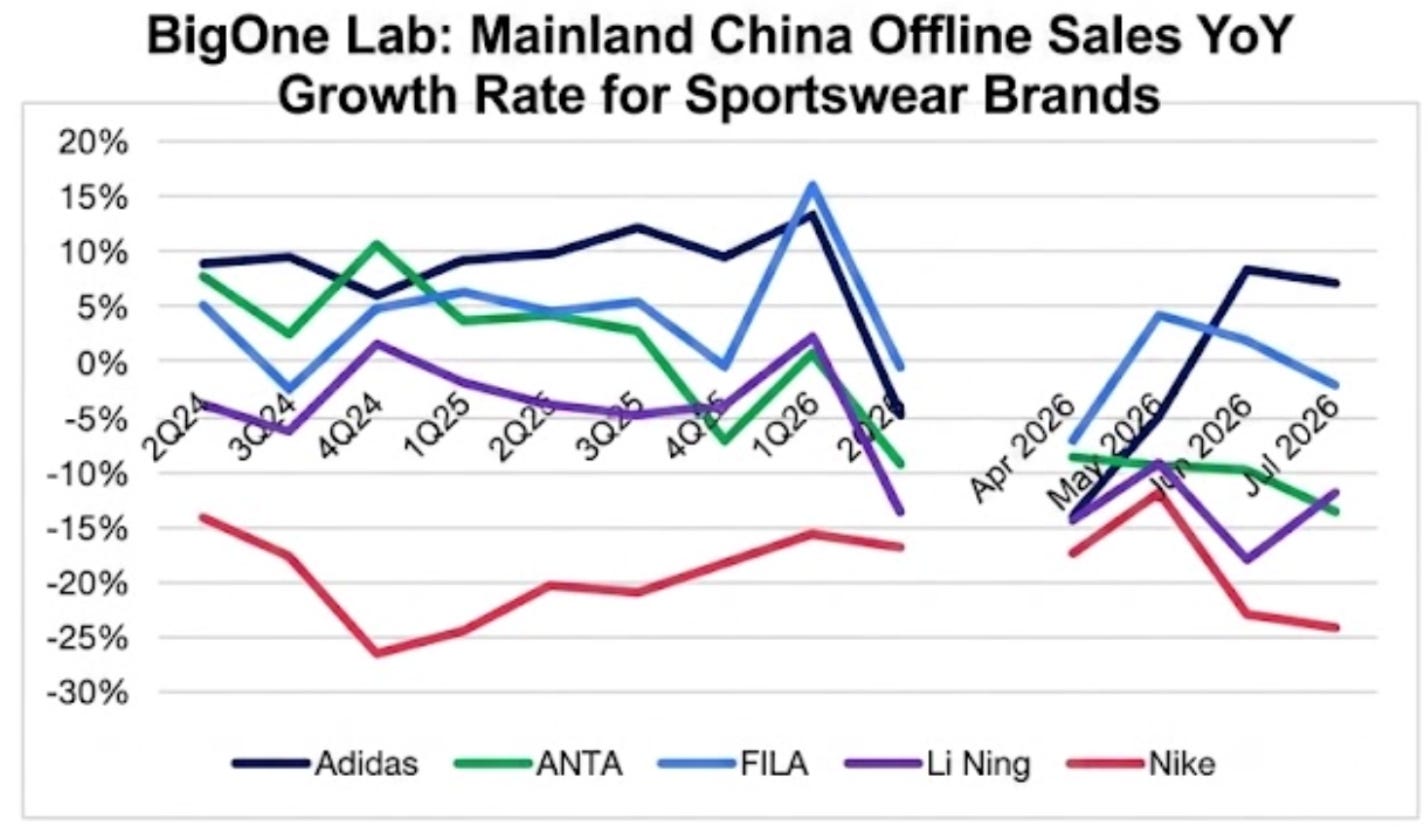
Nike extended the weakness after the best performance in May (-12% YoY) and has weakened every month since. July average transaction (ATV) value fell 11%, likely reflecting heavier offline promotion, while volume fell 14% — Discounting to clear inventory is not buying any volume.
Anta Group is prioritizing price over volume across both brands. Anta’s main brand ATV rose 2% and FILA’s ATV rose 4% and has been positive year-on-year every month since the start of 2026, supported by the One FILA premiumization strategy.
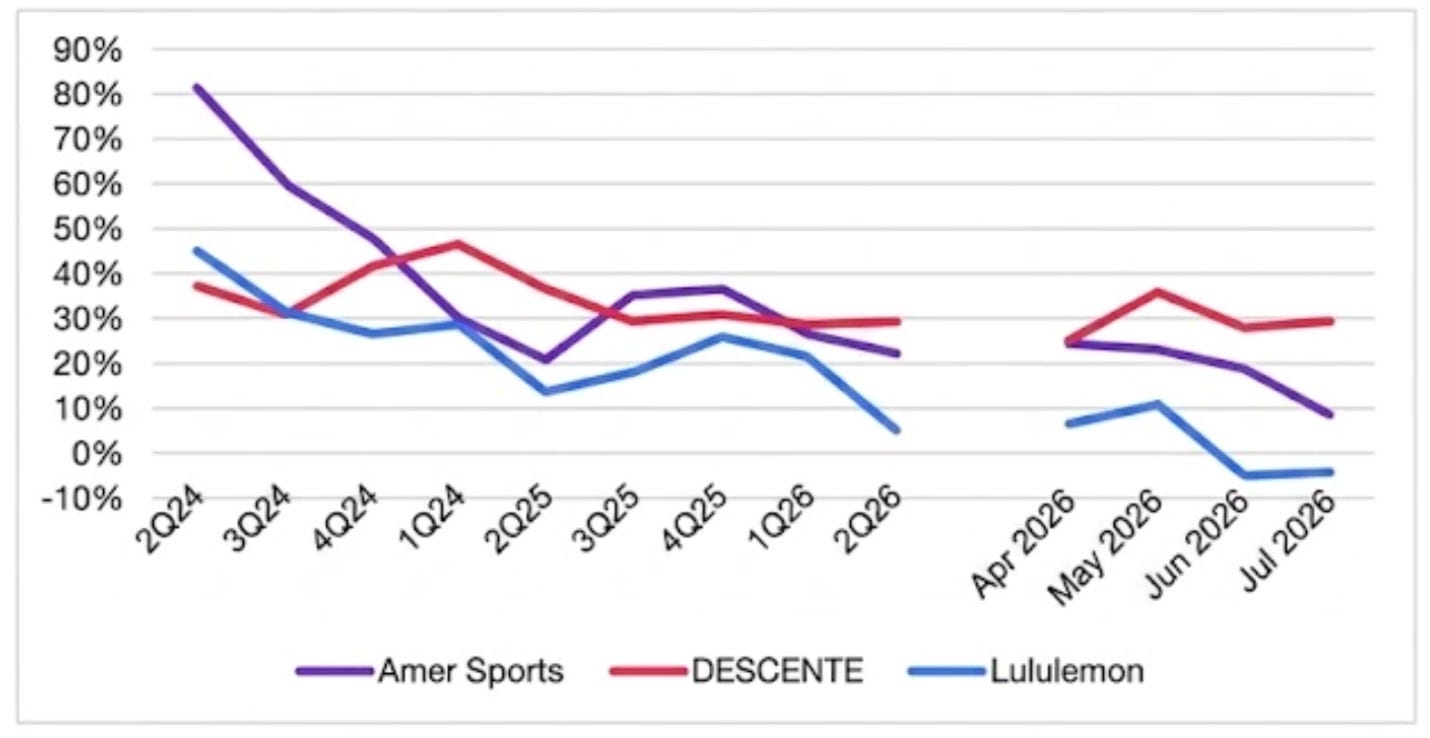
Sportswear brands: Lululemon’s fiscal Q2 (May–July) offline store sales grew just +2% YoY—a sharp deceleration from +19% in previous quarters—after falling -5% in June and -4% in July. This points to a high risk of missing management’s mid-to-high double-digit guidance for China.
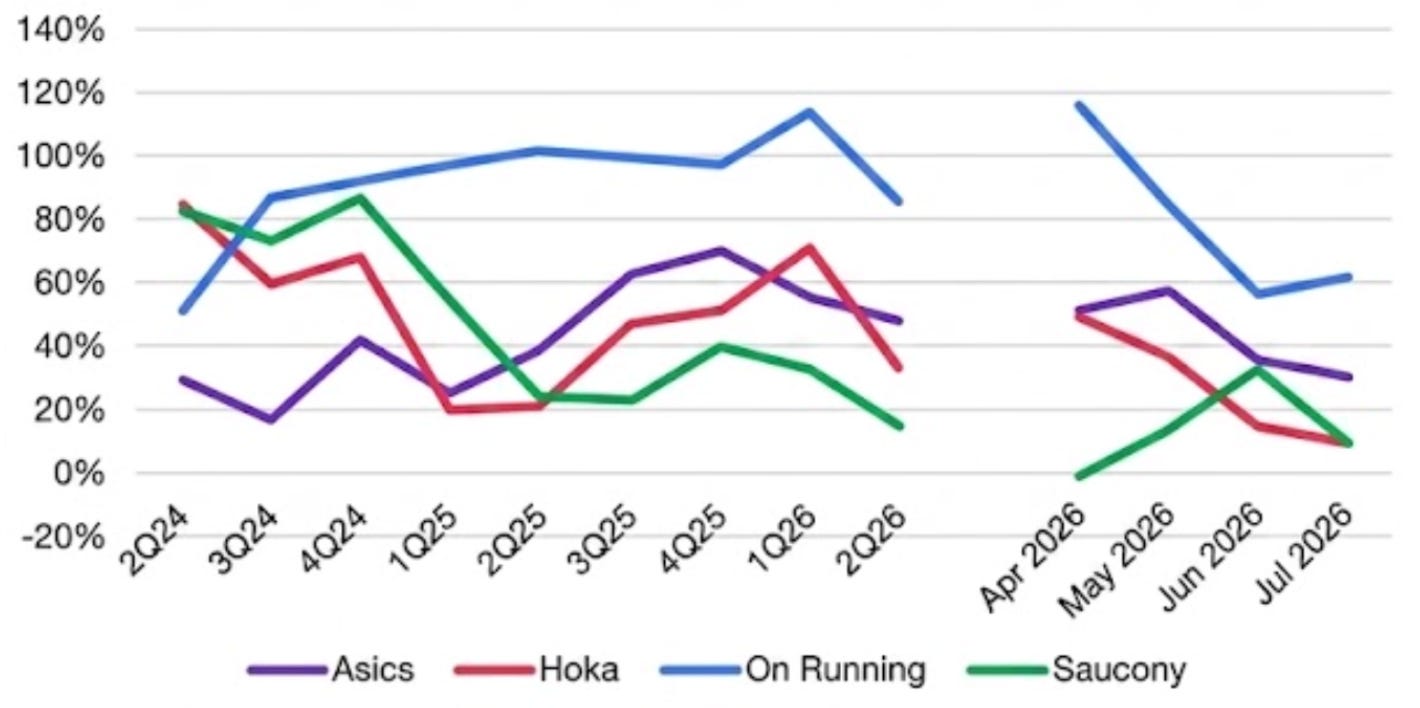
Running shoes: On accelerates while the rest cool. On remains the strongest name in our footwear coverage, with ATV up 4%.
Disclaimer: All content in Baiguan Pro is for informational purposes only and reflects directional views based on publicly available information and Baiguan's proprietary data. Nothing here constitutes investment advice or a recommendation to buy or sell any security. Please conduct your own investment research before making any investment decisions.