


Applications are still open for the 2026 Autumn Baiguan China Tour:
Robotics & AI Executive Tour in Beijing from Oct 19-23
Advanced manufacturing in Foshan and Shenzhen from Oct 26-30 (4.5 days)
You can check out the pricing and RSVP here:

Please feel free to contact us at Baiguan_ChinaTour@bigonelab.com with any questions.
On almost any weekend in China this year, somewhere, a few hundred people are trying to get a working product up before Sunday night.
The people in those rooms keep getting younger. Scroll Red Note or Douyin, and you’ll see a steady stream of kids showing off what they’ve built with AI. A 10-year-old made an award-winning game by chatting with AI. A 13-year-old uses AI to teach vocabulary to millions of followers. At Red Note’s first hackathon in April, one team averaged 13.5 years old and still took home an award. Parents are signing kids up for AI coding classes, and the Ministry of Education and 17 other departments have stated goals to broadly expand basic AI education in primary and secondary schools by 2030.
Hackathons are where a lot of this energy ends up. They are free to enter, often generously funded, and now happen almost every weekend. In today’s newsletter, I want to take you behind the scenes of China’s recent hackathon boom and look at what Chinese communities are building. We’ll explore what this means for AI commercialization, the country’s talent pool, and the business behind weekend hackathons—which are becoming a lifestyle for many in China today.
From a few a year to almost every weekend
For most of the last decade, hackathons in China were a niche, insular thing popular only among the developer communities. The format arrived around 2012 through the developer community SegmentFault and stayed mostly inside tech companies and coder circles. Almost everyone in the room was a programmer.
That changed fast. In a September feature, China National Radio quoted a developer who judges these events regularly: he now sits on as many hackathon panels in a single month as he used to in a whole year. By early September, the Greater Bay Area (Guangdong–Hong Kong–Macao) alone had hosted 28 hackathons in 2026. In Beijing, Shanghai and Shenzhen, hackathons now run nearly every month. A campus startup site tracking the calendar counted dozens in August and September alone, and struggled to find one that wasn’t about AI.
Some of these hackathons are enormous. ByteDance’s TRAE AI Creativity Contest drew 37,000 sign-ups and 14,000 submitted products. Zhihu’s spring hackathon had more than 3,600 participants, from a 13-year-old middle schooler to a medical PhD.
The catalyst of the booming hackathon scene is simple: building got cheap. When you can describe a product in plain Chinese and an agent writes the code, a 48-hour sprint stops being a coding contest and turns into a product contest.
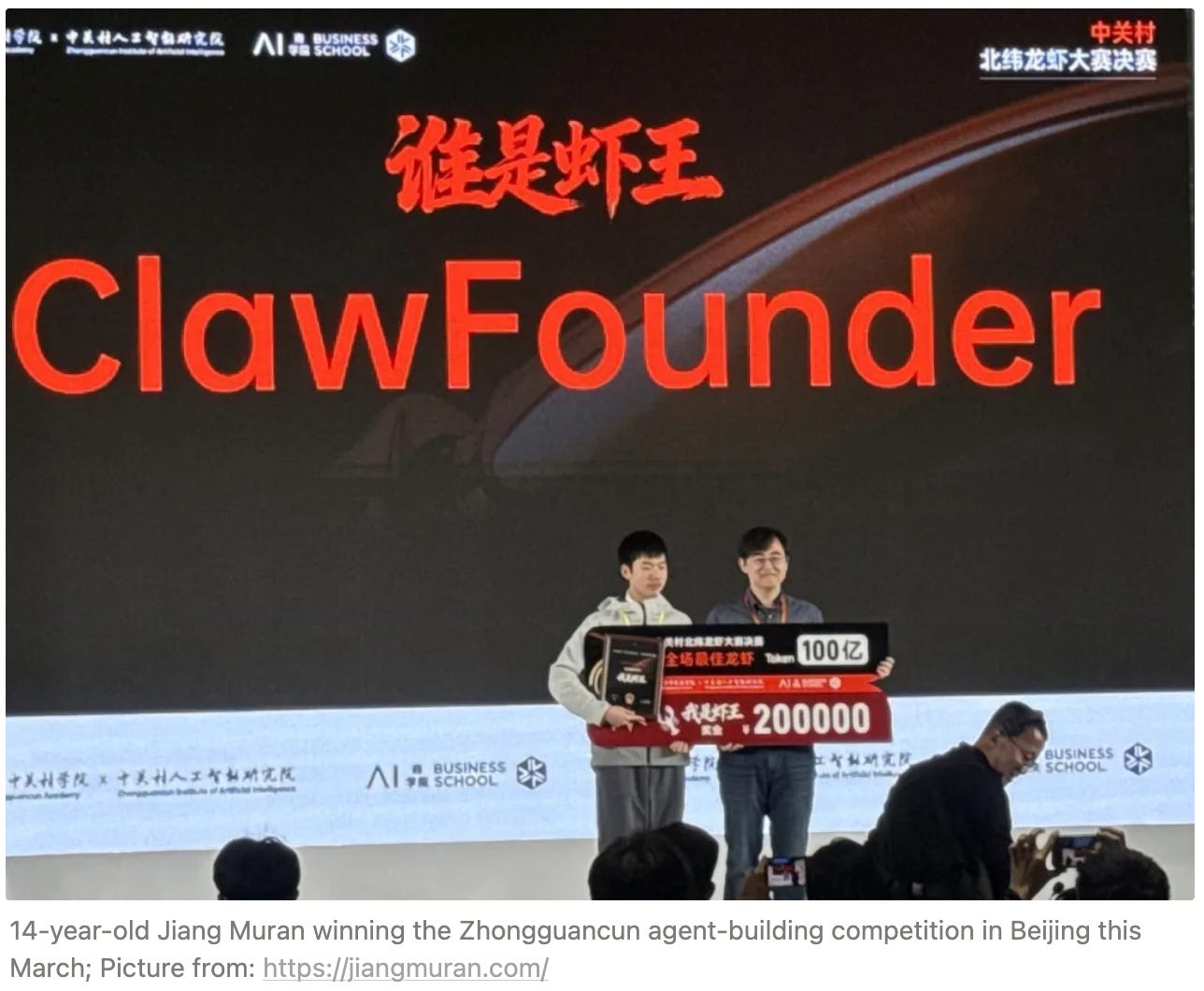
In March, an agent-building contest in Beijing's Zhongguancun didn't even ask for code; entrants just showed what their agent actually did, and judges scored real-world value. Out of several hundred entries, the champion was a 14-year-old eighth-grader, Jiang Muran, whose ClawFounder turns an idea into a launched product on autopilot. He took home ¥200,000 plus 10 billion tokens.
In my piece on the one-person company boom, I noted that 75% of Chinese solo founders now come from non-technical backgrounds. Many of them get their first rep at a hackathon.
The high schoolers who built the stage
China’s builder community is getting younger. This summer, AdventureX, the country’s biggest youth hackathon, took place in Hangzhou and drew about 9,000 applicants for 800 spots. The average participant was only 21, and each had access to a pool of ¥20 million worth of AI credits, robot kits, 3D printers, and drones.
AdventureX, however, was not born out of the AI boom. Zhu Haoyu, a Hangzhou high schooler who goes by Ryan, had been slipping into overseas university hackathons using his older sister’s ID. After a loss at an international student competition, he decided to run his own.
From the start, AdventureX had a slightly rebellious, unconventional streak. He and classmate Xu Chen, both juniors at Hangzhou No. 14 High School at the time, set a few rules: no entry fee, free lodging and prizes, and five days of building. But participants had to be under 26, because Ryan and his team wanted builders who were not seasoned startup veterans or cogs in big-tech machines. To find real builders, Ryan also put behavioral questions into the application form, such as: “If you met a Martian, how would you introduce humanity to them?” One answer delighted him: “Shoot the Martian.”
The first edition in July 2024 had 247 builders and 67 projects. The founding team got ZhenFund partner Liu Yuan to take part, and persuaded Hangzhou’s Hupan Innovation Center to provide the venue and meals.
Two years later, AdventureX 2026 was the biggest youth hackathon in China this summer. The organizers planned for roughly 700 domestic and 100 international participants, and cumulative foot traffic over five days passed 60,000. There was a ¥1 million prize pool, tents and sleeping bags for people who didn’t want to go back to the hotel, and a Woodstock-style music night on the final evening. This year the team also open-sourced a 50,000-word hackathon playbook, saying it wants 100 cities and 1,000 student groups to run their own.
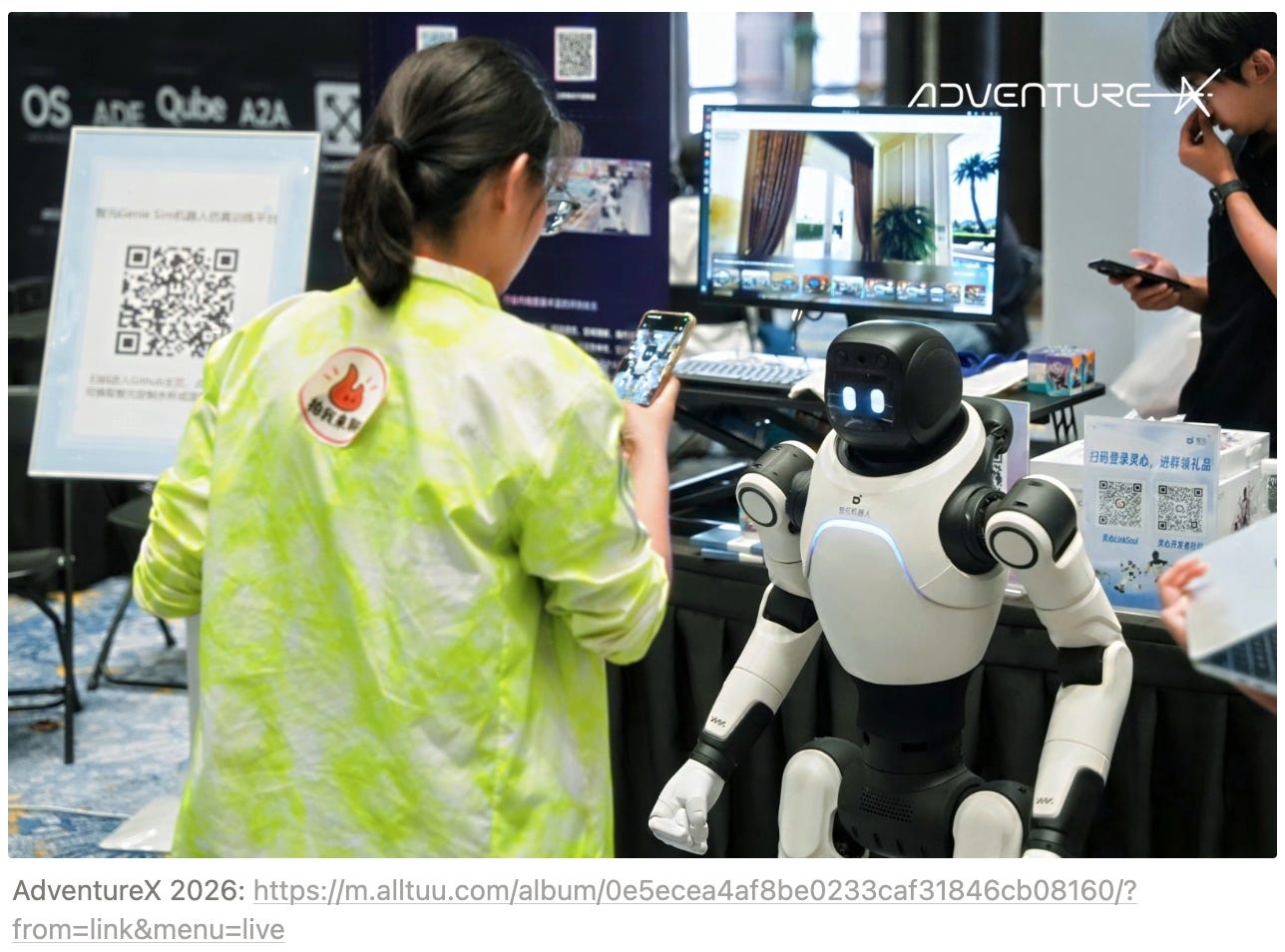
The overall 2026 champion, per a community-compiled winners guide, was Pengiu, a smart pet collar that helps dogs socialize and make friends. Other winners paired AI with earbuds, smart glasses and a quadruped robot. Because the participants were young, many were not constrained by textbook ideas of success and built products around their own interests and needs: recording fragments of daily life, AI companionship, sleep health, solo travel, and smarter ways to rest.

You can view AdventureX’s gallery to see other submitted and winning projects this year: https://gallery.adventure-x.cn/projects. (Not sponsored; just for anyone interested in checking out what kinds of applications and products are being built at the event.)
One number is worth pausing on. How much are the projects coming out of AdventureX actually worth?
That number may or may not hold up. But I think the core takeaway is something else: we are seeing a new, younger generation of Chinese builders who are tired of climbing the corporate ladder and ambitious enough to aim to become world-class entrepreneurs and innovators.
In the team’s year-end essay, Ryan wrote in his own blog:
There was once a question that stung us deeply—the famous Qian Xuesen’s Question:
“Why do our schools always fail to cultivate outstanding scientific and technological innovators?”
Today, 20 years later, we believe AdventureX is providing part of the answer:
True innovators emerge only when evaluation systems shift from exam papers to creation, and when students are encouraged to explore the unknown and solve real-world problems rather than mechanically memorize and test-prep. We are putting this vision into practice.
Who pays for a free weekend?
For the young builders, a hackathon is a stage. For many others in the room, it has become a real business. AdventureX is free to attend, and so was the Zhongguancun contest Jiang won: free meals, free hotel rooms, free compute, cash on top. Someone is paying for it all, and each of them is buying something specific.
