


Let’s start with a number that could feel impossible: in the two trading days after Mango TV announced China’s first satellite-broadcast AI long-form drama, its parent Mango Excellent Media (300413.SZ) added roughly ¥11.7 billion (about $1.6B) in market cap — two consecutive 20%-limit-up sessions, with its trailing P/E spiking to 95x [*].
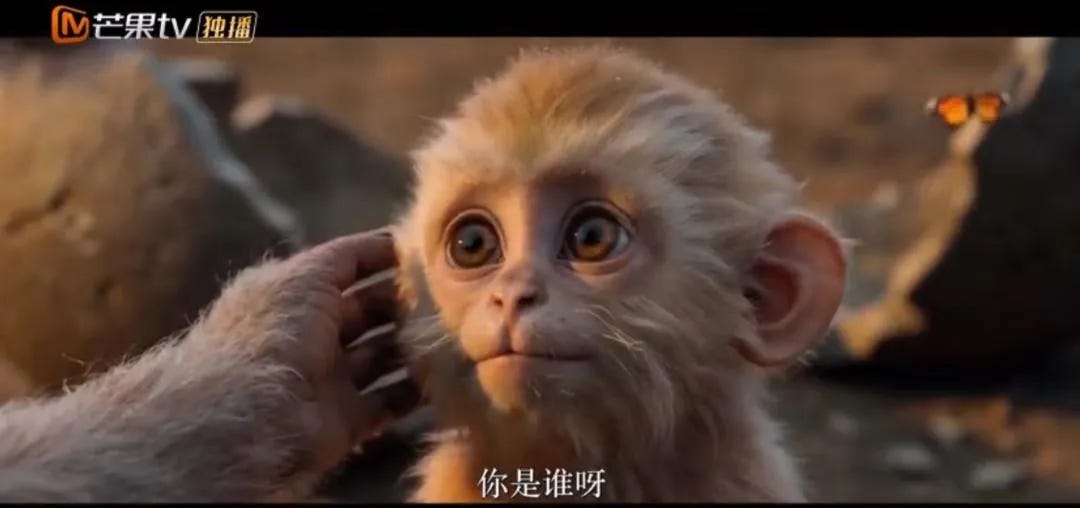
The catalyst was 《后西游记》(”Journey to the West: After”)— a 30-episode, 40-minutes-per-episode mythological series that aired August 31, 2026, simultaneously on Mango TV and Hunan Satellite TV’s prime-time slot. There are no human actors, no film crew, no on-location shoots; every character, set, and frame is generated by AIGC. Per the production team, the cost came in at roughly one-tenth of a traditional drama of comparable length [*].
Hunan TV—commonly nicknamed “the Mango TV” because its logo resembles a mango—holds a very special place in the childhood memories of Chinese people born in the ‘80s and ‘90s. It has always been a pioneer, introducing reality television, variety entertainment, and talent competitions while most traditional Chinese networks stuck to old-fashioned programming. And now, it is placing a new bet: AI-generated dramas.
Seedance, and a regulatory green light
The show was built on ByteDance’s Seedance 2.0 / 2.5 models, delivered through Mango TV’s in-house AIGC Innovation Content Center [*]. That alone is a notable vote of confidence in a domestic video model from a tier-one broadcaster.
But the more interesting unlock is regulatory. The show is the first project to run under the National Radio and Television Administration’s “边审边播” (review-while-broadcasting) mechanism, rolled out under the NRTA’s so-called the “21 Articles” [*].
Issued in August 2025, the 21 Articles are the clearest signal yet of Beijing’s shifting posture on audiovisual content:
The 40-episode cap on TV dramas is gone.
Overseas IP adaptation is explicitly encouraged.
“Review-while-broadcasting” is piloted — but only for series, seasonal, anthology, and sitcom formats (the structurally modular kinds that don’t need a fixed ending locked before air).
In other words, the regulator is simultaneously loosening format restrictions and embedding AI-native production into the compliant mainstream. For a year that I earlier called 2026: Year One of China’s AI Film Industry, this is the moment the establishment stopped treating AI video as a fringe experiment.
While people debated “does it look real,” China started getting paid
AI animation is among the first categories to reliably generate cash flow. Prior to Mango TV airing the show, Chinese netizens were already watching AI shorts online. For instance, ‘AI anime drama 漫剧’—anime series created purely by AI—has become the addictive phenomenon known as ‘mealtime shows’ due to its ability to pack addictive hooks and memes into short episodes
While the discourse is still stuck at “but does the AI hand look right?” or “can AI writing really replace a human?”, in China, AI video has quietly become a cash-flow business. As I wrote back in my AI film industry piece, we’ve moved well past the “toy project” phase. The monetization isn’t theoretical anymore — it’s showing up in platform payouts, in recharge numbers, and in overseas app-store receipts.
The most important mental model: AI video models are engineered to spike dopamine, not to be philosophically profound. A vertical short-drama viewer is on a subway scroll looking for a 20-second emotional hit — the slap, the reveal, the underdog comeback. They don’t care if the glass-physics is slightly off. It’s the visual equivalent of junk food: cheap to make, irresistible to watch, but highly profitable.
Let me show you the receipts.
Where the money actually is: three working models
1) AI 漫剧 (AI “anime dramas”)
AI anime-dramas are the sleeper hit of 2026. Production is startlingly cheap: a 3D AI anime runs about ¥2,000–2,500 per minute versus six figures for traditional animation [*]. Platforms have built explicit monetization rails — Douyin, 红果 (Hongguo, micro drama platform owned by Bytedance), and Tencent’s 火龙漫剧 (Huolong) have launched dedicated anime revenue-share plans.
Per-episode payouts can reach thousands of yuan for shows crossing 10 million views [*]. Some verified accounts report personal AI-content incomes above ¥200,000/month without selling courses — purely from platform share and novel affiliates [*].

2) AI live-action short dramas — already topping the charts.
Since the start of 2026, multiple AI live-action short dramas have become breakout hits: 《斩仙台 AI 真人版》 (Zhan Xian Tai AI Live-Action) crossed 100 million views in six days; 《嫡女泣血》 (The Legitimate Daughter Weeps Blood) surpassed 230 million views to top industry charts [*].

Period-costume and Chinese fantasy-adventure are already very popular formats of micro-dramas in China and have become the “guilty pleasure” of many. Even before the emergence of AI, an entire “assembly line” already existed for producing these fast-paced, addictive series. They bypass A-list stars, instead licensing novel scripts from the internet and sign internet influencers or lesser-known actors. Now, AI has simply driven production costs—which were already squeezed—down to rock bottom.
3) The “B2B” model: “legitimate” film and TV integration.
Early this year, the acclaimed Chinese director Jia Zhangke released an AI film built on Seedance 2.0, starring an AI version of himself — a signal moment of a top-tier professional embracing the stack [*]. Similarly this year, Kuaishou’s Kling was integrated into the popular historical drama 《太平年》 (Swords Into Plowshares), where AI-assisted storm-and-naval-war sequences improved efficiency 8–10x while holding cinematic quality [*].
That’s what I call the “B2B” model: sell the model and workflow into professional pipelines, not just to consumers.
The micro drama export: almost every AI short drama abroad is Chinese
If you’ve been watching the overseas short-drama charts, you’ve probably noticed something: the AI video short plays flooding foreign app stores are almost entirely made by Chinese companies. This is the direct sequel to the Chinese-made short-drama boom abroad I covered when ReelShort first topped the US App Store — except now the marginal cost of a new title has fallen off a cliff.
According to Sensor Tower’s Q1 2026 statistics, out of the $750 million global in-app purchase (IAP) market for that quarter, DramaBox (Dianzhong Technology) and ReelShort (Crazy Maple Studio) each generated nearly $140 million in IAP revenue, tying as global dual oligopolies. Together, these two China-backed leaders captured nearly 37% of total direct consumer spending worldwide for the quarter.
It is, in a sense, the video equivalent of the “token export” wave I wrote about earlier: Chinese AI capability leaving the country as finished, monetizable product.
