


Several years ago, I wrote that the search interest in China’s intangible cultural heritage (非物质文化遗产, or 非遗) was already booming. You could see it everywhere: consumer brands slapping “heritage craftsmanship” or “legacy of intangible culture” onto their packaging, sometimes deservedly, sometimes…not so much. Even when the actual craftsmanship pedigree was thin, the rebranding itself worked. It was the single most reliable, most instant traffic-gainer to win over a generation of Chinese consumers who were beginning to fall back in love with their own culture.
You’ve seen this story at the premium end, which we’ve covered extensively — most obviously with Laopu Gold (老铺黄金), the Beijing-founded “Hermès of gold” that I’ve written about several times. Laopu listed in Hong Kong in mid-2024 and the stock subsequently rallied more than 20x, briefly touching ~HK$150 billion in market value, on the strength of nothing more exotic than reviving Chinese traditional goldsmithing techniques — hammering, filigree, hollowing, and enamels — and packaging them as luxury. And you’ve seen it at the more mass-market end too, like with the Tong Shi Fu IPO (铜师傅) piece, where copper artisanship, middle-aged male gifting, and Pop Mart-style branding all blended into one investable asset class.
But over the years, the “intangible cultural heritage” labels are now EVERYWHERE. What started as a marketing label has matured, and consumers are starting to look beyond the surface.
Consumers are no longer satisfied with brands that just slap a heritage sticker on a generic SKU. They’re going deeper — looking for the real roots, the real history, the real design niches. And the data is starting to show it.
Our own data: antiques and collectibles are quietly outrunning the consumer market
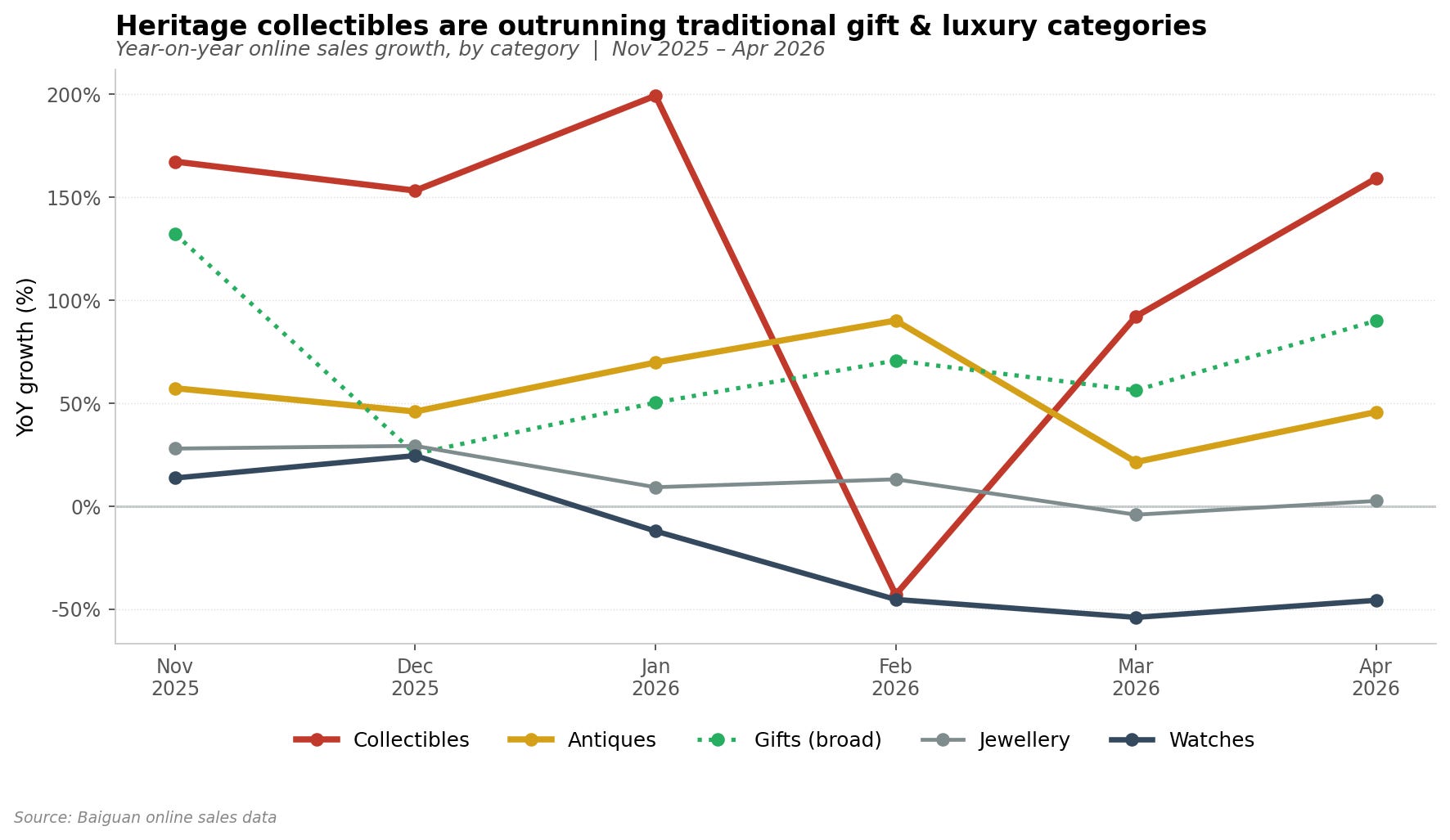
Our own online sales data this year revealed something that genuinely surprised me. The categories of antiques and collectibles are growing at a year-on-year pace that beats less-niche categories.
This is happening against a backdrop where overall Chinese consumption is, to put it kindly, not as strong as it used to be. So when a niche, “what-on-earth-is-that“ category outpaces the broader market, that’s a signal worth paying attention to.
In the collectibles category, the brand topping our charts both in absolute sales and in growth this year is a name most foreigners (and frankly, many Chinese people) have never heard of: 开心集藏 (which loosely means “Happy Collecting“).
The more interesting thing is what Happy Collecting’s core product is: bookplates/ex libris, which are small, often beautifully designed slips of art that book collectors paste inside the front cover of their books to mark ownership.
Bookplates originated in Germany in the mid-15th century, but fit into Chinese culture in a very specific way. China has its own much older parallel tradition: 藏书印 (cángshūyìn), the personal book seal, which dates back at least to the Eastern Jin dynasty and is one of the classical “studio elegances” of the Chinese literati. Every serious old-school Chinese book collector — from Ming-dynasty scholars to early-20th-century literary figures — had a personal seal that they would stamp inside their books.
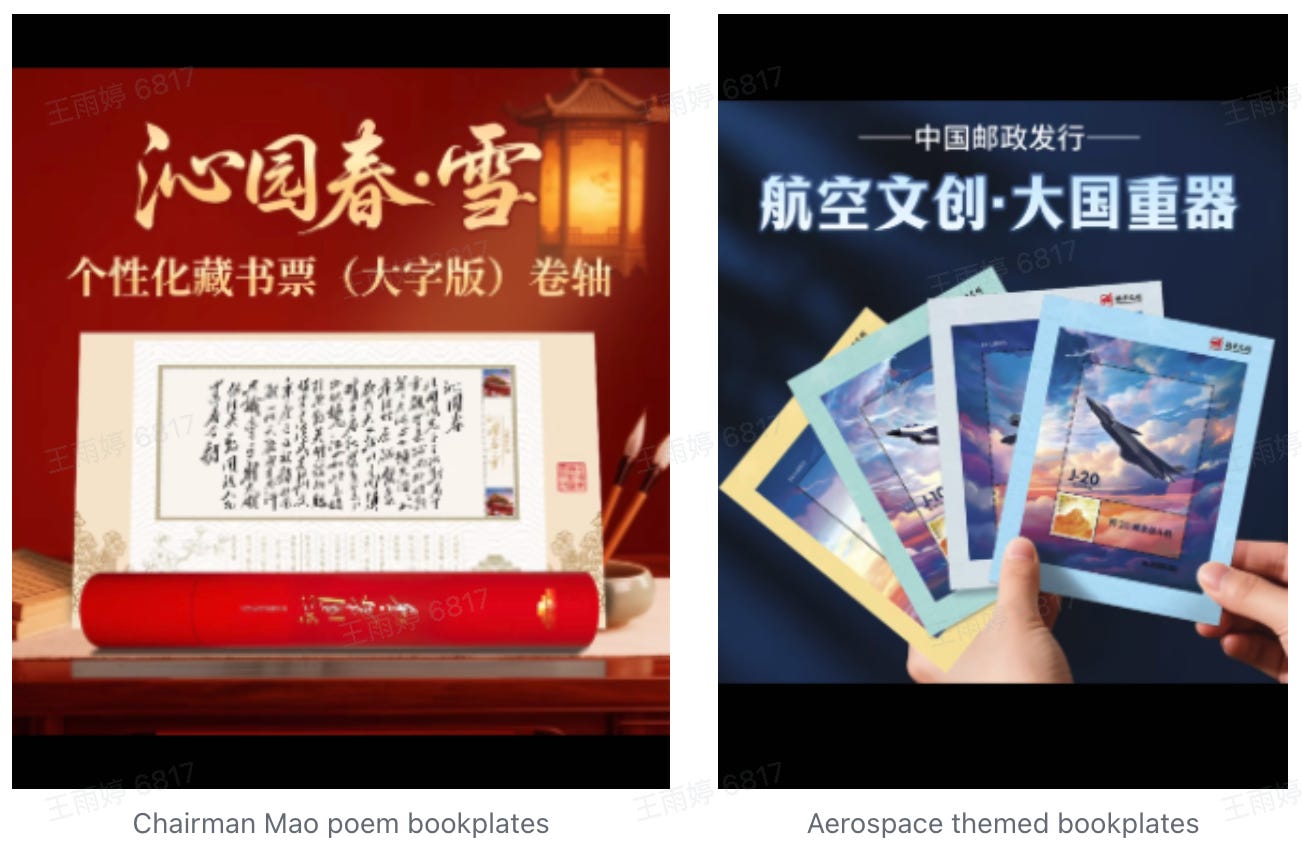
Happy Collecting’s best-selling bookplate themes feature imagery deeply rooted in traditional cultural symbols, such as the Forbidden City. Many also tap into patriotic sentiment, with themes ranging from historical slogans like “Serve the People“, wartime era heroes, to cutting-edge aerospace achievements like China’s domestic J-series fighter jets.
The company itself runs on a fairly typical Chinese e-commerce and MCN model. The operating entity actually started as an internet company back around 2014. It pivoted into e-commerce and livestreaming in 2021, and only in the last year or so really pivoted to the cultural collectibles categories, but is already selling well over one million RMB a month just in online sales.
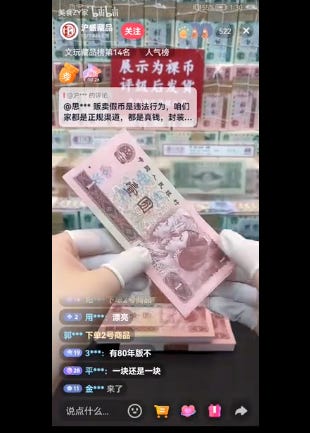
It partnered with many state-owned entities and companies, and is now the exclusive online channel partner for state-affiliated heritage institutions, including the Shanghai Mint and the China Numismatic Museum. That kind of partnership is meaningful, as these institutions usually hold the most widely recognized and lucrative cultural and historical IPs in China.
In the antiques category, what I noticed is even more telling. Almost all of the emerging brands topping our charts are domestic jewelry brands explicitly inspired by Chinese antiques or ancient aesthetics — not foreign luxury houses, not traditional gold chains, but new Chinese brands designing in the language of ancient Chinese motifs.
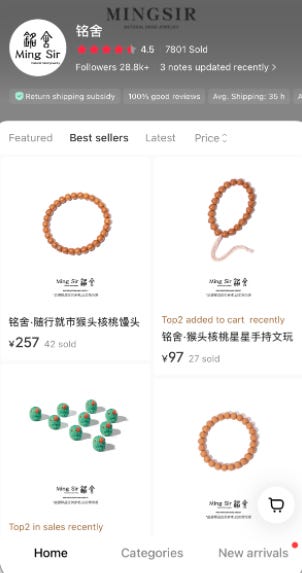
So far, the #1 brand in the category this year is 铭舍 (MingSir). Founder 陈一铭 (Chen Yiming) opened the first Ming She storefront at the end of 2013 — in a cultural relic market in Jinan, Shandong. He started by selling natural amber, turquoise, agate, and South Red agate, all materials with deep historical associations in Chinese ornament. He grew from a single small shop into a wholesale network supplying jewelry and jade shops across Shandong province, then transitioned hard into Douyin livestream commerce. He now sets monthly GMV targets in the hundreds of millions of RMB during peak shopping festivals, and has reportedly hired 70–80 people just to do quality control on individual beads. That’s a tier of operational discipline that most observers don’t associate with “people selling antiques on Douyin.
The pattern, in both cases, is the same: these brands almost all heavily invest in online presence. Despite being still relatively small, local and somewhat elusive — but they’re burgeoning.
The cultural sensation behind all of this: the antique livestream craze
If you want a single piece of cultural evidence that Chinese young people have fallen in love with their own heritage, it’s a man on Douyin who calls his show 听泉赏宝 (roughly translates to “Listening-to-Springs, Admiring Treasures“).
His real name is 丁祥栩 (Ding Xiangxu). He posted his first short video on Douyin in April 2023 — titled “door-to-door buyback” — and started livestreaming antique appraisals (mostly ancient coins, at first) in August 2023. For the first few months, his streams pulled tens of thousands of viewers. Nothing crazy. Then, in early 2024, something flipped. By early 2025 his Douyin account had ~37 million followers and over 130 million total likes — making him, for a stretch, the single highest-profile cultural-content creator in China.
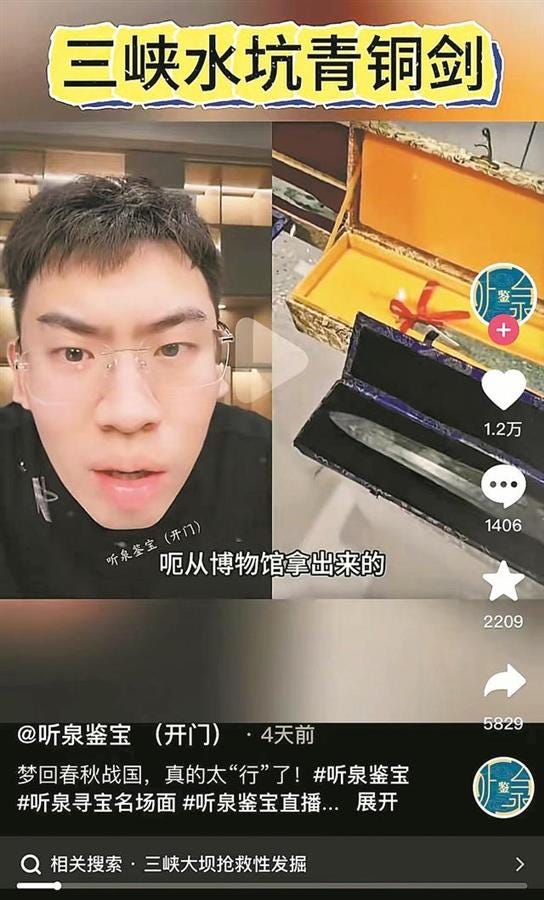
The format is part of what’s so revealing. Random viewers dial into his livestream holding up “treasures” they claim to have found in an attic, dug up in a field, inherited from grandfather, etc. — and he immediately, on camera, tells them whether it’s a Han-dynasty bronze or a 50-RMB tourist-stall fake. The bits often go viral: a guy holding up what he insists is a Ming sword turning out to be a 1990s factory tin; a grandmother showing a “Qing imperial” hairpin that turns out to be real and worth a small fortune. It’s pure infotainment, but it’s Chinese cultural infotainment — every clip is a free, two-minute crash course in ceramics, bronzes, coins, jades, and calligraphy.
He’s also been at the center of controversy: in October 2024, he abruptly went on hiatus after a viewer brought what they claimed were stolen museum artifacts to be appraised on his livestream. But nevertheless, tens of millions of young Chinese consumers are watching this for fun.
Ding’s sensational success very much mirrors that of Dong Yuhui, who rescued New Oriental’s failing business after the 2021 Chinese policy overhaul that prevented the company from providing tutoring services — he did it with the educational, informative style of his livestream sessions. Chinese consumers are generally very inquisitive and eager to learn, and right now that curiosity has shifted toward their own historical and cultural roots.
Take a step back, and what’s actually striking is that even the oldest, most “low-tech,” most stubbornly offline corners of the Chinese consumer economy — antiques, heritage collectibles, traditional jewelry — are now being run under an MCN + livestream model. That is quite different from how these industries operate anywhere else in the world. (For instance, you don’t see Sotheby’s running a Douyin account with millions of followers in China.)
My three takeaways: organic growth is hiding in “what-on-earth-is-that” categories
These brands are small. They’re local. They’re easy for foreigners — and frankly, for Chinese locals too — to miss. But I think the pattern matters, for three reasons:
First, China’s organic consumer growth has moved into the niches.
When I say “niche,” I mean something quite specific — categories that are obsessively cherished by one group, and that another group would react to with “wait, what is that? I’d never spend money on that, ever.” That’s where the growth is now. Mass-market consumer needs are largely satisfied; the logical end-state there is a price war (which we’re already seeing in autos, in food delivery, in coffee, in clothing, in electronics — you name it).
Niche-enthusiast demand, on the other hand, is where consumers are still willing to pay a real premium — and where competition is fragmented enough that a single well-run brand can still build a meaningful business.
Let me give you an example: in Beijing, where I live, a lot of locals are deeply into collectible walnuts. Your reaction might be, “what could there possibly be to buy about a walnut?” — but real Beijing walnut connoisseurs can rattle off varieties the way a wine collector does grapes. A nice matched pair can run several thousand RMB; a premium pair can run as much as 300,000–400,000+ RMB (~US$50,000), with a very active secondary market. (Picture trading Labubu on the secondary market — but for walnuts.)
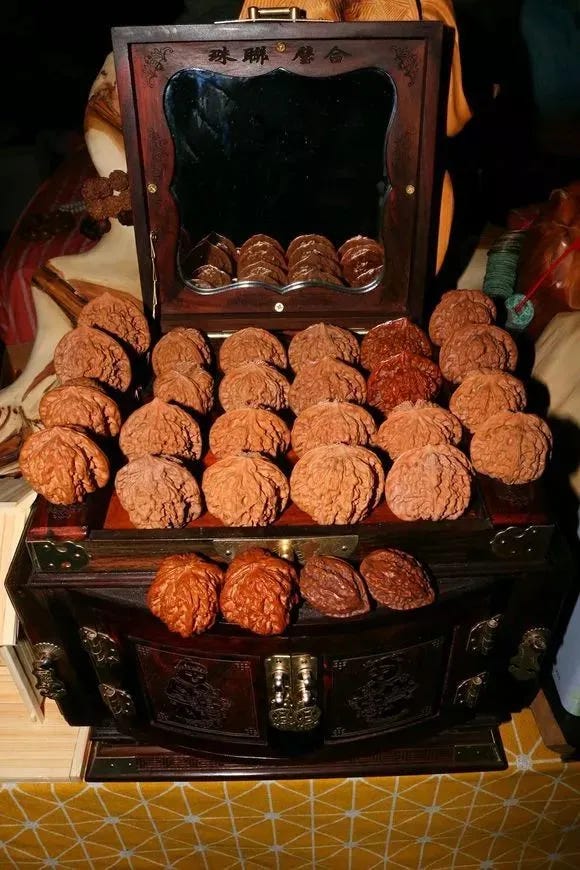
Of course, the walnut market is just one example. There are many such niche markets that I’m not even aware of, but they’re quietly burgeoning across China.
According to some industry research, as of 2021, roughly half of online cultural-collectibles buyers were young (between 25 and 34 years old). On Xiaohongshu, the #文玩女孩 (”girls who collect”) tag has cleared 2.3 billion views — a clear signal that this is a consumer trend you cannot ignore.
(If you think about it, isn’t Labubu also one of the “what-on-earth-is-that” for many?)
Second, the “brand-ification trend” of these cultural IPs has accelerated.
