


I must apologize for the slightly clickbaity subtitle.
Many Chinese netizens do jokingly refer to this company as ‘Pop Mart for middle-aged men’ due to its focus on figurines and collectibles, but its business model couldn’t be more different. That said, I promise an interesting look into how Chinese consumers are rediscovering their passion for traditional craftsmanship in today’s post.
There’s a joke that’s been circulating in China for years about the spending hierarchy of Chinese consumers. The rough order goes: women > children > the elderly > pets > men. Specifically, middle-aged men.
The stereotype is fair. Chinese middle-aged men — the ones running companies, managing client relationships, attending business banquets, and bearing the burden of financing the family — tend not to spend on themselves. But their money goes to status, to relationships, to gifts.
So when a company specifically targeting this demographic just went public in Hong Kong, it was worth paying attention to — even if almost nobody did.
Tong Shi Fu: the copper artisanal products
铜师傅 (Tong Shi Fu, or “Copper Craftmaster” if translated literally, 0664.HK) listed on the Hong Kong Stock Exchange on March 31. The IPO didn’t go well on debut — shares opened down 41% from the offering price of HK$60 and closed down nearly 49%. Not the kind of first day that generates headlines for the right reasons.
But the business itself is interesting. Founded in 2013 in Hangzhou, Tong Shi Fu is China’s largest copper cultural and creative products company. It makes copper figurines, desk ornaments, and decorative pieces — the kind of objects you’d find on the desk of a Chinese business owner, displayed in a meeting room, or held in the palm of a hand as a fidget toy. Revenue hit around 570 million yuan in 2024, with gross margins of 35%.
Both Shunwei Capital and Xiaomi (through its subsidiary Tianjin Jinmi) are shareholders, together holding over 22% of the company. Interestingly, Xiaomi’s CEO Lei Jun personally backed Tong Shi Fu as far back as 2017 with a 110 million yuan Series A, followed by a 310 million yuan Series B in 2018. He called it “the enterprise most like Xiaomi outside the entire Xiaomi ecosystem” — which, if you know how Lei Jun thinks about brand-building and product positioning, is a genuine compliment.
In a way, the comparison makes sense. Like Xiaomi in its early days consolidated many white-label brands, Tong Shi Fu took a traditional category dominated by anonymous workshops, applied design thinking, built a recognizable brand, and used e-commerce to reach a national audience (In 2024, online sales accounted for 76.7% of its revenue!)
The Commercialization of Craft
The rise of Tong Shi Fu doesn’t make sense without the broader backdrop.
Over the past few years, the revival of Chinese traditional culture and craftsmanship has been one of the most consistent undercurrents in China’s consumer market — and it’s getting more commercial. We’ve been covering different facets of this story since 2023.
Take Laopu Gold**,** for example. I’ve previously discussed how their success stems from a return to “ancient gold” techniques, tapping into gold’s deep-rooted status as a cultural symbol in China. But there is an ongoing debate: Is Laopu’s hype driven by genuine craftsmanship or simply by gold’s value-retaining properties amidst skyrocketing prices?
Laopu’s commercial success was indeed significantly supported by gold’s dramatic price appreciation in recent years. But Tong Shi Fu probably represents the other side of the coin. Copper artifacts also possess a significant cultural legacy and a devoted (albeit niche) collector base. Unlike gold, the appeal here isn’t financial hedging; it’s pure appreciation of the craft.
Bridging old and new
The brand is not just selling traditional copper crafts; it is actively trying to make them speak to contemporary culture.
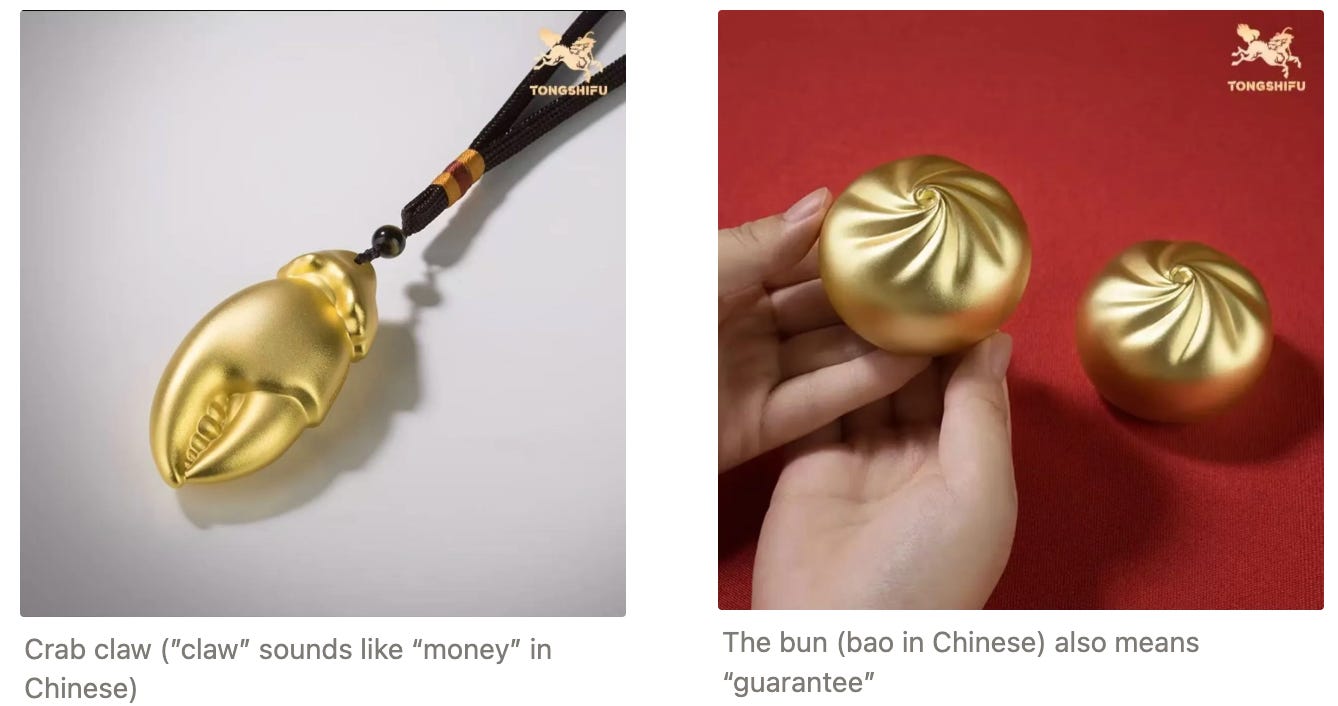
Some of this happens through homophonic puns. For instance, they offer a collectible shaped like a crab claw (qián 钳) to signal wealth, as the word for “claw” sounds like the word for “money” (qián 钱) in Chinese. Another piece is shaped like a bun (bāo 包) and is titled “Guaranteed Success,” since bao also means “guarantee” in Chinese. These puns land immediately with the target consumer.
The company has also aggressively pursued IP licensing—the high-growth business model followed by companies like Pop Mart and Miniso. They have released figurines featuring characters from the blockbuster animated film Ne Zha 2, Dunhuang cultural motifs, and even Captain America. Although these IP-driven products are not yet the core revenue drivers, they signal a deliberate push to reach younger consumers and expand the brand's cultural range beyond traditional gifting.
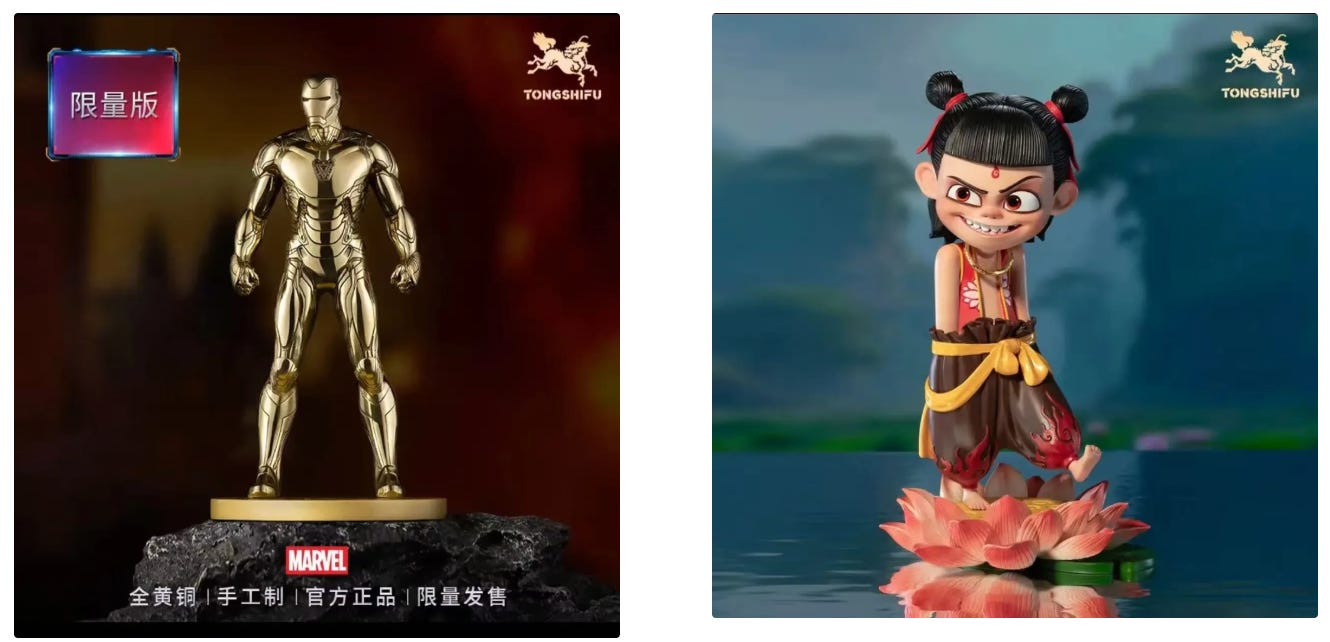
In this sense, copper artisan products are undergoing a journey very similar to Laopu Gold’s: taking something that once felt old-fashioned or niche and finding a way to make it resonate with modern aesthetics. (For a long time before Laopu Gold went viral, it was common for young Chinese consumers to view gold jewelry as unfashionable—something only an “elderly auntie” would wear).
Gift giving—The “necessity” for the middle-aged man
Interestingly, copper products have captured an essential demand among middle-aged men: the need for gifting.
For instance, nearly all of Tong Shi Fu’s top-selling SKUs are variations of the Ma Dao Cheng Gong (meaning “success upon arrival” in Chinese) or Ma Shang You Qian (money upon arrival) desktop copper horse. It is widely considered a foolproof choice for anyone looking to impress a client or business partner—particularly those who are middle-aged.
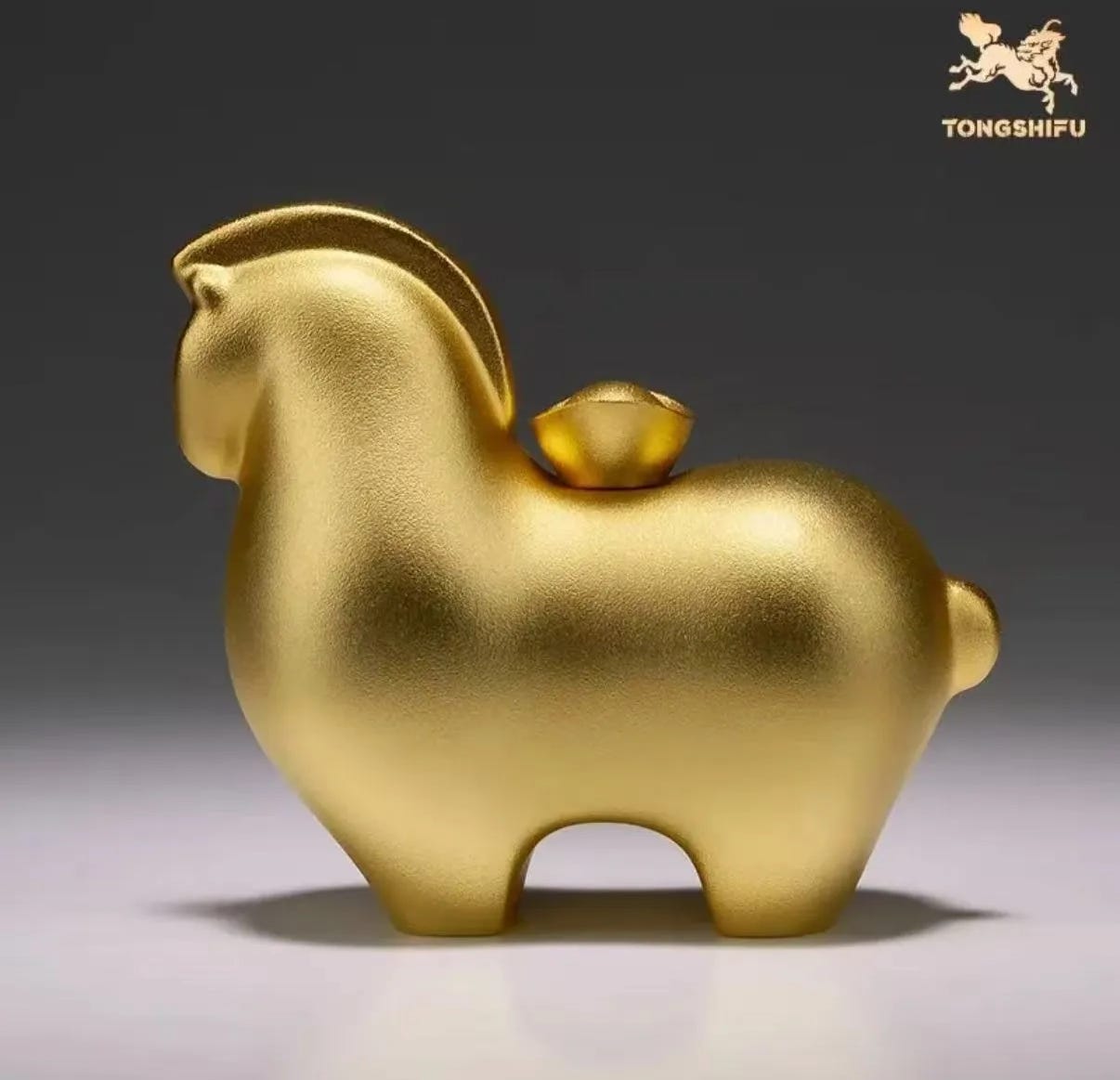
For many Chinese men in that demographic, this aesthetic is practically universal: it is grand and perhaps a bit cheesy, yet it successfully signals wealth and social status through puns and auspicious animal symbols. (Horses, deer, and gourds all remain staple choices in Chinese gifting culture.)
At the higher end of the spectrum sits Zhu Bingren Copper (朱炳仁·铜). Also based in Hangzhou, it is a more premium brand targeting a similar demographic and gifting scenario, but with more elevated positioning.
Zhu Bingren is one of China’s most celebrated copper artisans—a “National Intangible Cultural Heritage” inheritor whose work has been presented as state gifts to foreign dignitaries. Compared to Tong Shi Fu, which targets the mass market, Zhu Bingren tends to create more traditionally inspired symbols and totemic pieces. These can feel less “trendy” and more “old-fashioned,” but they are undeniably grander and, naturally, command a much higher price point.
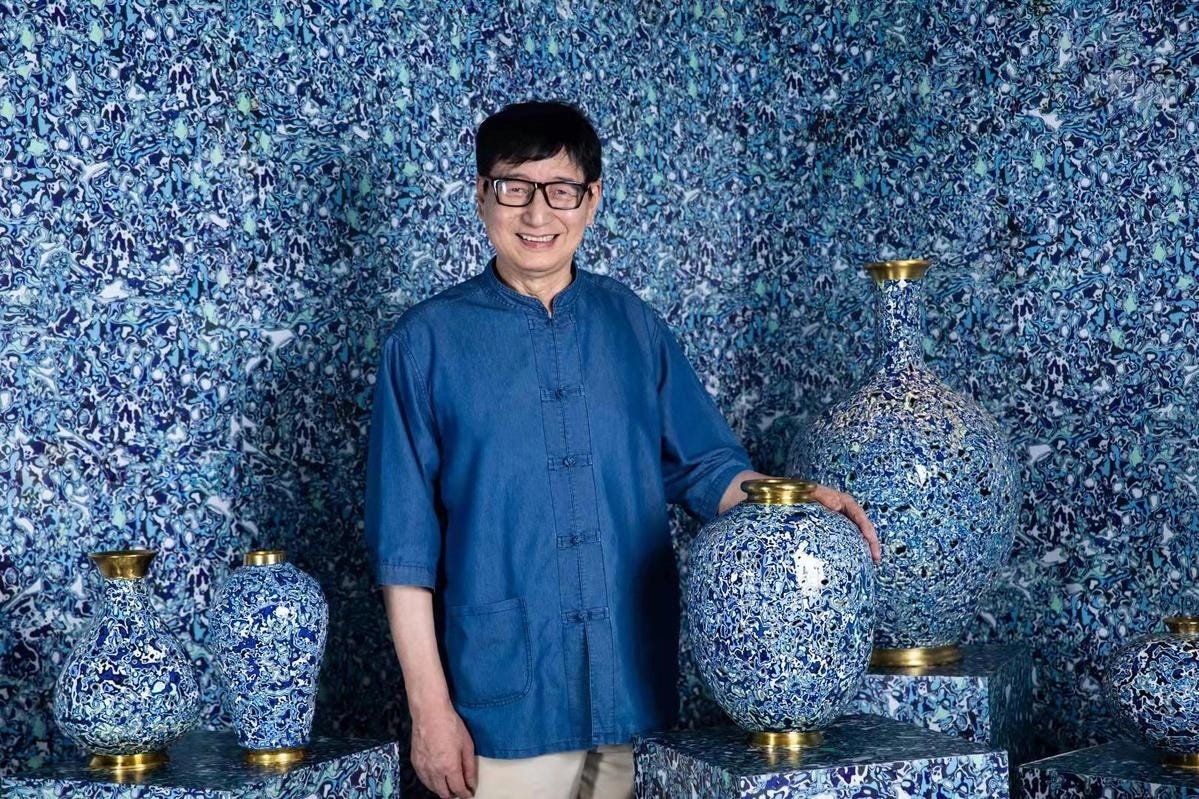
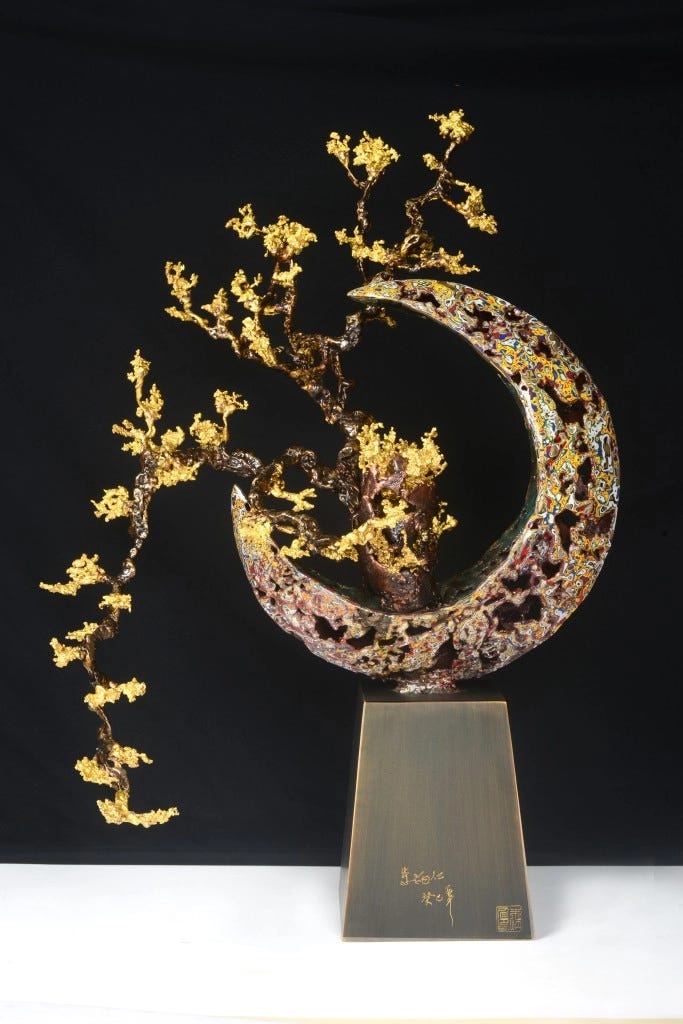
The brand now operates over 230 stores across mainland China and recently opened its first overseas location in Singapore. Reportedly, the company is also in the process of pursuing an IPO on the Beijing Stock Exchange.
While these two copper artisan brands target different customer segments, they are riding the same underlying current: the professionalization of Chinese heritage.
Branding: the opportunity for Chinese artisan products
Despite the abundance of traditional craftsmanship in China, the level of brand development in this space has historically been very poor. Most great craftsmanship is sold anonymously — from family workshops, or by artisans working in obscure side streets with no storytelling, no national distribution, no scalable identity. Or, at the other side of the spectrum, pieces by masters only circulated within the niche groups without transparent market pricing.
That’s changing.
I believe this shift represents a massive opportunity for both Chinese companies. While I don’t necessarily think a brand like Tong Shi Fu represents a massive TAM on its own, the rise of brands like Laopu Gold and Tong Shi Fu proves that China is successfully commercializing its cultural heritage with more mature brand building and storytelling.
We are also seeing the emergence of ways to “capitalize” on traditional products in the secondary market. While I’m not always certain this is a positive from a purely artistic perspective, from a market standpoint, it means these crafts are gradually becoming truly investable assets.
China possesses hundreds of thousands of distinct forms of craftsmanship. Beyond the few public companies, smaller brands are rising everywhere. Many of these are led by solo founders or young artisans using Xiaohongshu (Red Note) as their primary launchpad. Compared to older-generation artisans, today’s generation has much stronger digital literacy and business sense.
Even among these smaller workshops that haven’t yet caught the eye of big capital, the commercialization is already well underway.
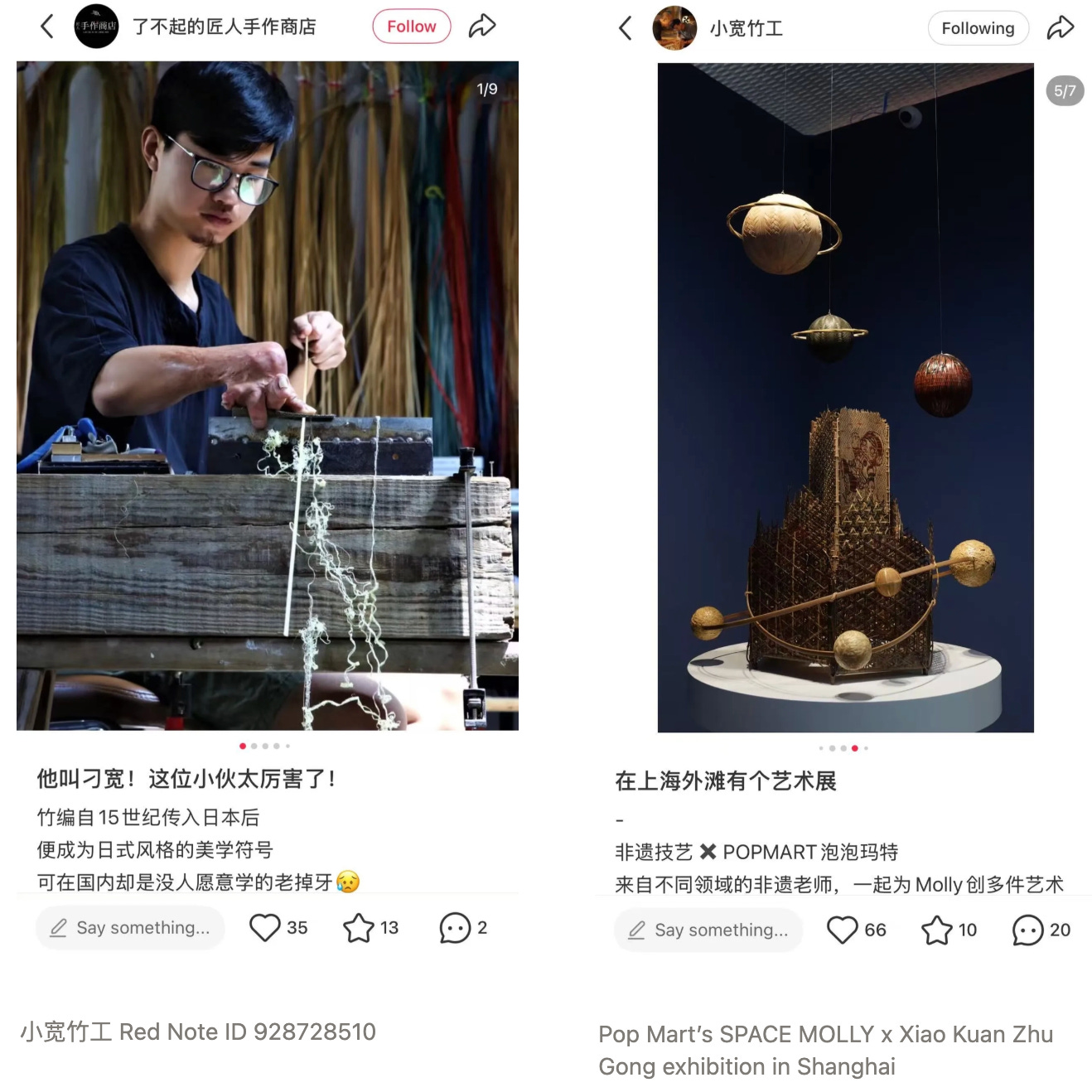
For instance, I’ve been following an artisan named “Xiao Kuan Zhu Gong” (小宽竹工) for several years (whose workshop is also based in Fuyang, Hangzhou! I must say, the atmosphere in Hangzhou—and Zhejiang Province as a whole—has indeed nurtured successful entrepreneurs across every industry).
He is a handicapped artisan who creates beautiful zhubian (bamboo weaving) crafts. He started with no reputation, running his own Xiaohongshu store, but he has always possessed a rare combination of pure craftsmanship and sharp business sense. For instance, he didn’t just sell finished pieces; he launched DIY kits and did an excellent job of branding his personal story and “behind-the-scenes” process to enhance his brand’s value.
He is a prime example of the many, many artisans currently stepping into the spotlight.
Recently, Pop Mart launched a collaboration with him, proving that even for brands that do not specialize in traditional crafts, embracing cultural heritage is no longer optional—it is a strategic necessity.
China has hundreds of thousands of distinct crafts waiting for their "Laopu moment." — the "Cultural China" trade is just getting started!


