


The received wisdom on marketing in China has been fairly consistent for the past decade: if you’re not on Douyin, Xiaohongshu, and WeChat, you don’t exist. Get a top-tier KOL, produce beautiful short-form content, dominate the algorithm, convert. Repeat.
That playbook is increasingly running into a wall — specifically, with the segment of consumers that aspirant and luxury brands most want to reach.
China’s educated, high-income urban professional women — especially the 30-to-45-year-old Tier-1 city lawyer, managers, finance director, or entrepreneur — have developed a distinct allergy to the content machine. They haven’t gone offline. They've migrated. And the destination, for a meaningful slice of them, is podcasts.
The fatigue is real
The short-video economy was built on novelty, stimulation, and manufactured aspiration. For a period, it worked extremely well at converting attention to commerce. But novelty has a half-life. By the mid 2020, a growing cohort of Chinese women in their 30s and above — precisely the demographic with real spending power — started describing their experience of Douyin and Xiaohongshu in terms that sounded less like entertainment and more like a utility bill: something they check out of habit, not pleasure.
The platforms haven’t stopped working. But for the most sophisticated consumer segment, they have stopped meaning anything. When everyone is on Xiaohongshu selling a curated version of their life, the feed collapses into a single undifferentiated aesthetic. Buying a bag because you saw it in a 15-second video stops feeling like a considered choice and starts feeling like being manipulated.
This is the demand signal that a handful of Chinese premium brands — earlier and more clearly than international luxury houses — picked up on and acted on.
Giada: What the urban elite Chinese woman’s role models look like
GIADA is an Italian-founded womenswear brand now owned by the Chinese luxury group Redstone Haute Couture, with price points in the tens of thousands of RMB per garment.
In 2022, rather than doubling down on KOL seeding or live commerce, the brand launched a podcast called Yan Zhong Hua Shu (岩中花述, phonetically similar to “Flower on the Rock” in Chinese) on Xiaoyuzhou FM — China’s premier indie podcast app — with legendary television host Chen Lu Yu as permanent host.
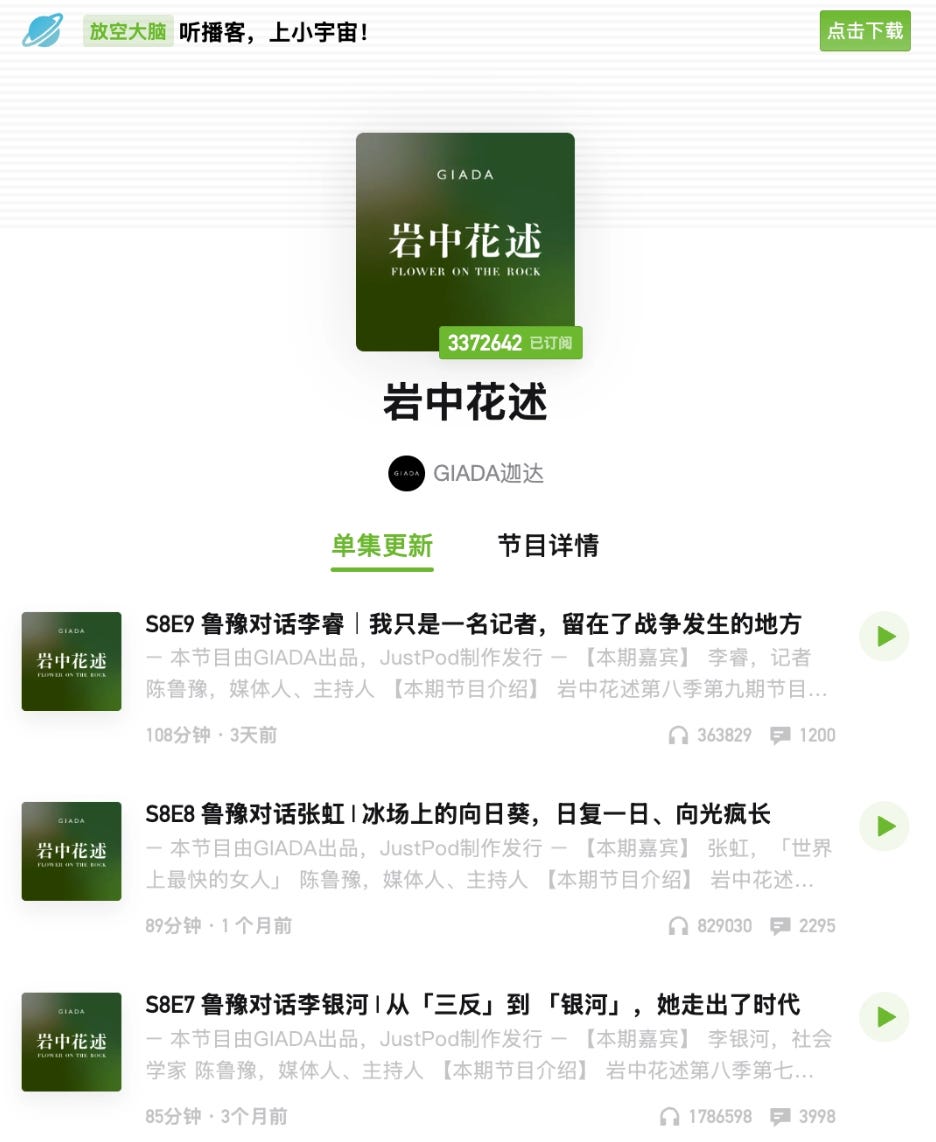
The format is deliberately unhurried. Each episode runs roughly 80 minutes. Lu Yu and a guest — drawn from literature, film, art, theater, and academia — discuss life philosophy, personal history, and what it means to be a woman in contemporary China. Product placement is effectively nonexistent. GIADA is the backdrop, not the subject.
After six seasons and nearly three years on the platform, Yan Zhong Hua Shu has accumulated over 1.07 million subscribers on Xiaoyuzhou — making it the largest branded podcast in the Chinese-speaking world, according to industry tracker JustPod. A single 2024 episode featuring Zhan Qingyun, a law graduate of the Chinese University of Hong Kong and Harvard University and a highly accomplished debater and legal professional, has so far drawn over 2,000,000 plays on Xiaoyuzhou alone.
To understand why this matters commercially: GIADA bypassed conventional celebrity endorsement, live commerce, and algorithmic Xiaohongshu/Douyin seeding. Instead, it built a sustained, high-trust relationship with exactly the demographic it wanted — women who don’t just want to buy a coat, but want to buy into what the brand represents.
Songmont: a different execution, same logic
Songmont — the domestic leather goods brand that went from fifth to first on Tmall’s Singles’ Day bags and accessories chart between 2022 and 2024 — also runs a podcast called Shan Xia Sheng (山下声, “Sound Under the Mountain”) on Xiaoyuzhou FM, with over 142,000 subscribers.
The format is more interview-driven: journalist Zhou Yijun talks with guests such as Li Na (Chinese tennis player), filmmaker Jia Zhangke, and Taiwanese actress Wen Qi. The conversations orbit themes of creativity, strength, and womanhood — not bags.
The podcast is part of a broader content strategy that has made Songmont unusually legible to its target consumer: urban women aged 25–45 with a strong sense of freedom, independence, and ambition who want to be themselves, not defined by societal norms. The podcast is doing something that Douyin ads cannot: building emotional equity.
We covered how Songmont rose from a purely online brand to a formidable player last year:

The Chinese podcast ecosystem they’re betting on
To understand why podcasts have become a viable brand-building vehicle in China, it helps to understand what China’s podcast market actually is — because it looks quite different from the Western model.
