


While everyone is transfixed by the sensational drama surrounding Jensen Huang, China’s AI models, and indeed its entire AI industry, are approaching their own darkest hour. Earlier this week, we published a note titled "After Jensen, can Chinese open models still close the gap?" on this topic.
Today, we are publishing another article by our long-time contributor, Bob Chen, a venture capital investor and a macroeconomics researcher. Bob’s original, 6-point article was posted in Chinese but got removed after a heated debate on China’s internet. Yet its phantom has been creating ripples both inside and outside China. For example, earlier this week, Rui Ma of Tech Buzz China published a viral tweet summarizing Bob’s key points.
Today, we are publishing Bob’s article in full with his approval.
To check out China’s latest AI developments and other advanced industries firsthand, you are invited to complete a 2-minute survey for our upcoming Spring 2027 China Tour series. Your interests will help shape our program.
China’s AI Models Face Their Darkest Hour
By Bob Chen
On November 12, 2026, Jensen Huang resigned.
After 33 years at the helm of Nvidia, the man who had become almost synonymous with the global AI revolution left the company he founded under a cloud of controversy over personal relationships and national security.
China’s AI industry may be losing far more than a relatively sympathetic friend willing to sell it chips.
Huang had long been one of the most influential opponents of US restrictions on chip sales to China. He repeatedly warned Washington that shutting Nvidia out would only help China build a computing ecosystem of its own. As a businessman, he wanted Nvidia to retain its grip on the Chinese market. But national security policy has never been obliged to bow to commercial logic.
Huang’s departure coincided with a sweeping Democratic victory in the US midterm elections. Yet the intrigue surrounding it might suggest something more: as Republicans suffered their electoral defeat, China hawks within the party and around Trump used Democratic-aligned media to mount a purge of his inner circle, seeking to cut off business leaders’ direct, personal influence over him.
We have known since the last trade war that a leader who haggles, cuts deals and talks interests is far easier to contend with than an ideological elite that leaves even less room for negotiation with China. Over the next two years, however, it may be the latter we have to confront.
This is also a sensitive moment in the expansion of US restrictions on China’s AI sector: what began with chips is spreading to global computing capacity, model technology and supply chains.
Advanced chips are becoming harder to buy. Overseas GPU rentals are coming under scrutiny. OpenAI and Anthropic are tightening their defenses against model distillation. Loopholes once tacitly tolerated are being closed and turned into political issues. Even optical transceivers, an area in which Chinese suppliers have already established themselves in the US AI supply chain, are being singled out for monitoring.
The United States is trying to close off almost every major external avenue through which Chinese AI can catch up.
Worse still, even if Chinese companies overcome these obstacles and train a capable model, the domestic market may be unwilling or unable to pay enough for it. Epoch AI estimates that the combined annualized revenue of China’s six leading AI companies is only a tenth of OpenAI and Anthropic’s combined total. ByteDance’s flagship AI app, Doubao, already has 419 million monthly active users, yet LatePost reports that it generated less than RMB 1 million per day in the first half of 2026. A Tencent Research Institute survey found that only 9.8% of Chinese AI users had ever paid for the technology. Tencent’s WorkBuddy, its work agent mirroring Claude Work and Codex, has ARR only at $500 million given all the advertising and compute power invested.
China’s distinctive path into the information age has made us exceptionally good at advertising, shopping, livestreaming and short dramas, while leaving us far behind in using digital technology to improve productivity.
China has more than 900 million online shoppers and over 600 million users of microdrama platforms, yet US spending on software is almost six times China’s. We have never lacked digital users. What we lack is a market for productivity software that persuades individuals and businesses to keep paying.
External restrictions are colliding with a domestic struggle to monetize AI. The cost of catching up is rising just as price competition intensifies. Meanwhile, advances in US general-purpose models are eroding the advantages of specialized models for embodied AI and robot intelligence. They may even undermine the very reason for some Chinese AI startups to exist, just after those companies have raised enormous sums.
Together, these forces are pushing China’s large AI models, and its broader AI industry, into a darkest hour of their own.
1. Chips Are Out of Reach. Rented Compute Is Slipping Away, Too.
On November 13, Reuters published an investigation based on more than 150 Chinese government procurement records, project investment documents, construction contracts and corporate disclosures. It identified computing projects with planned investment and contract values totaling more than RMB 23 billion that involved restricted Nvidia chips, including the H100, H200 and H800.
Years after US export controls on advanced chips took effect, some Chinese computing projects are still building their investment plans around Nvidia hardware they cannot reliably obtain. If the chips fail to arrive, construction, financing, and technical plans may all have to be reworked.
People used to insist that there was always a way to get the cards, and simply assumed the data centers could be brought online. Perhaps that was only because the other side had yet to get serious about enforcement, and because sympathetic figures such as Huang, along with networks of middlemen in Southeast Asia, kept the channels open.
There used to be another option if the chips could not be bought: rent the computing power overseas.
Chinese companies could rent data center capacity in Singapore, Malaysia, the Middle East or Europe, leaving Nvidia GPUs outside China while accessing their training capacity remotely. Nvidia could keep selling chips, cloud providers such as Oracle could keep renting out compute, and Chinese model developers could keep working.
That route is now under threat as well.
On November 3, the Financial Times reported that, under pressure from the US government, Oracle had canceled a proposed five-year overseas computing agreement with Tencent worth an estimated $7 billion. The arrangement would have provided computing capacity equivalent to roughly 100,000 advanced AI chips through data centers in Southeast Asia.
The more consequential institutional change is the US Remote Access Security Act, or RASA.
The House of Representatives passed the bill on January 12 this year by 369 votes to 22. Its central idea is to extend export controls beyond the physical transfer of chips to their remote use. If Chinese companies cannot import certain advanced GPUs, why should they be able to place them in a third country and access them over the internet?
On November 11, The Information reported that the US Commerce Department was drafting rules that could bring Malaysia, Singapore, Thailand, Indonesia, Brazil, Norway and South Africa under stricter controls on advanced-chip exports and remote access. [Baiguan note: the rule was published on November 15, after Bob’s original article]
Washington used to focus mainly on where GPUs were shipped. It is now turning to who ultimately uses them. Even if the chips never enter China, a license may still be required when their computing capacity is made available to a restricted entity.
And if China decides to abandon its reliance on Nvidia and switch entirely to domestic computing hardware, the United States has another line of defense.
The MATCH Act, introduced in April, seeks to enlist allies such as the Netherlands and Japan in further restricting China’s access to advanced semiconductor manufacturing equipment, critical components and related technical services. The bill has passed the House Foreign Affairs Committee but has not yet become law.
Its target is China’s future capacity to manufacture advanced chips for itself.
If Nvidia is unavailable, China can turn to Huawei. But if tighter restrictions also cover some of the key equipment and services needed to manufacture advanced domestic GPUs, China will have to spend more time and more capital building a complete, self-reliant semiconductor manufacturing system.
From chip imports and overseas compute rentals to the equipment needed to make chips at home, Washington is trying to squeeze several routes to advanced computing power at once.

2. The Distillation Shortcut Is Closing: Costs Soar, but Investors Are Losing Faith
Chinese model developers once had another highly efficient way to catch up despite limited compute: distillation.
US frontier labs spent vast sums training models, exploring technical approaches and accumulating high-quality data. Chinese companies could then learn from advanced models’ outputs, feedback and reasoning patterns, rapidly narrowing the technology gap with relatively modest computing resources.
China’s progress in recent years also owes much to its own pretraining, model architectures, engineering improvements and reinforcement learning. But the efficiency gains that distillation brought to research and development cannot be ignored.
Now, US model developers are strengthening their defenses.
On April 23, the White House issued a national security science and technology memorandum targeting adversarial model distillation. In September, Anthropic published a report accusing several Chinese AI labs of using large numbers of accounts to extract Claude’s capabilities. OpenAI has also announced technical countermeasures against unauthorized extraction of model capabilities. Preventing distillation is evolving from a matter of commercial rules into a coordinated technological defense and a government policy issue.
In notes from an October 11 discussion of China’s large-model industry, some investors and industry participants estimated that direct distillation could become five to ten times as expensive, or as much as twenty times as expensive in extreme cases.
If learning from frontier models is no longer straightforward, Chinese companies will have to shoulder more of the cost of training models themselves.
High-quality training signals that could once be obtained directly from frontier models may now have to be found, generated and validated independently.
Ordinary internet text can only take a model so far. Competition in the next generation of models is moving into coding agents, complex task planning, AI for science, spatial understanding and robotics.
These applications make entirely different demands on data.
Software agents need records of real tasks being carried out and reliable ways to verify results. Scientific research requires specialists, laboratory equipment and meaningful feedback. Robotics needs motion data from complex physical environments, contact feedback, examples of failure and extensive experimentation. Acquiring all this takes money, time and, in some cases, actual physical equipment.
Nor are data collection and experimental validation like buying GPUs, where paying gives you a reasonably predictable amount of computing capacity. Many experiments may turn out to be fruitless; many training approaches may require repeated trial and error.
Chinese companies may have to incur some of the same exploratory costs that US frontier labs have already paid.
The business model of catching up quickly with less capital is therefore facing a fundamental change in its cost structure.
Advanced compute is becoming harder to obtain, while independent training, data development and complex experimentation are demanding ever more compute and capital.
If US frontier labs also use AI itself to accelerate scientific research and model development, the gap could widen at an accelerating pace.
Participants in the industry discussion cited above predicted that China’s lag behind US frontier models could grow from an estimated three or four months to twelve months. A breakthrough in recursive self-improvement could stretch it further, to eighteen or twenty-four months, while costs soar.
Investors, meanwhile, are starting to lose faith.
Zhipu and MiniMax have fallen roughly 86% and 88% from their highs this year. Alibaba and Tencent are being criticized not so much for spending too much as for spending heavily with little to show for it and no convincing sign that they are catching up.
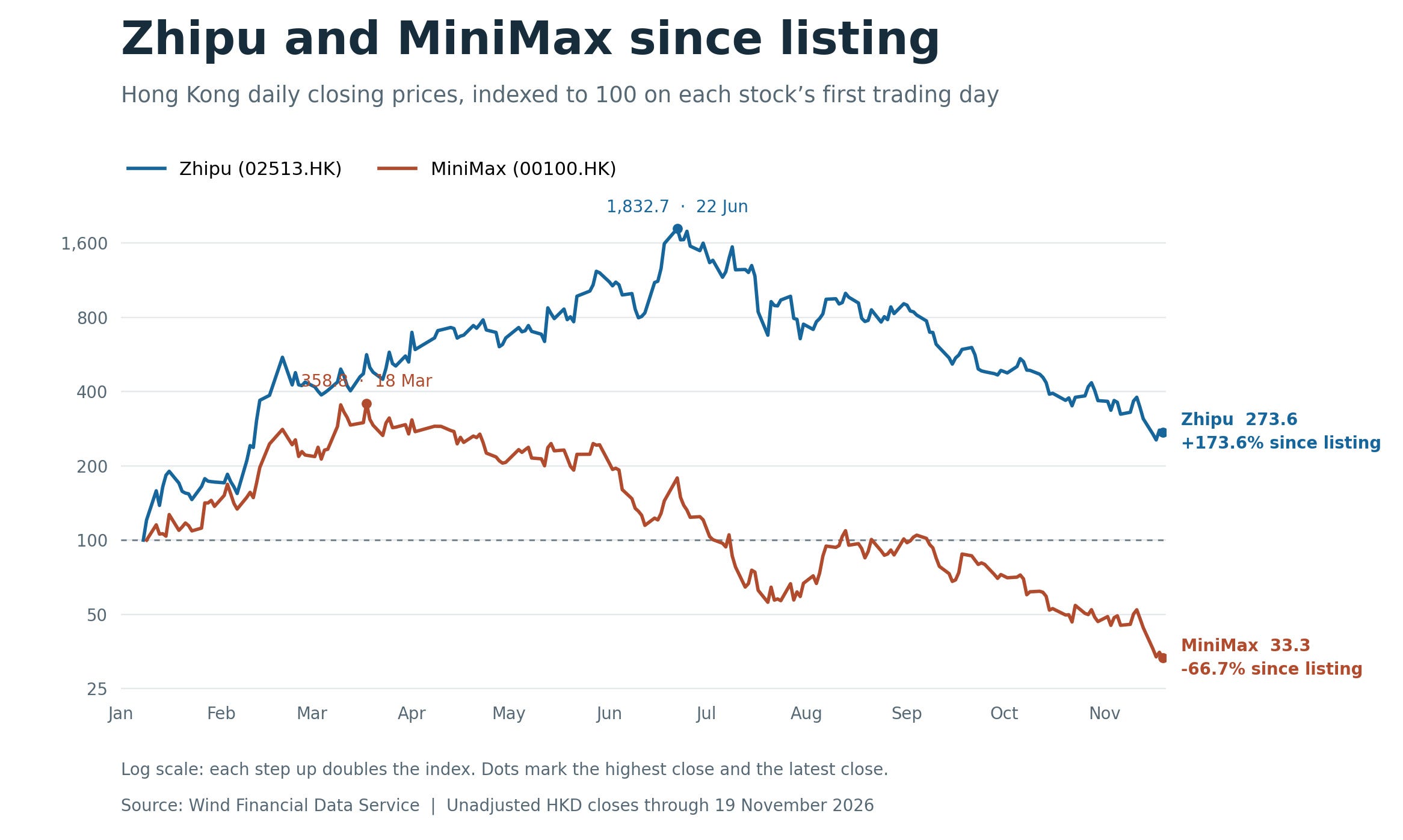
Capital markets are reassessing the long-term value of model developers. That is a signal worth watching.
Investors once had reason to believe that Chinese companies could keep closing the gap with the frontier while spending far less on R&D than their US peers. Even with modest current revenue and profits, steadily improving capabilities appeared to leave enormous room for future monetization and higher valuations.
That assumption is now being shaken.
Without cheap distillation, companies must buy their own computing capacity, build data infrastructure, gather real-world feedback, and run larger training runs and experiments. All of these are long-term, capital-intensive undertakings with uncertain outcomes.
More troubling still, the cost of developing the next generation of models may continue to rise even as durable differentiation between models becomes harder to achieve.
OpenAI and Anthropic also face enormous capital expenditure and uncertain profitability. But they have a larger paying market, a global customer base and the financing capacity of the cloud computing industry behind them.
China’s internet giants, by contrast, face criticism for spending tens of billions of yuan on a food-delivery war whose achievements are hard to identify. By the time they looked up, the competitive landscape had barely changed, but a crucial window for catching up had closed, and vast resources had been wasted.
Independent Chinese model developers often face an even tougher position.
Large internet companies can at least subsidize AI research with advertising, e-commerce and cloud revenue. Even if their model businesses are not yet profitable, they can use AI to improve their core operations, defend their user gateways, and attract more enterprise customers. Independent developers must make the model services themselves pay.
As catching up technologically becomes more capital-intensive, access to capital may itself become a decisive competitive advantage.
China’s model industry could therefore face an increasingly brutal process of consolidation.
Investors may gradually come to recognize an uncomfortable reality:
They once paid a premium for the promise of catching America on the cheap. They may now find that Chinese companies must develop models at costs that increasingly approach those in the United States, while serving a far smaller revenue pool.
For model developers without defensible proprietary technology or dependable cash flow, that may be a more serious problem than a short-term fall in share prices.
To check out China’s latest AI developments and other advanced industries firsthand, you are invited to complete a 2-minute survey for our upcoming Spring 2027 China Tour series. Your interests will help shape our program.