


When we examine China’s consumer market, youth cohorts and the silver economy command the spotlight, while the “post-80s” trapped in the middle are often dismissed by marketers as a generation weighed down by aging parents, young children, and mortgages. Yet they are precisely the ones touching the broadest and most authentic household spending scenarios in China.
In today’s newsletter, we are pleased to share Part I of Cyanhill Capital’s 2026 annual report, The Post-80s: From Carrying the Load to Reallocating the Money. Part I revisits the macro backdrop of the post-80s generation alongside China’s modernization, their high-leverage material realities, and the transitions and inner contradictions they exhibit across career, marriage, parenting, and elder care.
At Baiguan, we are always committed to bringing in experts from all fields to offer on-the-ground insights into China’s shifting landscape. We think Cyanhill is among the best early-stage investment firms in China and believe their perspective provides invaluable clarity on how consumer behavior is evolving across key demographic cohorts.
About Cyanhill Capital: Cyanhill Capital is an early-stage investment firm focusing on the consumer sector, with strong ties to China’s market and innovation ecosystem. As a homegrown venture capital firm, our success stems from autonomous thinking and deductive reasoning—applying deep industry frameworks and targeted insights to identify exceptional opportunities.
At Cyanhill we employ aesthetic systems as our foundational methodology—evaluating founders’ ability to shape brands, define industry positioning, and design business rules as predictors of long-term value. We believe exceptional companies differentiate themselves through aesthetic decision-making in business creation.
If you have a business plan or other inquiries, you can reach out to: bp@cyanhillcapital.com
Cyanhill Capital 2026 annual report
The Post-80s: From Carrying the Load to Reallocating the Money
Understanding a generation entering the second half of life is a key to understanding China’s next stage of consumption
Preface
The post-80s generation has disappeared. At least in today’s public discussion and research, they seem to have vanished.
Few people realize that, among the “post-X” generational labels now in common use, “post-80s” was the first to take off in Chinese public discourse and spark wide debate. It was also an important starting point for the systematic use of “post-70s,” “post-90s,” “post-00s,” and the rest.
The first Chinese cohort to be given a generational label has become the one that gets the least attention today.
Open any consumer report and young people are easy to find. What the post-90s are thinking, what the post-00s like, what Gen Z is paying for: from a cup of bubble tea to a concert, every shift in young people’s behavior is studied. Look to the other end and the silver generation is just as sought after. As the population ages, elder care, healthcare, wellness, travel, and companionship are making the “silver economy” the new growth story.
Caught in the middle, the post-80s seem to be nobody’s concern. The consumer industry even has a half-joking saying: “Don’t sell to the middle-aged.” The reasoning sounds sound enough: they have aging parents above, young children below, and a mortgage of their own to pay.
But precisely because they have parents above and children below, they touch the widest range of consumption scenarios. And over a longer horizon, the factors that suppress their spending follow a clear life-cycle pattern. Their children will largely come of age and become financially independent. Mortgages that have run for years will near their end. Meanwhile, their parents’ generation will reach advanced age and eventually pass away, ending the long-term support relationship, and family wealth will go through a new round of intergenerational transfer.
Over the next decade, one generation’s wealth, time, and attention will all be reallocated.
When a generation’s life cycle overlaps almost entirely with a nation’s modernization, how do those sweeping social changes ultimately land on an ordinary person’s job, family, and bills? How did they become who they are today? Where are they spending their money now, and where will they spend it next? When the AI era and the longevity society arrive together, what will the second half of their lives look like?
With these questions in mind, we began our study of the post-80s.
The Backdrop of the Post-80s
To understand the post-80s, we may first need to go back to when the term first appeared.
From the late 20th century to the early 21st, “post-80s” entered the Chinese public eye. At first it was not a strict demographic concept. It mainly referred to young writers born in the 1980s who were active in literature and online discussion. They wrote about youth and growing up, and also about their discontent with, and rebellion against, the rules of the adult world. The rise of writers such as Han Han and Guo Jingming brought a group that had rarely had a public voice into view, for the first time, as a distinct collective.
Interestingly, “post-80s” was not originally a friendly label. Mainstream society had no experience with this generation, could not read them, and criticized them often. Only children, rising material comfort, the market economy, pop culture, the internet: the environment they grew up in was radically different from their parents’. In the discussions about them, “self-centered,” “rebellious,” “pampered,” and “unable to endure hardship” were once common verdicts. What would a generation raised this way become? Nobody knew.
Between outside scrutiny and the young people’s own self-expression, “post-80s” gradually grew from a literary label into the identity of an entire generation. Afterward, decade-based labels such as “post-70s,” “post-90s,” and “post-00s” gradually entered everyday language. In a sense, the post-80s were not only a generation named by “post-X,” but also the key starting point for that naming practice entering Chinese public life.
This is worth pondering in itself. Why was it with the post-80s that Chinese people began to feel the idea of “generations” so strongly?
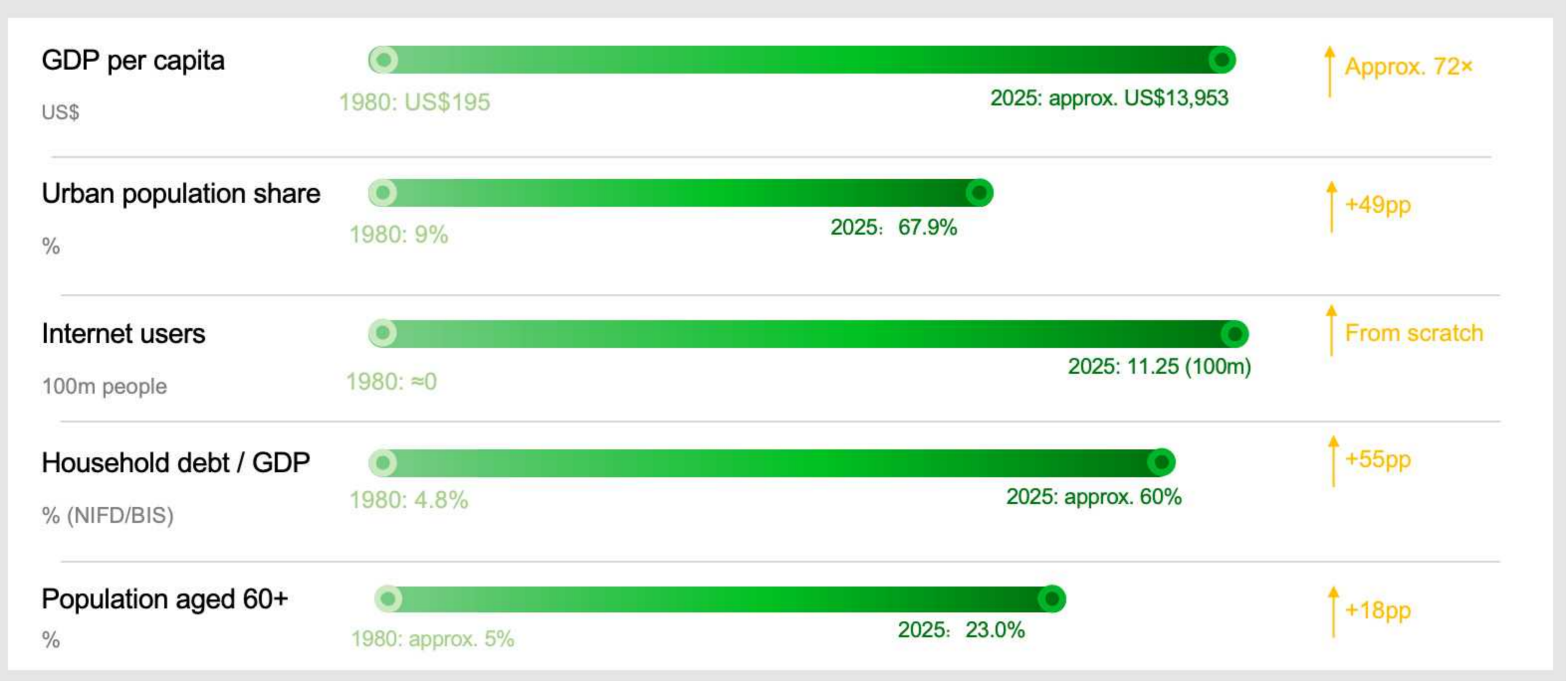
One important reason is that China changed so fast. In 1980, China’s GDP per capita was only about US$195; in 2025, it was nearly $14,000. Urbanization rose from 19% to 67%, internet users from zero to 1.1 billion, household leverage from 4.8% to 60%, and the population aging rate from 4.9% to 22%. Changes that took many countries several generations, China’s post-80s lived through within a single generation.
In a society that stays much the same for decades, people born ten years apart do not necessarily have radically different formative experiences. But post-reform China is not such a society. Economic growth, urbanization, educational expansion, housing marketization, the one-child policy, consumer society, and the internet arrived one after another within a few decades. Ten years was enough to make two cohorts’ childhoods, schooling, work, and family lives completely different. The post-80s stand right at the center of this upheaval, marking the divide between the old generation and the new.
When they were born, China’s reform and opening-up had only just begun. Their childhoods still carried memories of relative scarcity, yet they reached adulthood in a consumer society of abundant goods. As children, many families still lived in the lingering warmth of the work-unit system and acquaintance society; as adults, they faced market competition, population mobility, and the modern workplace. They spent their childhoods in a world without the internet, then became China’s first generation to embrace it en masse. From their parents they inherited values of stability, saving, homeownership, and family duty, while growing up they also encountered individual choice, self-fulfillment, and consumerism on a large scale for the first time.
The forces of the era ultimately settle into individuals. If we look for the shared undercurrents that truly explain this diverse cohort, we see two things first.
In the material world, they are a heavy-asset, high-leverage generation. Housing entered ordinary households’ balance sheets to an unprecedented degree, tied closely to marriage, urbanization, education, and wealth accumulation. The post-80s both caught the asset growth of the property boom and became one of the most deeply involved participants in the housing loan market.
In the inner world, they are a generation of transition and contradiction. Tradition and modernity, family and self, stability and freedom, thrift and consumption: two value systems that do not fully align coexist within them. Many seemingly contradictory choices are not indecision, but the real imprint of a rapidly transforming society on individuals.
A Heavy-Asset, High-Leverage Generation
The post-80s are first of all a “heavy-asset generation” in the macro sense. This does not mean every post-80s person owns substantial assets. It means their coming of age coincided with the period when China drove growth through fixed-asset investment and large-scale infrastructure. The costs of that infrastructure expansion were largely passed on to this generation through the housing system, shaping their heavy-asset character.
In 1988, the Shanghai–Jiading Expressway, mainland China’s first expressway, opened. The oldest post-80s were only eight. Over the following three-plus decades, China went through an infrastructure expansion rare anywhere in the world.
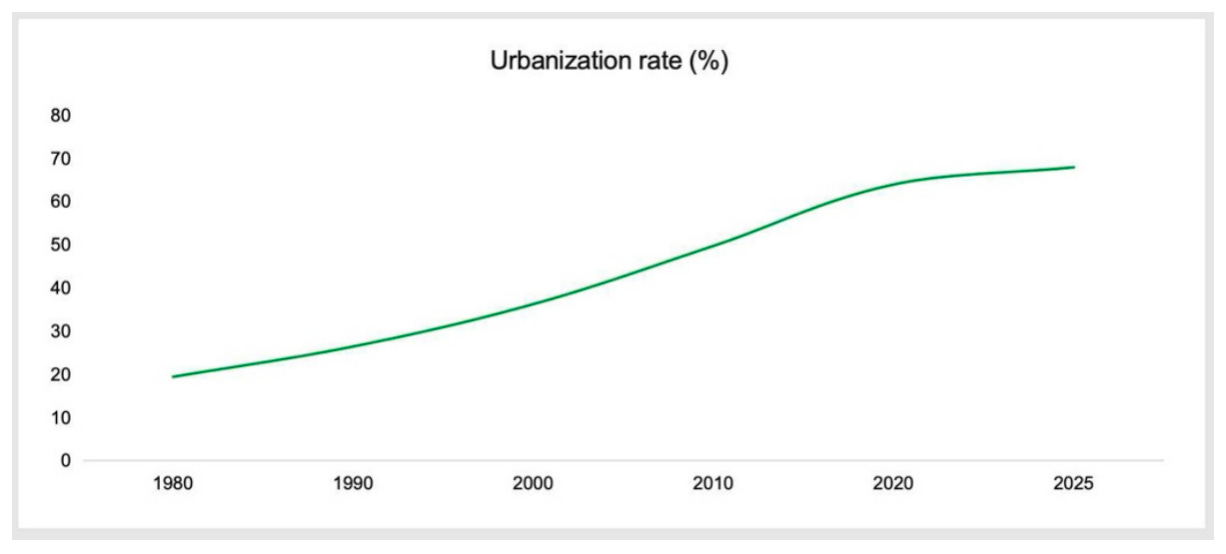
China’s urbanization rate rose from 19.39% in 1980 to 67.89% in 2025, meaning hundreds of millions of people moved from countryside to town, and from small towns to big cities, within a few decades. The post-80s’ life trajectory is embedded in this spatial restructuring. As children, they may have known dirt roads, open-air toilets, coal briquettes, and public phones; as adults, they are used to subway commutes, high-speed rail, mobile payments, and instant delivery. Many started out in county towns, townships, and villages, entered cities through education and work, then bought homes, married, and had children there. They are the most typical migrants of China’s urbanization.
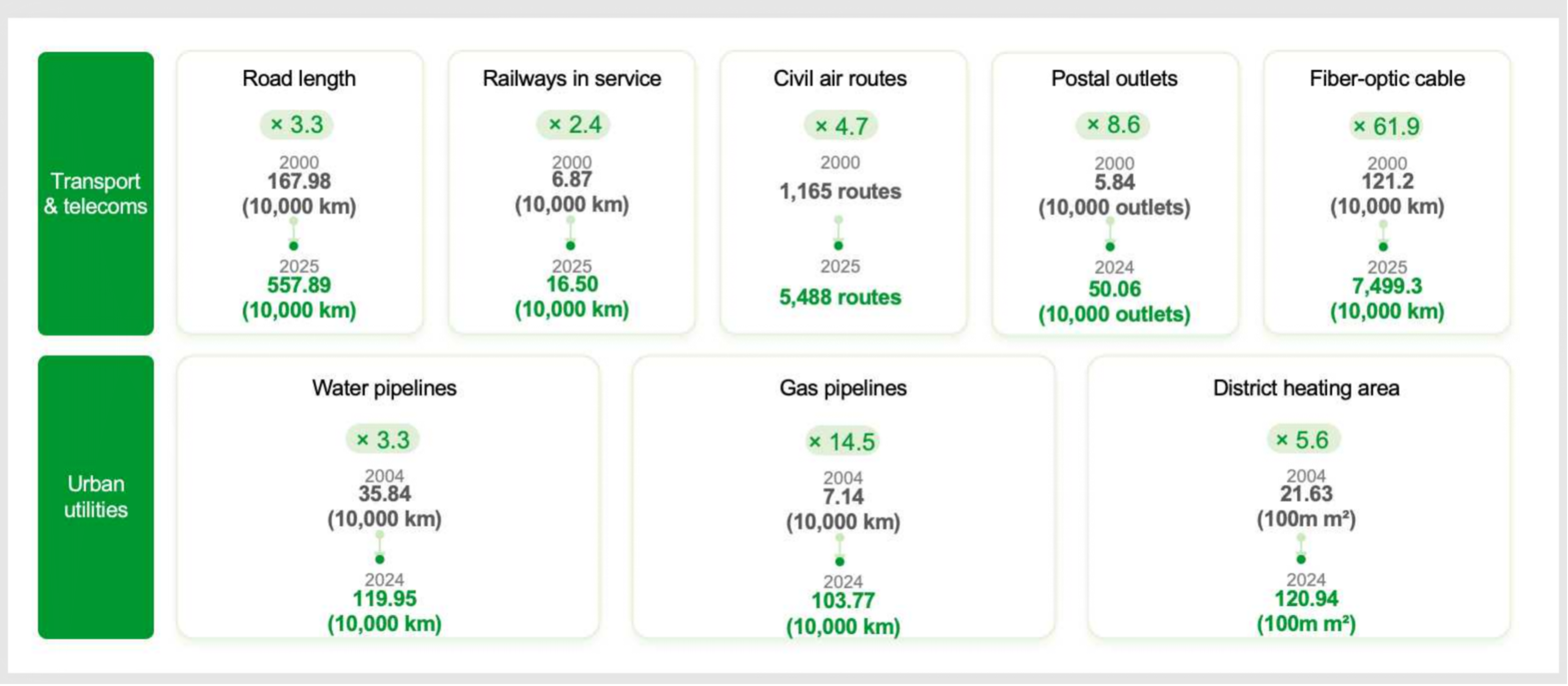
First, the radius of human mobility has widened. From 2000 to 2025, China’s total road length grew from 1.6798 million km to 5.5789 million km, 3.3 times the original. Railway mileage rose from 68,700 km to 165,000 km. In 1980, China had only 181 civil aviation routes; by 2025 there were 5,488, 30.3 times as many.
Second, the circulation capacity of information and goods has leapt. Total optical cable length rose from 1.212 million km in 2000 to 74.993 million km in 2025, 61.9 times the original. Postal outlets increased from 58,400 in 2000 to 500,600 in 2024. Meanwhile, a vast network of unseen urban utilities was laid underground. From 2004 to 2024, total water supply pipeline length grew 3.3-fold and natural gas pipelines 14.5-fold. From 2000 to 2024, centrally heated area grew 10.9-fold. Over these two decades, urban water access and gas coverage reached 99.6% and 98.6% respectively

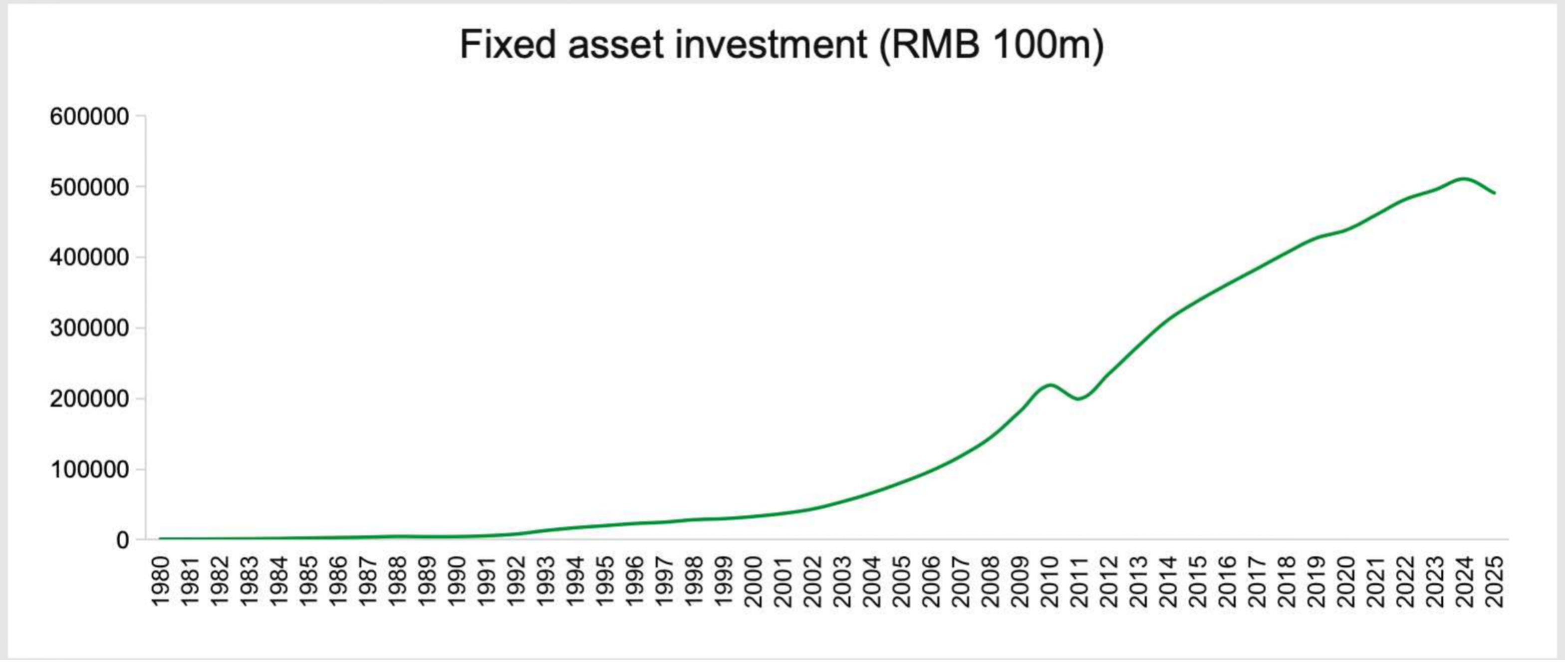
Behind this large-scale urban construction lay decades of massive capital investment. In 1980, China’s total fixed-asset investment was only 0.091 trillion yuan. By 2000 it had reached 3.29 trillion yuan, and by 2025, 51.10 trillion yuan. In nominal terms, annual fixed-asset investment grew 560-fold between 1980 and 2024.
Since the late 1990s, land sales, real estate development, and infrastructure investment have gradually formed a mutually reinforcing cycle. Local governments raise funds through land sales and land-backed financing, and put them into roads, rail transit, municipal facilities, and land development. Improved infrastructure then lifts surrounding land values and housing prices, setting the stage for the next round of urban expansion.
This development model, built on large-scale investment and land development, supplied the funding and space for China’s urban expansion. It also changed how the costs and benefits of public facilities are distributed. Although infrastructure is a public good, its costs did not fall evenly on everyone. They were passed on disproportionately to households that entered the housing market during the expansion phase.
In short, China’s heavy-asset model of modernization landed on the post-80s generation in the form of high leverage. According to estimates by the Chinese Academy of Social Sciences, China’s household leverage ratio rose rapidly from under 10% in 2000 to 60.6% in 2021, roughly a sixfold increase in just twenty years. Research shows that mortgages account for more than two-thirds of the increase in household debt in a given period, and the post-80s were the core group of homebuyers in this round of mortgage-fueled leveraging.
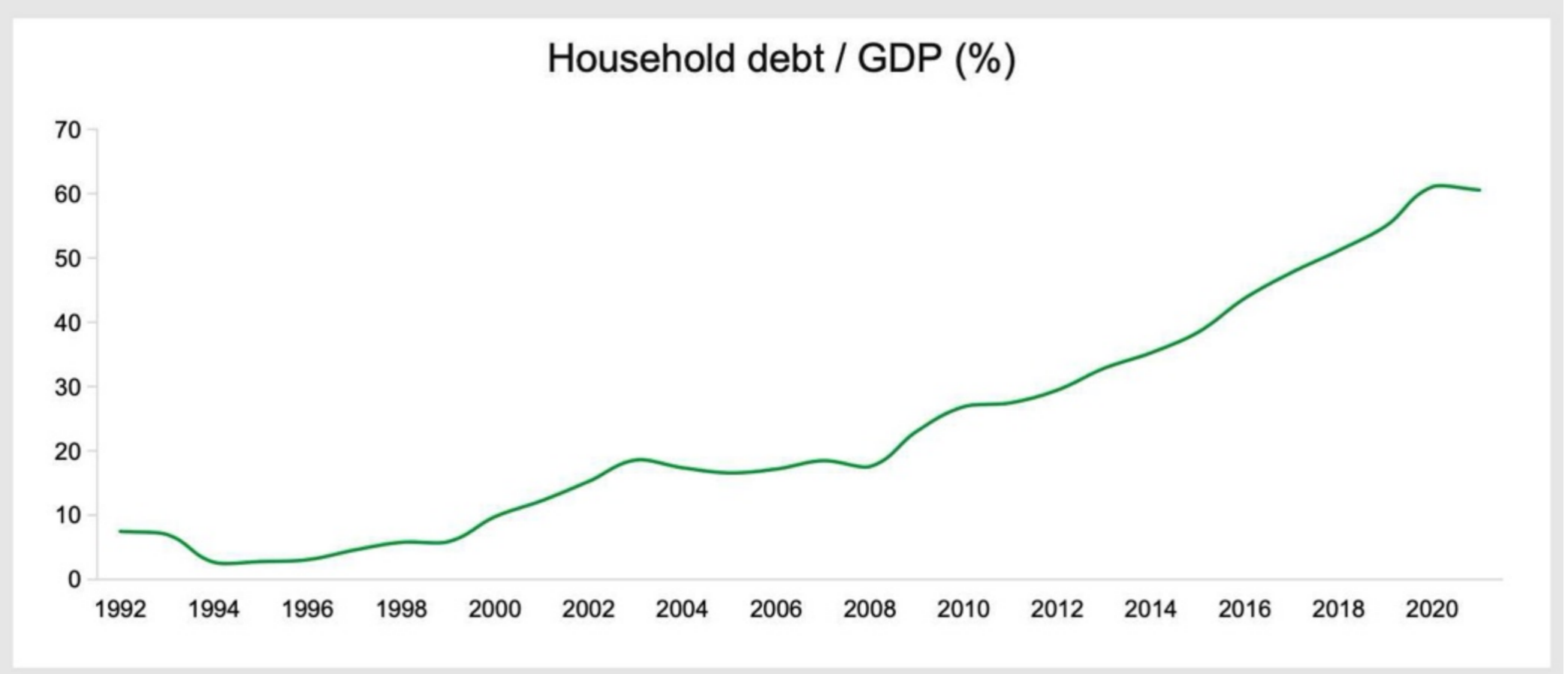
The post-80s were both beneficiaries of the urban infrastructure dividend and major bearers of its costs. When welfare housing allocation largely ended in 1998, the oldest post-80s had just turned 18. Around 2003, when the property market entered a phase of rapid growth, the first post-80s began working. After 2008, they entered the age of marriage, childbearing, and homebuying in large numbers. After 2015, they became the main buyers of both first homes and upgrade homes.
In 2003, China’s commercial housing sales totaled about 337 million square meters in floor area and about 795.6 billion yuan in value. By 2021, sales area had reached 1.614 billion square meters, 4.8 times the 2003 level, and sales value had reached 17.02 trillion yuan, more than 21 times as much. Value grew far faster than area, which means buyers were paying for more than just more housing: they also faced a markedly higher cost per unit of housing.
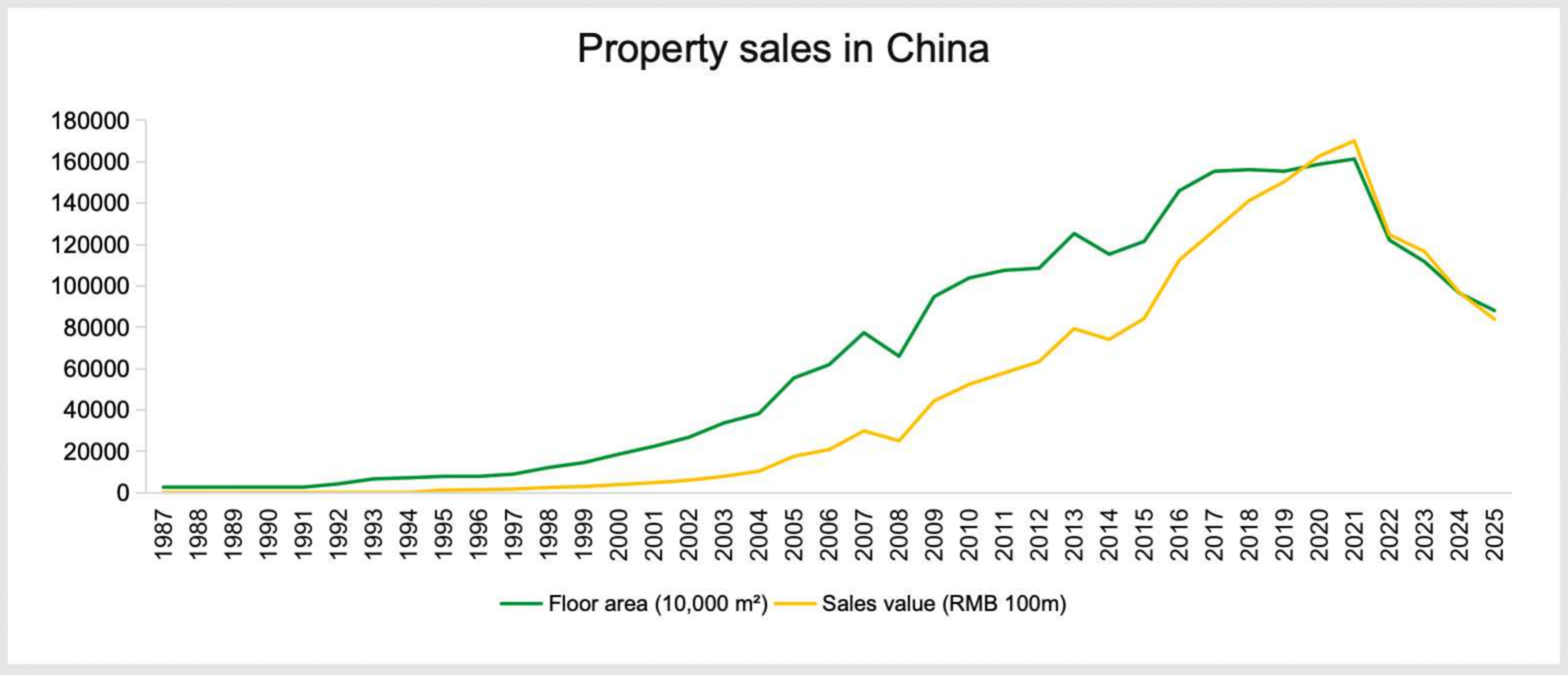
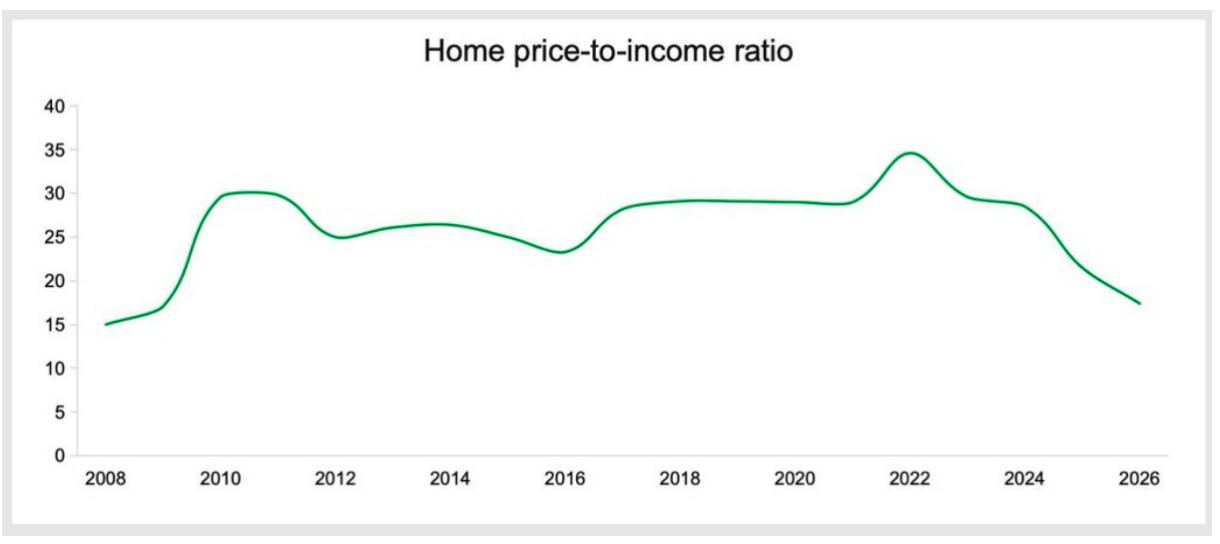
Some of the post-70s benefited from welfare housing allocation or the low-price window in the early years of housing marketization. By the time the post-90s began buying homes in large numbers, the property market had already entered a phase of high prices, large inventory, and slowing growth. Only the post-80s lived through the whole arc: the end of welfare housing, the expansion of the commercial housing market, the spread of mortgage credit, and the peaking of household leverage. Within that arc, they made their first home purchases and, in part, their upgrade purchases. The post-80s were the largest core group in the nationwide wave of credit-fueled homebuying, and took on housing debt with little choice. For this reason, we define them as the high-leverage generation.
According to China Merchants Securities’ estimates based on China Family Panel Studies (CFPS) survey data, post-80s households spend an average of 107,300 yuan on mortgages. That is 1.7 times the 62,400 yuan of post-70s households and 2.1 times the 50,000 yuan of post-60s households, yet average savings are similar across the three generations. For post-80s households, mortgage spending reaches 106% of savings, well above 59.9% for the post-70s and 54% for the post-60s. Their savings rate is 56%, which is 10 percentage points lower than the post-70s and 31 points lower than the post-60s.
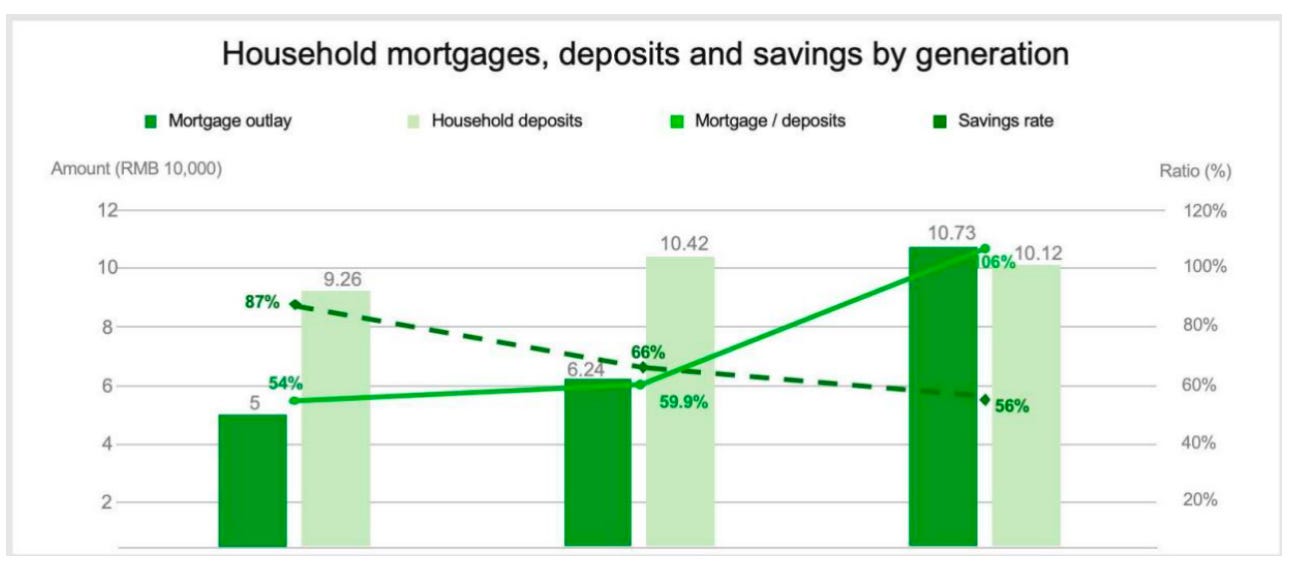
The post-80s’ “high leverage” is not just about larger mortgages. It lies in the stronger squeeze that housing costs put on household liquidity and new savings. The post-80s built family assets through homebuying, but they also face longer and heavier cash-flow constraints as a result.
In short, China’s heavy-asset model of modernization landed on the post-80s generation in the form of high leverage. China’s ultra-large-scale infrastructure and urban expansion relied on the land and housing markets to shift costs onto society. Having lived through the property market’s boom years in full, and having completed marriage, childbearing, and homebuying in a concentrated window, the post-80s naturally became a generation weighed down by burdens, with assets tied up in property and tightly constrained cash flow.
A Generation of Transition and Contradiction
If heavy assets and high leverage shaped the post-80s’ material circumstances, then rapid social transformation shaped their inner world.
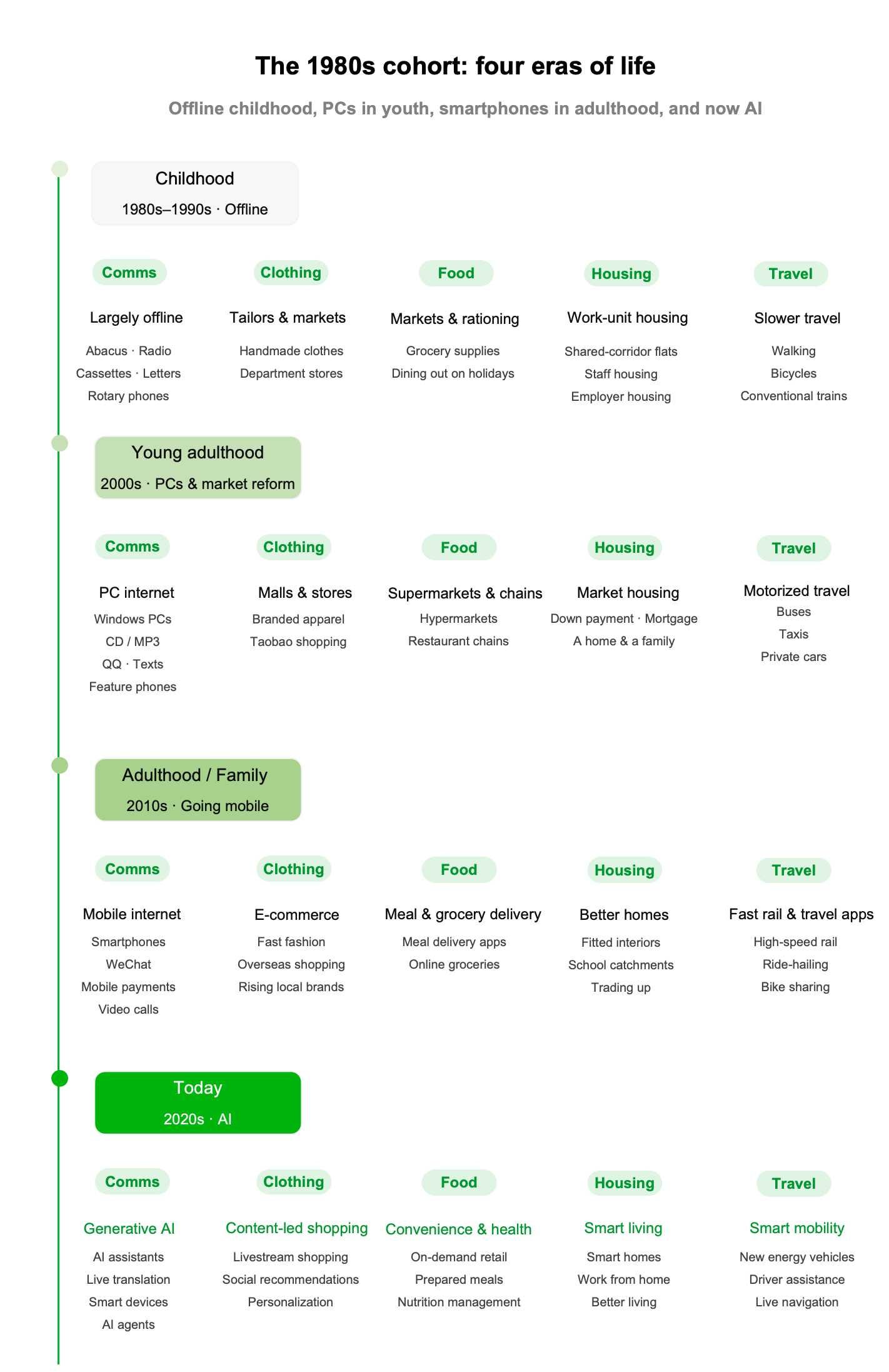
What makes the post-80s distinctive is not only that they lived through more change than other generations, but that much of it came while their values were still taking shape. As children, they were taught a set of ideas about stability, obedience, the collective, and delayed gratification. As adults, they entered a society that stresses competition, mobility, efficiency, and individual choice. From their parents they inherited the ethic of responsibility of the traditional family, and from the market economy and internet culture they gained a sense of individuality. They believe that buying a home, marrying, and raising children are necessary stages of life, yet they have also begun to ask whether a marriage is happy, whether a job is worth it, and whether life must follow a set sequence.
The old standards have not fully withdrawn, and the new ones have already taken effect. Old responsibilities still have to be met, and new needs cannot be ignored. These two sets of rules, layered on top of each other, form the sharpest contradiction in the post-80s.
Career: Expanding Opportunity and Intensifying Competition at Once
The post-80s were the first large-scale beneficiaries of the mass expansion of higher education in China. In June 1999, the central government decided to greatly expand university enrollment. That year, regular college admissions rose 47% year on year, and China’s higher education accelerated from elite to mass education. Since then, the gross enrollment rate has kept rising, and more children from ordinary families have been able to enter cities, professional jobs, and the modern corporate system through university.
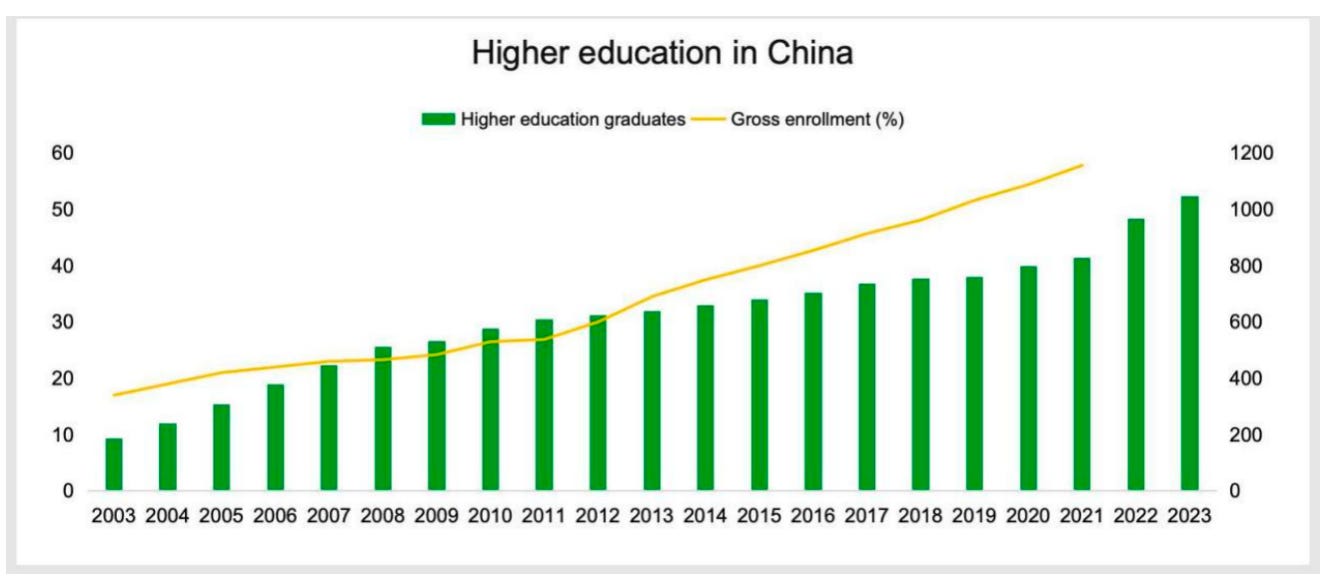
Educational expansion opened the door to career advancement, but it also quietly changed the rules of competition. As a university degree went from a scarce credential to a hiring threshold, the advantage it conferred began to diminish, and competition moved toward higher degrees, stronger skills, and more work experience. The post-80s believed that “knowledge changes destiny,” and were also the first to find that a degree alone was no longer enough to secure a stable job with steadily rising returns. They enjoyed the opportunity dividend of mass education, and also bore the competitive cost of its spread.
At the same time, the first half of their careers coincided with the job expansion driven by marketization, urbanization, and the internet economy, while the second half has begun to meet slowing growth, organizational restructuring, and shifting employment logic. Career difficulties that once surfaced mostly in workers’ forties or fifties have been pulled forward by the market to around age 35. Age cutoffs, promotion bottlenecks, layoff risk, and the pressure of finding new work have made the post-80s the first market-employed generation to face the “Chinese-style midlife career crisis” in large numbers.
The technological revolution has amplified this tension. In 1997, China had only 620,000 internet users; by 2025, there were 1.125 billion, including 602 million users of generative AI. The post-80s are not digital natives, yet they lived through the full succession of the offline era, the PC internet, the mobile internet, and AI. They entered each new wave of the economy by learning and adapting, and had to prove themselves again with every technological turn. This condition of “growing experience, constantly changing rules” is an important feature that sets the post-80s apart from earlier generations.
Marriage: Traditional Expectations and Awakening Individuality at Once
The post-80s’ marriages show a tug-of-war between traditional values and individual autonomy. As the only-child generation, they are bound by society’s traditional expectation to settle down and build a career, yet they also place greater weight on emotional compatibility within marriage.
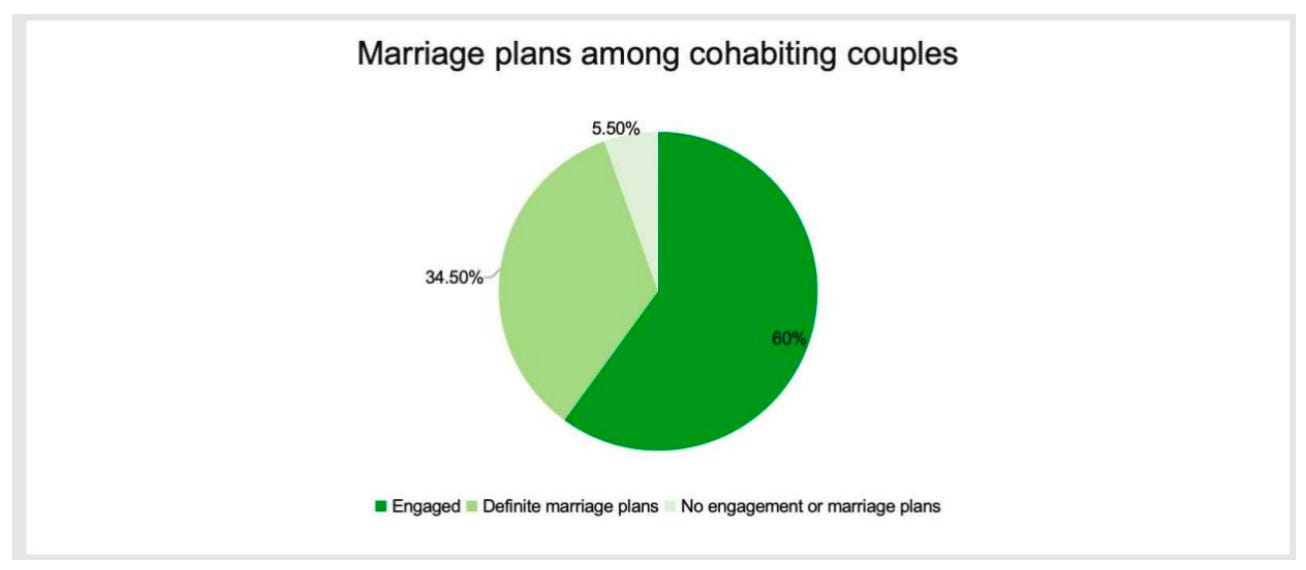
According to the Fudan Yangtze River Delta Social Transformation Survey (FYRST), modern courtship behaviors such as premarital cohabitation are fairly common among the post-80s. More than 40% of post-80s respondents had cohabited before marriage, but 60% of them were already engaged, 34.5% had clear plans to marry, and only 5.5% were neither engaged nor planning to marry. They have accepted more modern forms of intimacy, yet their end goal is still mostly marriage.
The post-80s’ choice of partners shows a similar pattern. According to FYRST, marriages between families of matching background (门当户对) remain the mainstream. Nearly half of post-80s respondents met their spouse through an introduction, mostly by elder relatives or parents. Only 5% said they could fully accept a “naked wedding” (marrying without a home, a car, or a ceremony). Yet within actual marriages, 83% of wives have as many years of education as their husbands or more. The outer framework of traditional marriage remains, but gender relations and standards of equality inside marriage are changing. The traditional “gradient marriage” (wife less educated than husband) is declining, while highly educated “homogamy” (spouses with equal education) and female “marrying down” (husband less educated than wife) are rising.
The post-80s were the first generation to pursue individual happiness within the traditional marriage system. They no longer readily accept their parents’ view that marriage is just “pooling resources to get by,” yet it is hard for them to opt out of marriage entirely, as younger generations do. Their individual consciousness has awakened, but family responsibility has not gone away. Marriage is both a source of emotional support and a possible source of pressure.
Parenting: Raised in a Hands-off Manner, Raising Children Carefully
Many post-80s had a markedly hands-off childhood. Their parents were busy working, and they organized their own lives at school, in courtyards, and on the street. Families cared most about food and warmth, and rarely discussed child psychology, parent–child communication, or nurturing interests in any systematic way.
But when the post-80s became parents themselves, their standards changed. They began to pay attention to nutrition, educational methods, emotional development, and time with their children, hoping to avoid repeating what was missing in their own childhoods: understanding and room for expression. The Fudan survey shows that more than 75% of post-80s parents still value traditional qualities such as honesty, politeness, filial piety, and a sense of responsibility. But some give less weight to obedience and to “having to be a good student,” and prefer to give their children relaxed, self-directed room to grow.
Progressive ideas have not eased real-world pressure. Having benefited from breaking through by way of education, post-80s parents are deeply convinced of its value and hold high expectations for their children’s schooling. They generally pursue refined, high-quality education, and have become a core group in society’s “education involution” and “hyper-parenting” (鸡娃) competition.
This means the post-80s’ careful parenting comes from both changing views of education and the push of competition for resources. They want their children to grow freely, but worry that too little investment will cost their children opportunities. They want to reduce their children’s stress, but still have to plan schools, courses, and paths to higher education. Behind “raised loosely, raising children carefully,” the parental role has been upgraded from basic caregiver to education planner, emotional supporter, and resource organizer.
Elder Care: Responsibility to the Older Generation, Lower Expectations of the Next Generation
Elder care shows most clearly how the post-80s are squeezed between traditional responsibility and modern ideas, with the pressure running in one direction only.
The post-80s are the generation most affected by the one-child policy, and in cities especially the “4-2-1” family structure (four grandparents, two parents, one child) has become reality. Compared with earlier generations who had several siblings, their elder-care duties are harder to share within the family. Compared with younger generations who more often delay or forgo marriage and children, they have generally already entered the “aging parents above, young children below” family structure.
The Fudan survey shows that nearly 90% of Shanghai’s post-80s believe that, as children, they should take responsibility for caring for their parents in old age, so traditional filial piety has not disappeared among them. In the same survey, only about 20% of respondents said they wanted to live with their parents, yet nearly two-thirds actually do. High housing costs, the need for childcare support, and the burden of elder care force them to keep close family cooperation even as they pursue independence between generations.
When they think about their own later years, the post-80s are more independent. They are less likely to see having more children as old-age security, and unwilling to leave their later years entirely to their children. They are beginning to accept savings, insurance, community services, and elder-care facilities. Toward the older generation, they still follow “children have a duty to support their parents.” Toward the next generation, they no longer wish to emphasize “raising children to provide for old age.”
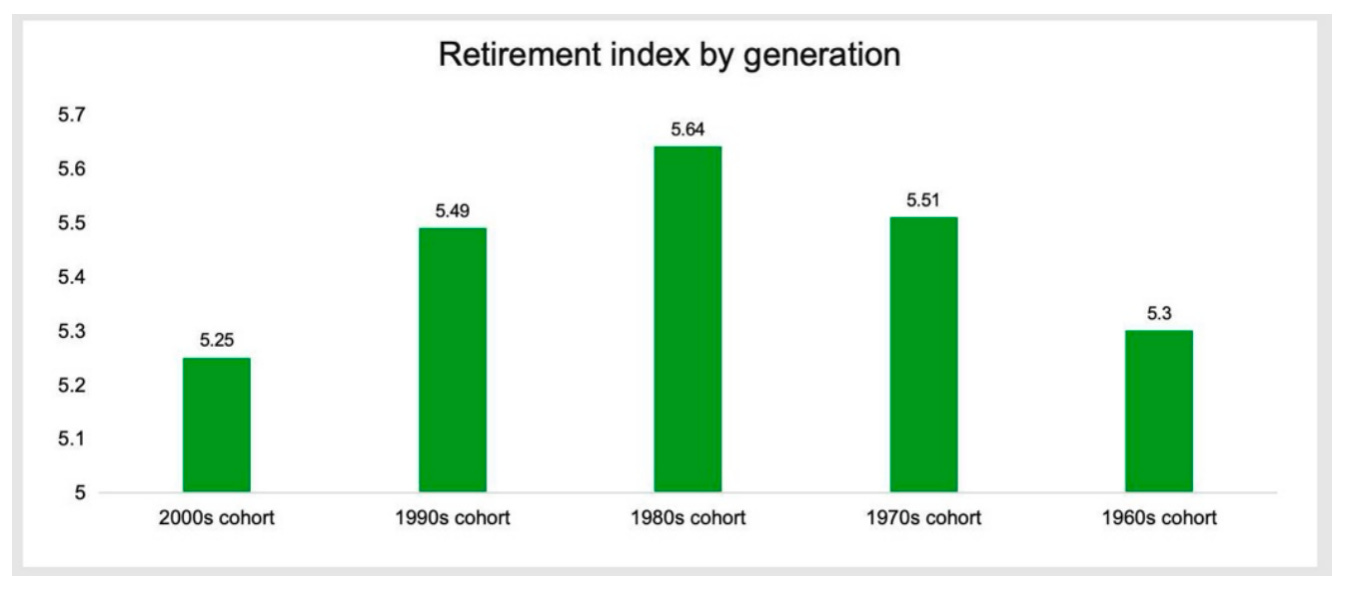
According to the 2025 China Residents’ Retirement Readiness Index Survey Report, the post-80s score 5.64 on the retirement readiness index, well above other generations.
(The retirement readiness index is a weighted score of retirement-responsibility awareness, understanding of financial planning, ability to understand financial issues, completeness of retirement plans, adequacy of retirement savings, and confidence in obtaining the expected income. It reflects residents’ overall level of retirement readiness.)
The post-80s did not directly end family-based elder care. They bore the cost of switching elder-care models themselves. They must look after their parents, try not to burden their children in the same way, and prepare for their own later years in advance. Responsibility for the older generation, care for the next, and finally arrangements for themselves make up the most typical responsibility structure of this generation.
The post-80s are the generation of “old and new rules layered together” in China’s social transformation: while their values were still taking shape, they absorbed two logics that pulled against each other. This contradiction runs through four dimensions of their lives. In careers, they benefited from university expansion and the internet dividend, but were also the first to meet degree devaluation, the age-35 career bottleneck, and the repeated need to prove themselves across technological shifts. In marriage, they keep the traditional framework of matching family backgrounds and marriage as the destination, yet have begun to ask about emotional compatibility and gender equality. In parenting, they were raised loosely, but because they escaped through education themselves, they have become the mainstay of “careful parenting” and “hyper-parenting involution,” torn between wanting their children to be free and fearing they will miss opportunities. In elder care, as the only-child generation in the “4-2-1” structure, they stand alone between the generations: toward the old, they uphold filial duty and work closely with family; toward the young, they give up “raising children for old-age support” and turn to savings and socialized elder care. With old responsibilities not yet shed and new needs already here, the post-80s, squeezed from both directions, have borne the transitional cost of change in China’s family and social models.
Heavy assets and high leverage are the post-80s’ material foundation. Transition and contradiction are the inner structure built on that foundation. The former determines how much money they have to spend; the latter shapes the order in which that money is spent. Together they form the backdrop of the post-80s and give a starting point for understanding their consumption choices today and the shift in their future bills.


