


Shanghai has always sold a particular idea of living well. Walk Julu Road or Anfu Road on a Saturday, and you see it in the small details: linen jackets over sneakers, old plane trees over coffee queues, windows dressed like someone actually lives behind them. Chinese people still call that mood 小资 (xiaozi), the city’s petit-bourgeois taste for atmosphere, soft light, and clothes that look considered without looking loud. I have always joked with friends that every time I go to Shanghai, it is almost impossible not to blow through a month’s budget. The city keeps inventing new reasons to spend.
Fashion and OOTD culture run through the blood of many Shanghainese—it’s how they make a statement and find meaning in daily life. The boundless variety of styles never fails to leave people in awe: regardless of your personality or fashion statement, you can always find your own stage on the streets of Shanghai. No wonder a wave of indie and designer brands has taken root here.
Recently, a Shanghai-born German Army Trainer (GAT) brand called Pane caught my attention as it went viral on overseas social media. Pane has already become a “must-buy” for many foreigners in the few short years since its founding in 2022. Ironically, it remains a small, emerging name at home, even largely flying under the radar for many locals who aren’t particularly into fashion.
I think behind Pane’s success lies a story about how a younger generation of founders in China now thinks differently, and how international aesthetic sensibilities show up from day one. At Baiguan, we’ve covered many stories about how China moved from garment factories to domestic brand power that can challenge foreign names. Today, let’s explore the other side of the coin: Chinese brand power is now evidently emerging in overseas markets as well.
How Pane became a “must-buy” destination for the “China Haul” trend
On Yongyuan Road in Jing’an district in Shanghai, the line outside Pane often forms before the store looks busy. Shoppers wait for numbered slots. Many already know which silhouette they want. Staff have told local reporters that foreign visitors can account for roughly 30% of foot traffic and 35% of sales on ordinary days at some Shanghai doors, and higher on holiday peaks.
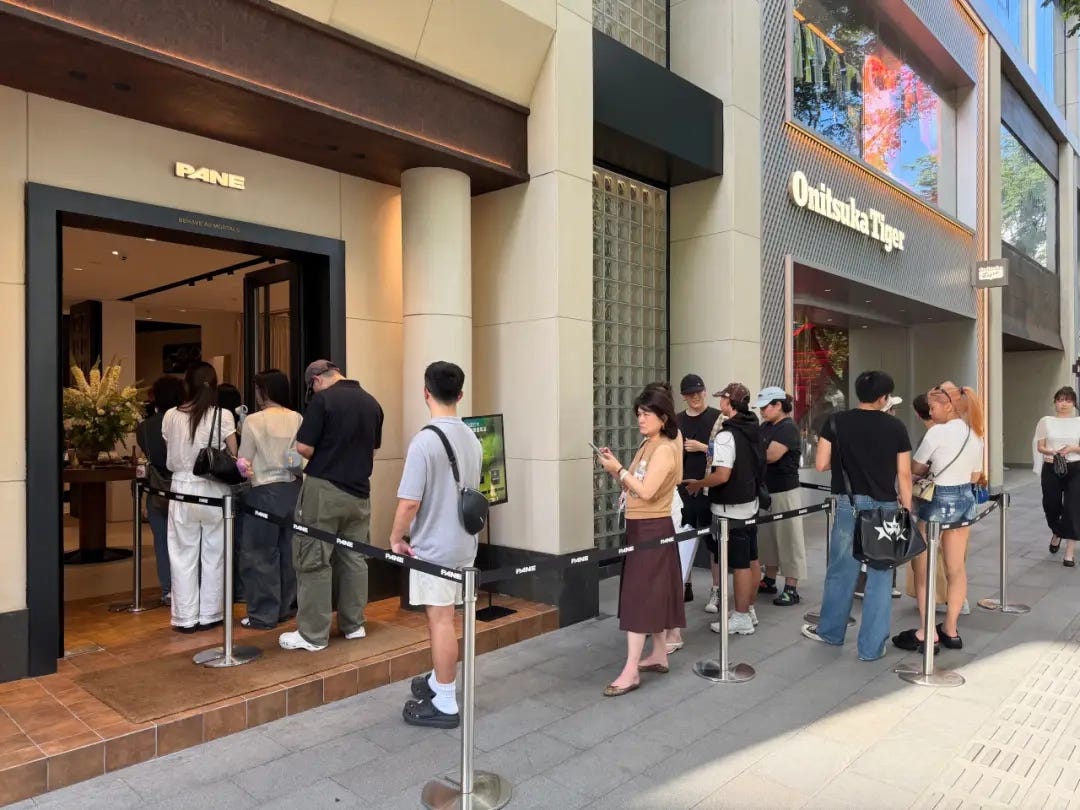
I dropped by Pane’s store in Sanlitun, Beijing, on a Tuesday evening, and the crowd size lived up to the hype: the room was filled with both foreigners and locals—not something you’d typically expect to see on a workday evening.
The overseas heat came first. Pane’s Instagram read like a fashion magazine archive: deconstructed German Army Trainers with dress-shoe finishing, and almost no logo shout. British GQ and Hypebeast quickly picked the brand up. In 2025, United Arrows, Japan’s influential select-shop group, restocked Pane repeatedly. Being kept by a buyer system is a quality judgment few young Chinese labels earn quickly.
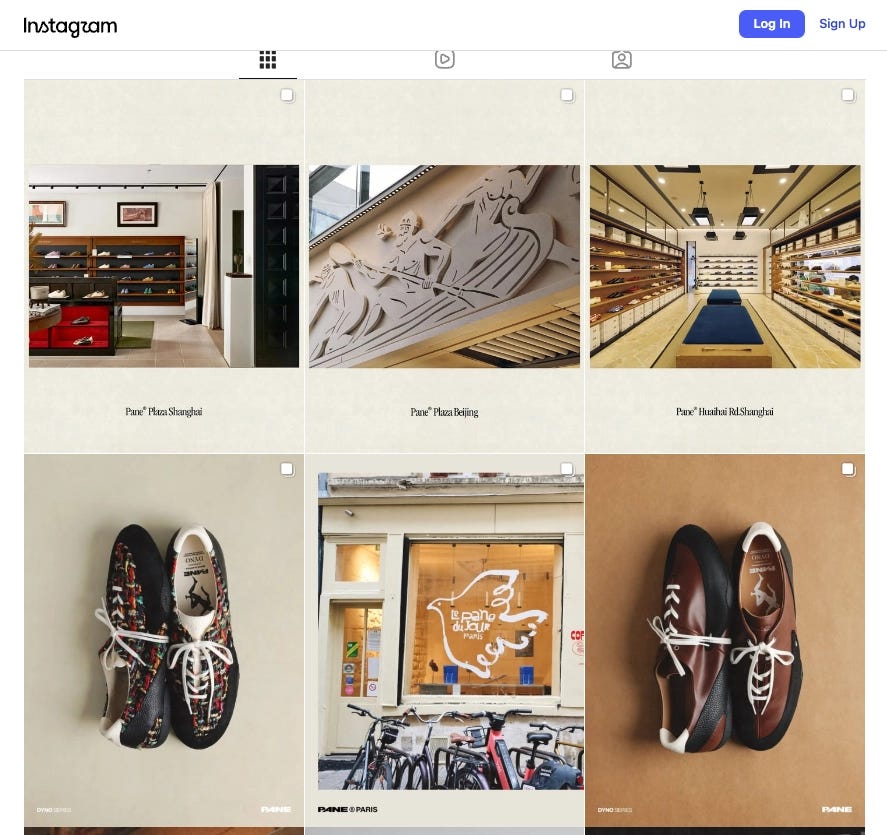
Surprisingly, Pane’s product sits inside a crowded category. German Army Trainers have been everywhere for years, from military surplus references to Onitsuka-adjacent city sneakers.
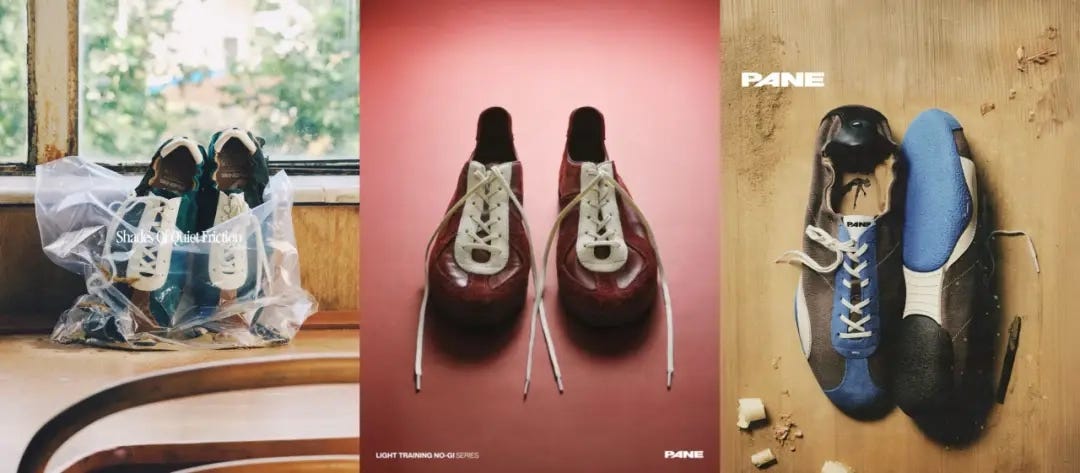
Pane made its name by treating the GAT like menswear rather than like a logo sneaker: the breakout Light Training NO-GI rebuilds the shape with dress-shoe finishing, quieter proportions, and almost no branding noise. The variety of colorways offers plenty of personalization, meaning shoppers who already own a GAT still have a reason to buy a pair from Pane.
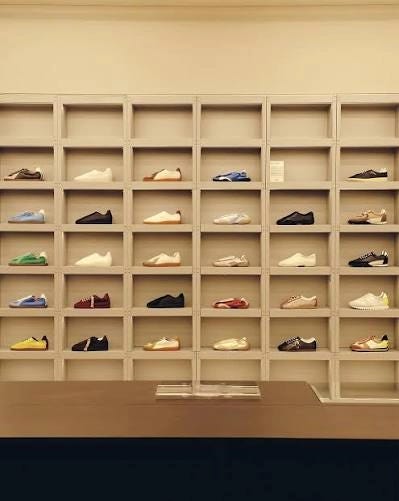
Walking into Pane’s store feels like stepping into a vibrant color palette (they display items much like On Running does). Many designs feature bold combinations by mixing textures (e.g., pairing leather with suede) and contrasting colors, yet they remain tasteful enough for everything from everyday wear to business-casual occasions.
I personally bought a pair, and they are really comfy. The wall of colorful shoes in their store makes it hard to resist buying a couple more. What really surprised me was how effectively their marketing reaches male consumers—a group that is generally much harder to sell to. (I first heard about the brand from my boyfriend, who normally cares zero about fashion. I think that’s truly remarkable.)
Despite the design variety, the pricing is straightforward. Most shoes are priced between 800 and 1,000 RMB ($120–$150), and the immediate psychological effect is that consumers can focus on selecting their favorite design rather than comparing prices, which lowers the barrier to purchase.
The pricing works well both ways: for foreigners visiting China, the $120–$150 price range (plus tax refunds) means they can enjoy designer-level quality on a fast-fashion budget, making Pane a popular destination for foreigners amid the broader “China Haul” trend. For domestic consumers, Pane offers an affordable way to make a fashion statement without paying 3x to 5x the price for a luxury label (e.g., Maison Margiela, one of the go-to names in the GAT category).
Pane’s overseas social media following rose from just over 30,000 in September 2025 to more than 140,000 by June 2026. A global site launched around late 2025 and ships to the US, EU, UK, Japan, Korea, and Southeast Asia, usually about 30% above China prices. The Hypebeast interview put the strongest international audiences in Japan, Bangkok, and the United States, with a first overseas shop planned for Thailand.
It’s quite remarkable to see a Chinese consumer brand commanding a price premium in overseas markets, especially since almost all exports, however strong, win over foreign markets through competitive pricing rather than brand power.
The young founders who think in two markets
The founder behind Pane is Chen Ning. He was a finance bro before he built the bespoke menswear label Full Monty in 2015, then turned fully to shoes seven years later, in 2022.
A decade of menswear discipline shows up in the finishing: proportion, material, and how a rebuilt German Army Trainer, the Light Training NO-GI, sits next to ordinary city clothes. In the Hypebeast interview, the team described its target as consumers aged 25 to 45, with a women-oriented intent, even though its early Instagram following was heavily male on their own account, around 70-80%.
Domestically, its commercial path started on WeChat mini-programs and moved to Tmall in 2023. Since the brand was founded, Pane hasn’t taken the livestreaming price-war path that many other brands are now inevitably involved in. Most recently, Pane has moved into pop-ups and themed shops across Shanghai, Beijing, Shenzhen, Hangzhou, Guangzhou, and Shenyang.
Pane is by no means the only successful domestic indie brand. In fact, in recent years, a wave of indie brands has come out of China and won the overseas market. For instance, we covered another example in 2024:

Chen’s cohort tends to assume that a shoe must hold up next to Tokyo or Copenhagen references from the start. That is a different founder type from the prior generation that often treated brand as a domestic marketing layer on top of manufacturing capacity.
Many of the recent successful brands were born in Shanghai.
Shanghai’s street culture rewards that instinct. It trains founders to care about all the fine details that make a design work. They first focus on crafting an interesting and tasteful aesthetic—the proportions, the store atmosphere, even how a product looks dappled under the shade of plane trees—long before they ever write an overseas expansion business plan deck.
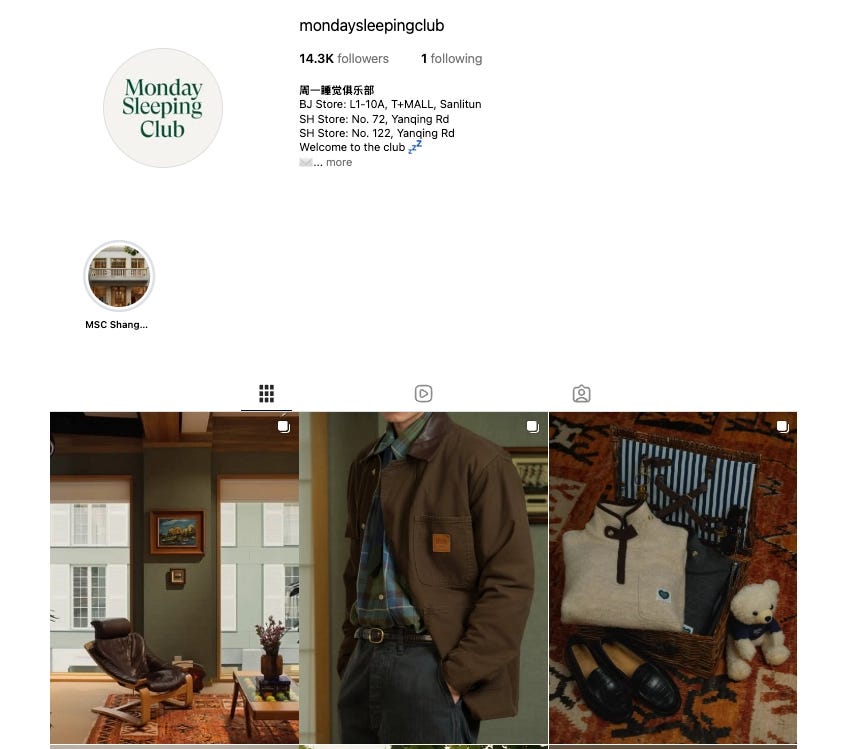
Monday Sleeping Club is another emerging brand that was born in Shanghai. The founder, Zhao Mo, previously built MYGE, one of the earlier Chinese streetwear labels, starting in 2007.
Monday Sleeping Club flipped weekday stress into a calmer joke: Mondays are for sleeping. Its Shanghai doors and 2025 W Hotels capsule (”Sound On. Mind Off.”) reveal another type of founder—people who already lived inside youth culture, then built a brand with a clearer lifestyle thesis and globally resonating vocabulary.
Looking at these young founders, I think a pattern starts to emerge: they understand two markets, knowing both how to do business at home and how to speak the brand language that resonates with global consumers.
From “guochao” at home to brands that travel abroad
Previously, we covered many stories about how “Guochao,” or “China chic,” won over domestic consumers with traditional design elements and heritage motifs made wearable for Chinese city life. For instance, Songmont is a strong example of that path: utilizing landscape and architecture to help Chinese shoppers feel that a bag carries cultural heritage and challenges foreign logos for Chinese wallets.

But looking at the rising indie brands that first won over the overseas market, a different pattern emerged: they don’t look “Chinese” at all.
