


This is the second guest writing piece by China Engine Room, longtime friend of Baiguan and a C-level executive at a top healthcare company in China with a career of more than 2 decades spanning healthcare, internet platforms, and AI in China. He writes about biotech, advanced manufacturing, and AI in his Substack.
We helped him translate and edit this piece, originally written in Chinese.
My family is from Weihai, Shandong Province. Both of my parents grew up in one of the area’s well-known fishing villages. Education and the national college entrance exam carried them into civil-service jobs and a local middle-class life, but they kept some of a fisher’s skills and equipment, including a boat. When they went out to sea, the catch was more than food. It was the best gift they could send their children and a direct expression of love.
Of all catches, eel ranked above all. In the past, when the family caught one, they were often reluctant to eat it. Good eel went mainly to Japanese buyers and had obvious cash value. Sending one to a child was a serious gesture. We tasted the fish, but also the scarcity behind it: the sea, the season, human skill and luck.
Years later, “鳗鱼饭eel rice” was easy to find on Weihai’s streets. A fish once considered too valuable for the family table, and often destined for Japan, had become a bowl of rice sold in shopping malls and neighborhood restaurants.
RedCan’s 2025 report on Japanese dining in China described eel rice as a niche category gaining attention. As of March 2025, China still lacked a national leader in this sector, but regional specialists had emerged, with representative brands operating more than ten outlets. Videos tagged “eel rice” had accumulated 820 million views on Douyin, while Xiaohongshu carried roughly 340,000 related posts. Earlier industry reports said domestic eel consumption at one point rose by more than 50% year on year after the pandemic, and that one Shanghai specialist sold more than 400 bowls a day. Clearly, eel is moving from an expensive item on Japanese menus toward a restaurant category that can sustain specialist shops and regional replication.
The change looked ordinary, but it rested on an industrial system.
Eel became an everyday restaurant dish because many unglamorous links matured together, not because of one miraculous invention. The relevant unit here is not a fishing village, but the chain from glass eels and grow-out ponds, processing plants, cold storage, and finally to exports and domestic restaurants.
Commercial eel farming has not closed the full loop from reproduction to grow-out. Farms still begin with wild-caught glass eels or elvers, then raise them in ponds or indoor systems. But what China’s experience shows is that China’s industrial capacity connects the parts that engineers can improve. Scarce juvenile eels encourage farms to raise survival rates. Inventories and cold storage can buffer volatile output. Processing can turn fish of different sizes into standardized products.
Sauerkraut fish took a similar route earlier. Boneless fillets of consistent size, including basa, worked with central kitchens and standardized seasoning packs to make the dish easier to reproduce across outlets. Tai Er, part of listed company Jiumaojiu (9922.HK), later became a national brand.
And this industrialization of eel farming is nationwide. Although Weihai and nearby Rongcheng have deep fishing traditions, China’s eel industry today extends far beyond Shandong. Fujian, Guangdong and Jiangxi also have large farming, processing and export bases. Fujian has long been important in eel aquaculture, grilled-eel processing and exports to Japan.
Dams, eldercare robots and caviar
Yichang of Hubei Province is usually associated with the Three Gorges Dam and Gezhouba. They belong to a monumental phase of Chinese industrialization: organizing water, electricity, navigation and construction along the Yangtze, then converting a natural drop in elevation into dispatchable energy and transport capacity.
What struck me in Yichang also operated at a smaller scale. While there, I visited an eldercare institution where I found a Fourier Intelligence companion robot. Fourier says it began with rehabilitation robotics and now serves more than 2,000 institutions and hospitals across more than 40 countries and regions. [Baiguan note: Fourier was also one of the robotics companies we visited during our last Baiguan China Tour.]
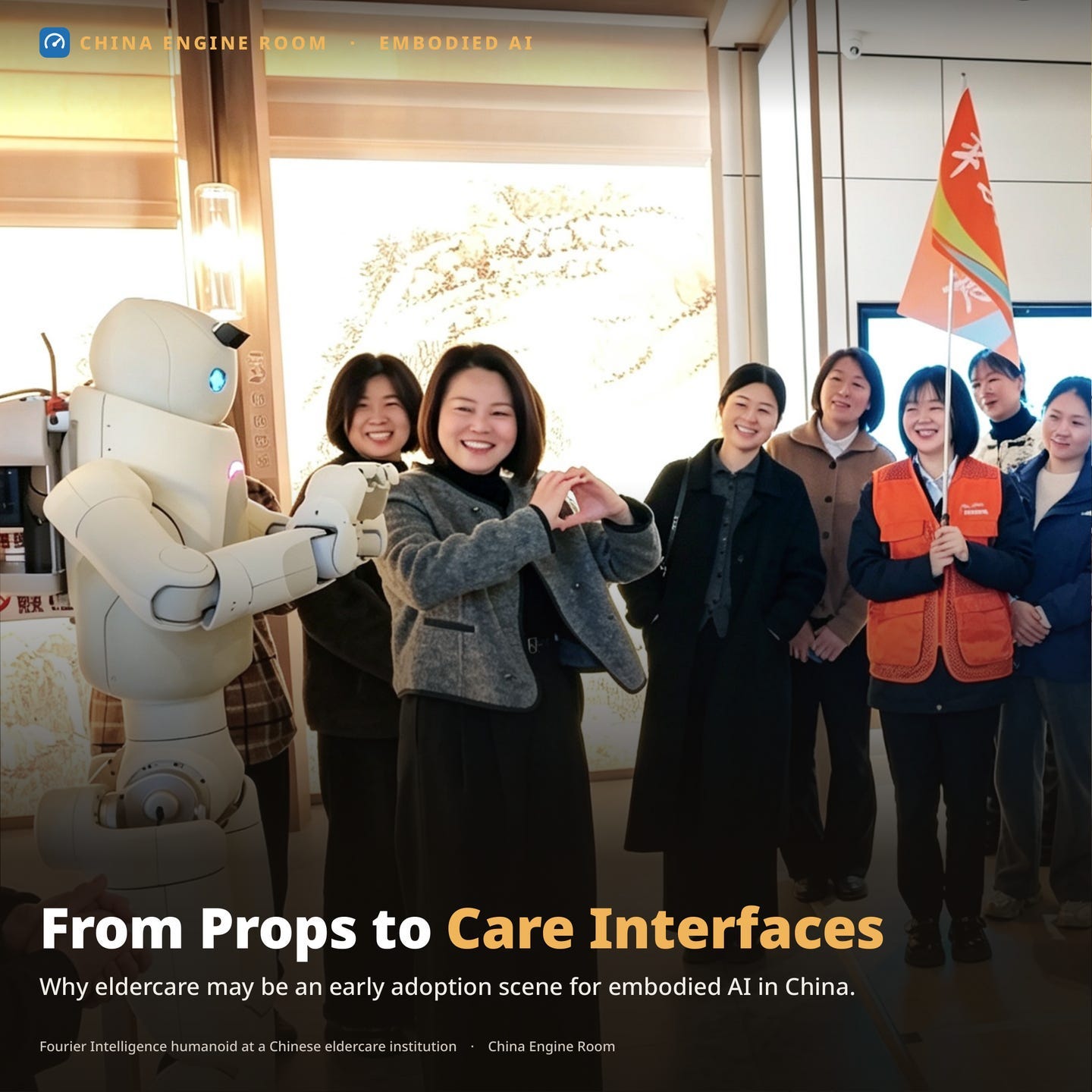
I previously argued that, although most embodied robots in China remain toys and exhibition pieces, eldercare institutions may be an early entry point for embodied AI.
At the care center, residents and staff are already willing to treat the robot as part of the service environment. Not that it could already provide full care for older people. But its value as a companion to residents is being warmly felt.
While we were still absorbed by the robot, staff served high-grade caviar as a local specialty and told us, to our great surprise, that Yichang had become an important center for caviar farming and processing.
The juxtaposition was hard to miss. One city is home to giant water dams, an eldercare robot and a food once reserved for luxury tables, all at once.
Caviar begins with sturgeon. The fish grow slowly and prefer cold, flowing, stable water. Supply once depended more heavily on wild waters, low temperatures and years of waiting. Industrial aquaculture breaks the problem into variables that can be monitored: temperature, water quality, dissolved oxygen, feed, the age structure of the stock, processing temperature, hygiene certification and cold-chain transport.
Net cages, purpose-built pools and container-like recirculating systems keep sturgeon in more stable cold-water environments. Electricity powers aeration, water circulation, monitoring, processing and refrigeration, approximating some conditions of cold, moving natural water. Public materials I saw describe age cohorts designed to maintain a stable supply. A Yichang municipal report this year said daily caviar output was about 200 kilograms and that orders for the first half were fully booked.
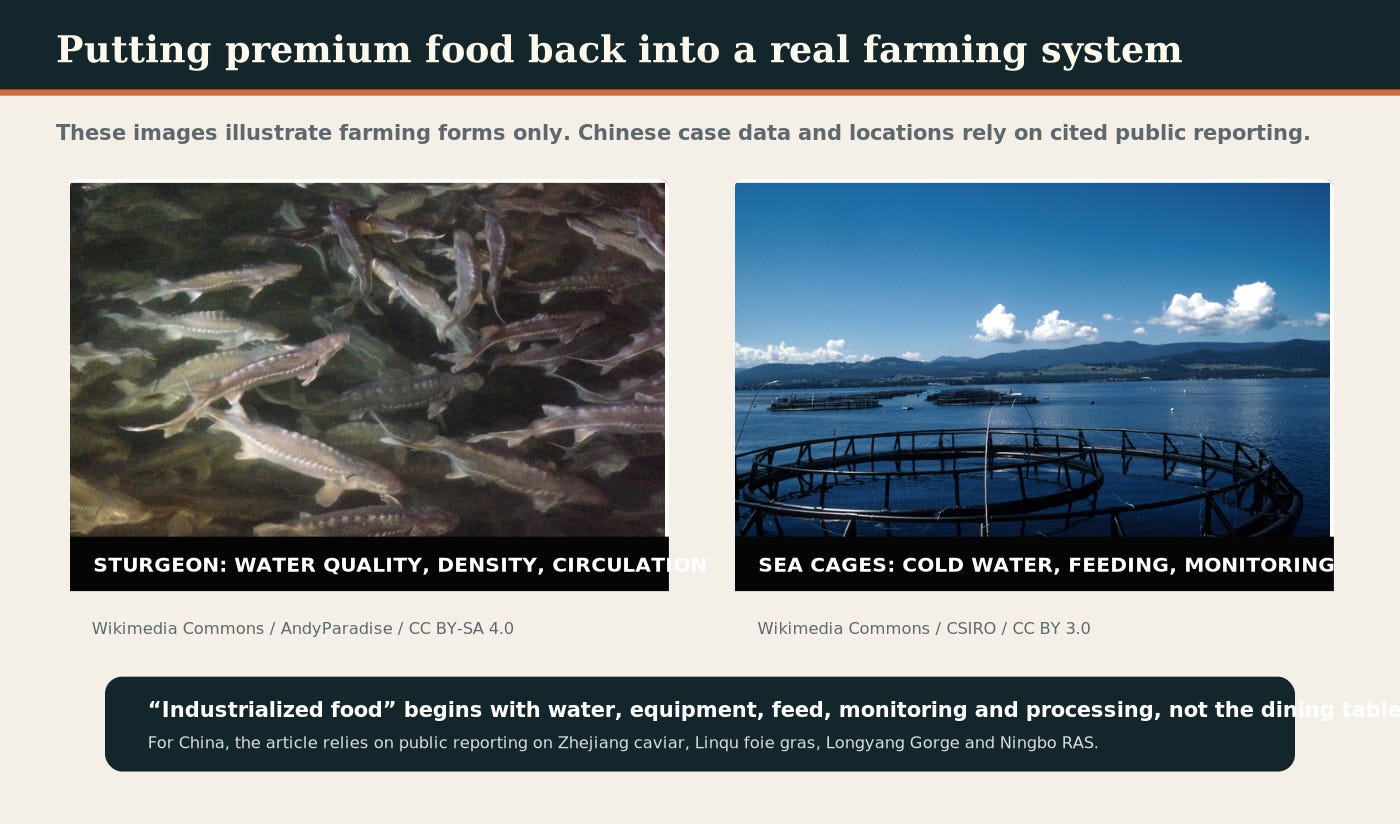
Caviar remains expensive. It has not become an everyday condiment. But its scarcity now comes from a different mix of constraints. Supply depends less exclusively on wild catch and chance, and more on farming cycles, facility capacity, processing, electricity and refrigerated logistics. Once production is divided into stages that can attract investment, depreciate and expand, costs have room to fall.
The Three Gorges, eldercare robots and caviar share a method. A dam manages water and power. A farm manages water quality and biological time. A care institution manages attention and human time. The objects differ, but each problem is being divided into equipment, processes, standards, and trackable data.
Industrializing healthcare into a fulfillment system
Healthcare has long faced an “impossible trinity”: good doctors, low prices and easy access are difficult to provide at the same time. I examined that tension in my first article at Baiguan, China may attain healthcare’s Holy Grail: cracking the “impossible trinity”.
In healthcare, I see the same pattern that I observe in eel and caviar: industrialization turns premium products and services into parts of a system that can be scheduled and connected.
Large imaging machines, domestically produced CT and MRI systems, centralized procurement and import substitution have lowered the cost of capabilities that were once expensive and spread them to more hospitals.
Online consultations, pharmaceutical e-commerce and home delivery connect work once scattered across hospital counters, pharmacies and patients’ waiting time.
Ant Group’s Afu Health offers one example of an AI health entry point: public reports put monthly active users at about 30 million and daily health questions at about 10 million by January 2026.
JD Health shows the scale of online healthcare and pharmaceutical retail, and Meituan’s on-demand pharmaceutical retail shows how platforms, pharmacies, courier networks and payment systems are reorganizing fulfillment.
Services once tied to doctors’ time, patients’ waiting, physical counters and pharmacy inventories are being split into entry points, models, medical records, payments, inventories, delivery and follow-up.
People remain central, but repetitive search, documentation, movement, and preliminary screening now run through devices, servers, terminals, and delivery networks.
Civilization runs on energy
Economic activity is conventionally divided into three sectors. Primary industry extracts or grows natural resources. Secondary industry transforms those resources into manufactured goods. Tertiary industry provides services.
This taxonomy tells us what an industry produces. It says less about how production is organized.
For that, I find another lens more useful: the extent to which a society can use energy and engineering to make its output controllable, repeatable, and scalable.
Seen through this lens, China’s three sectors are undergoing what I call a “三合一three-to-one convergence.”
I do not mean that agriculture and services are literally being reclassified as manufacturing, or that farmers and caregivers are becoming assembly-line workers. I mean that primary and tertiary industries are increasingly adopting the operating logic of secondary industry: standardized inputs, specialized equipment, repeatable processes, measurable outputs and logistics organized at scale. And all logic is rooted in energy, the first principle underpinning all human‑production activities.
The eel farm, the caviar producer and the healthcare platform therefore belong to the same story.
Aquaculture remains a primary industry, while healthcare remains a service. But an eel farm seeking higher survival rates, a sturgeon farm managing water quality and age cohorts, and a healthcare platform coordinating consultations, pharmacies, payments and delivery all increasingly resemble production systems. Their formal classifications differ, but the method by which they overcome constraints is converging.
Energy is what makes this convergence possible.
Scarce land creates pressure to produce more from each unit of land or water. Scarce labor creates an incentive to transfer repetitive work to machines. Biological variability is managed through pumps, sensors, temperature control and cold storage. Distance is overcome through warehouses, refrigeration and transport networks. Waiting time is reduced through software, servers and delivery systems.
In every case, a constraint once borne primarily by nature or human labor is partially converted into demand for equipment, organization and energy. Circulation pumps, processing lines, robots, servers, warehouses and transport networks may look unrelated, but ultimately they all appear as electricity and equipment costs.
This is the central fact of industrial civilization. The more constraints a society can reorganize in this way, the more energy it must be able to mobilize, and the more reliably it must be able to deliver that energy where it is needed.
Soviet astronomer Nikolai Kardashev once proposed classifying civilizations according to their command of energy. The science-fiction rankings matter less here than the intuition behind them. Energy use is not merely an outcome of development. It determines how much of the natural and human environment a civilization can bring within the reach of engineering.
China’s power system shows the scale of this transformation. According to the Our World in Data Energy Dataset, China accounted for less than 10% of global electricity generation in 2000, but roughly one-third by 2024, well ahead of the United States, the European Union, India and Japan.
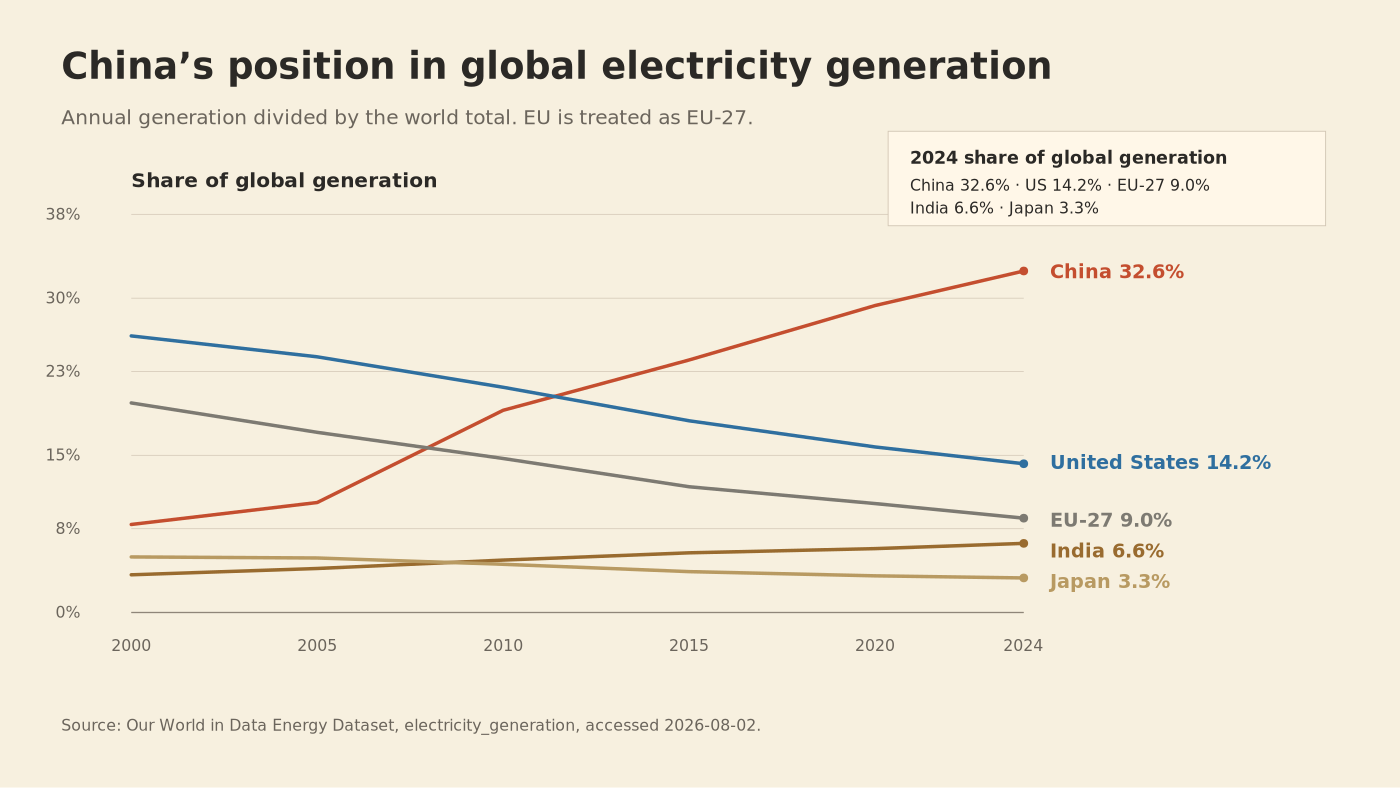
This enormous power system does not support only steel mills, chemical plants and car factories. It also runs aquaculture systems, cold chains, warehouses, hospitals, robots, servers and delivery networks.
China is not merely industrializing manufacturing, but is extending industrial methods into agriculture and services.
Yichang makes the connection visible. The Three Gorges Dam and Gezhouba wrote energy engineering into the landscape. Caviar production and eldercare robots bring the same engineering habit into agriculture and services.
The dams do not directly produce caviar or robots. The connection lies in the capabilities accumulated over decades: building infrastructure, manufacturing equipment, training engineers, managing complex processes and directing energy at scale. The sturgeon farm and the eldercare institution are smaller expressions of the same industrial logic that built the dams.
Industrialization does not abolish every constraint. Eel farming still depends on wild-caught juveniles. Sturgeon still take years to produce roe. Eldercare robots remain immature. But industrialization changes the character of these constraints. Problems once accepted as scarcity, chance, distance or unavoidable demands on human time become variables that can be measured, managed and gradually improved.
Lower prices and more storefronts are the visible results. Underneath them, natural resources, manufacturing equipment, energy networks and service processes are being connected into a single production system.
That is what I mean by “three-to-one convergence”: three sectors in economic statistics, but one increasingly industrial logic running beneath them.
As Laozi, one of the most famous philosophers in the world, said in his great work Tao Te Ching: “The Dao generates the One, the One generates the Two, the Two generates the Three, the Three generates all things.”
Here in modern China, the Dao is energy, and through engineering, it generates all the products and services that we need.
Keep thinking and writing, China Engine Room! I enjoyed this
The steps that the west had stumble painfully through are being implemented much more consciously in China.