


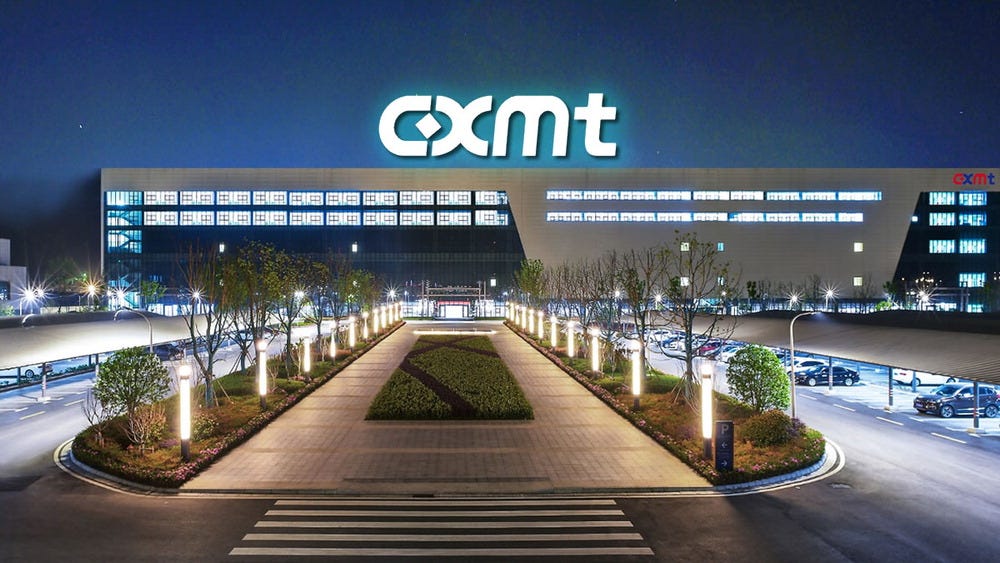
On July 15, ChangXin Memory Technologies, better known as CXMT, is scheduled to begin book-building for what may become China’s largest semiconductor IPO. Investor subscriptions will follow on July 16. The company plans to raise RMB 29.5 billion, or about US$4.3 billion, to upgrade its DRAM production lines and develop new memory technologies.
The arithmetic at the point of issuance is almost misleadingly modest. If CXMT raises RMB 29.5 billion by selling roughly 10% of its post-IPO equity, the deal implies a valuation of around RMB 295 billion. Yet the company’s prospectus estimated that its 2026H1 profit would reach between RMB 66 billion and RMB 75 billion. If we take the median, annualize it, and apply a multiple of only 6-8 times, we would place the company’s value somewhere around RMB 800 billion to RMB 1200 billion, which would still be only ~1/7 the size of SK Hynix or Micron.
The A-share market may go much further. CXMT would give domestic investors their only listed large-scale Chinese pure-play DRAM manufacturer, a strategic semiconductor asset, and a scarce way to gain exposure to the memory boom. The Financial Times reported analyst estimates of a post-listing valuation as high as RMB 3 trillion. That would put CXMT among the largest A-share companies, if not the largest.
The timing could hardly be better. AI has driven demand for high-bandwidth memory and server DRAM, while the established manufacturers have shifted more capacity toward those higher-margin products. That has tightened the supply of conventional DRAM used in PCs, phones, and ordinary servers, exactly where CXMT is strongest. Tencent has reportedly signed a multiyear supply agreement worth nearly US$3 billion, giving CXMT something a commodity-market entrant rarely enjoys: a large domestic customer and several years of demand visibility.
In a previous Baiguan article about CXMT, we argued that the company was not yet a black swan for Samsung, SK Hynix, and Micron. It was a gray rhino. Its technological gaps in HBM and advanced server memory remain real, but its approach has been visible for years and is now too large to ignore.
This article is about the city behind that gray rhino.
A government that invests like a venture capitalist
The “Hefei model” is often described as one unique form of China’s industrial policy. Its most distinctive feature was for the government to act as an equity investor.
The playbook works roughly like this. The municipal government identifies an industry with strategic value and finds an anchor company at a critical point in its development. City and development-zone entities take a large equity stake. The government then coordinates land, infrastructure, bank financing, and supplier recruitment around the anchor. If the company succeeds, the city gains a new industrial cluster while its investment vehicles gain valuable shares. Financial returns, experienced personnel, and political credibility can then be recycled into the next project.
The three canonical cases are BOE, CXMT, and NIO, although each represents a different version of the model.
BOE already existed when Hefei made its first large bet on the display-panel maker in 2008. The city helped finance and attract a sixth-generation LCD production line at a time when BOE needed huge amounts of capital, and China remained dependent on imported panels. The bet eventually made Hefei a center of China’s display industry.
CXMT was closer to a company that Hefei helped create. When the DRAM venture was launched in 2016, Hefei-backed capital reportedly provided RMB 14.4 billion of the first phase’s RMB 18 billion funding. The city supplied capital and facilities, then helped build a cluster of packaging, testing, gas, materials, and equipment suppliers around the fab. The technology and management did not come from the municipal government. They came from Zhu Yiming and GigaDevice, former Qimonda engineers, acquired intellectual property, and international DRAM expertise. Hefei’s contribution was to assemble these ingredients and give them time.
NIO was a rescue-and-localization investment. In 2020, when the electric-vehicle maker was close to running out of cash, Hefei-linked strategic investors agreed to put RMB 7 billion into NIO China. NIO moved its China headquarters to Hefei and placed its core China assets in the local entity. The deal saved the company at a critical moment and strengthened Hefei’s EV cluster. Whether NIO will become a durable, profitable company remains unsettled, so it is better treated as a successful rescue than as a finished industrial triumph.
SemiAnalysis calls the CXMT story “The Patience of State-Venture Capital” (emphasis our own):
Hefei’s state-venture capital could afford to lose money for a very long time. Unlike a private venture-capital fund answerable to LPs that expect a return on a fixed timetable, Hefei’s state-venture capital, ultimately backed by the city’s municipal and development-zone state entities, faced no such clock. They kept funding a company that, even after turning its first annual profit in 2025, still carried an accumulated deficit of roughly RMB 36.65 billion built up over nearly a decade.
This view, however, is only partially right. In fact, in China, Hefei is the exception, rather than the rule. Understanding this question well will go a long way to explain why the “Hefei Model” has not been able to inspire more followers today.
The balance sheet has no clock, but the bureaucrats have
The idea that the Chinese state capital is naturally patient often mixes up two different levels of government.
Yes, Beijing can maintain a strategic priority for a very long time. But that does not mean every province, city, development zone, or official operates with the same horizon.
The fundamental reason is that while China’s top officials often enjoy long tenures, its local officials do not.
A Chinese city leader normally has only a few years to make an impression in a particular post. Although not a statutory term, three to four years is a useful rule of thumb for the tenure of local leaders. One study of municipal political turnover found that around 72% of mayors and 80% of city party secretaries served for less than four years. Other research has shown that individual local leaders differ significantly in their effect on growth, and that those differences influence their promotion prospects.
Three years is enough time to build a road, launch an industrial park, or hold a factory-opening ceremony, but not enough to know whether a new DRAM manufacturer can become globally competitive.
Wanda, the largest operator of China’s commercial property, understood this political clock unusually well. A government-hosted profile of Wang Jianlin, Wanda’s founder, once explained part of Wanda Plaza’s appeal to local officials in a single sentence: a mall could open in 18 months, allowing local officials to see their “own” political achievement during their tenure. Under Wang, a former military man, construction began quickly. Investment and employment could be counted. A huge physical structure appeared. The opening ceremony usually took place while the officials who approved the project were still in office.
CXMT was the opposite kind of project. Its early progress was buried inside process recipes, yield rates, patents, and customer qualification. It required years of capital expenditure and operating losses. Almost a decade passed between the project’s launch and its first annual profit. By then, an ordinary city leader might have rotated through several different posts.
For simple bureaucratic reasons, successors in local government often do not prioritize their predecessors’ projects, if not actively undermine them (which is also common). For high-stakes, high-risk projects like these mega ventures, such a tendency not to follow the pre-designated roadmap can only be stronger.1
And this uncertainty enters the project before the investment is even made. An official considering a ten-year semiconductor bet must ask whether a successor will continue it, whether banks will believe that government support will survive a leadership change, and whether suppliers will relocate based on promises made by the current administration. The official must also consider whether years of losses will later be interpreted as proof of recklessness, perhaps by an auditor or disciplinary investigator who never shared the original assumptions.
This risk is not abstract. In a previous article about China’s search for “patient capital”, I described a state-owned fund manager who came under investigation because one portfolio company went bankrupt even though the fund as a whole had performed well. Such inquiries are commonplace today under the high-pressure anti-corruption environment.
Founders and financiers anticipate the same risks too. If they doubt that a city’s commitment will survive the next personnel rotation, they discount the promise today. Banks lend more cautiously. Suppliers hesitate. Project managers are pushed to deliver visible results before the technology is ready.
A conventional venture fund may face a fixed ten-year life, but its managers are financially tied to the same portfolio throughout that period. A municipal investment vehicle may exist forever while its political principals change several times.
Under some circumstances, this can make local state capital behave more short-term than a private fund, despite having a much longer-lived balance sheet. “Patient state capital” describes Hefei’s eventual achievement. It does not explain how unusual that achievement was.
What if the bet had failed?
Success makes the original decision look obvious. To understand the political risk, imagine the same story with a different ending.
Suppose CXMT had consumed tens of billions of yuan but never produced competitive memory. Hefei would have been left with a highly specialized fab, expensive equipment, suppliers recruited around an anchor customer that never reached scale, losses inside municipal investment vehicles, and credit exposure at local banks. A successor administration would have had to restructure the project while answering accusations that the original investment was a prestige project or a reckless gamble.
The same decision would acquire a completely different vocabulary. Strategic vision would become political vanity. Patient capital would become a refusal to recognize losses. Supply-chain construction would become stranded industrial assets.
Wuhan Hongxin Semiconductor shows what the failure scenario looks like. It was launched in 2017 with a planned investment of RMB 128 billion and ambitions to manufacture advanced logic chips. The project stalled amid financing and management problems. The local state-assets authority took control, and in 2021 the company dismissed its workforce without ever realizing its stated manufacturing ambitions.
CXMT and Wuhan Hongxin were not equivalent projects. CXMT had a serious founder, acquired technology, experienced engineers, and a commercially grounded product strategy. The comparison is about the decision facing a local official before the outcome is known.
Hefei had good judgment. It also had the good fortune to avoid a spectacular early failure long enough for the model to become self-reinforcing.
