


“Charts of the Week” is Baiguan’s series that features key data points to help you quickly grasp the general state of affairs in China in just a few minutes. We handpick the highlights of the data charts from a variety of sources, analyzing and delivering insights trusted by 100+ top institutional and corporate clients worldwide at BigOne Lab. Don’t forget to subscribe before you continue reading!
China is entering the 15th Five-Year Plan (2026–2030) with a rare explicit number on consumption. In July, the State Council approved the Expansion of Consumption 15th Five-Year Plan, setting a quantitative target: social retail sales of consumer goods around RMB 60 trillion by 2030. For a country that has spent post-COVID years trying to reflate domestic demand, that kind of headline number matters. It reads like a clear, unambiguous priority.
So many investors are asking the same thing: Is this the window where Beijing finally puts serious stimulus behind domestic consumption? A numeric target in a five-year plan can feel like the setup for a beta trade — especially when consumer equities already look depressed.
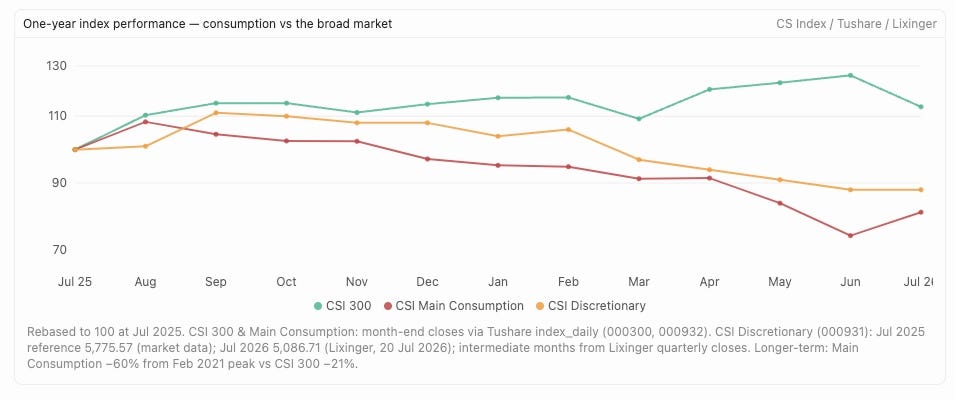
1/4 China’s consumption names are cheap but still unloved
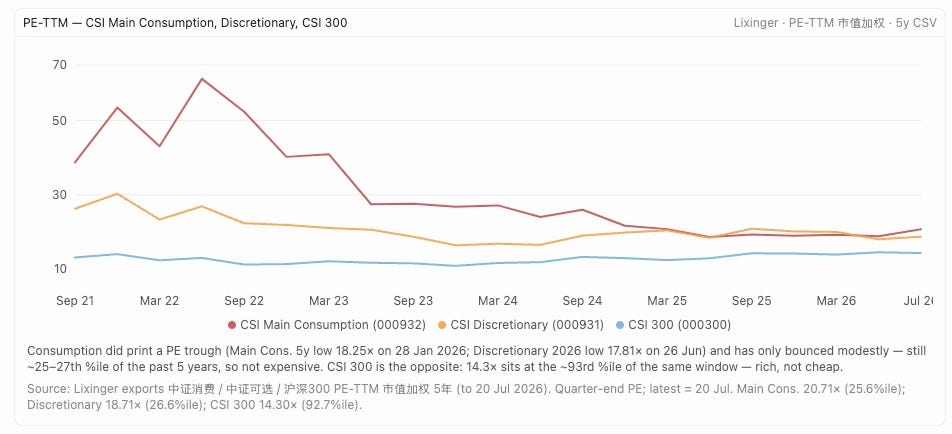
The consumer staples and discretionary sectors remain deeply discounted at a 25–27% five-year percentile after a mild rebound, standing in sharp contrast to the CSI 300’s elevated 92.7% percentile. This stark valuation divergence clearly reflects how capital markets are pricing a K-shaped economic reality—buoyed by strong momentum in the “new economy”, specifically AI and data centers, while domestic consumption remains sluggish.
In a past Baiguan Pro issue, we highlighted how computing infrastructure and new energy leaders have been replacing traditional enterprises within the CSI 300. Consequently, the index itself has transformed into a much more accurate proxy for China’s emerging 'new economy.'

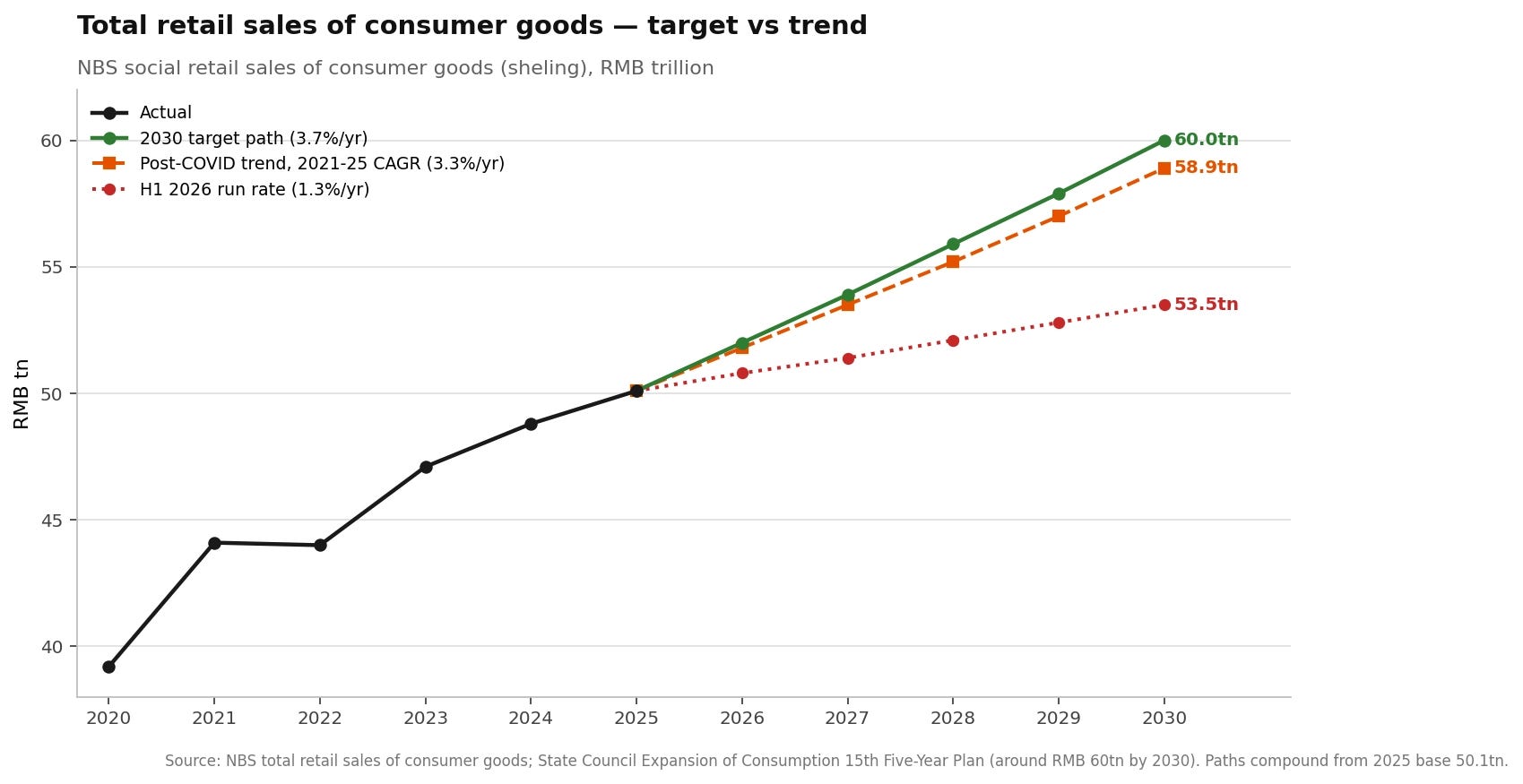
2/4 Does the RMB 60 trillion target mean massive stimulus is coming?
From 2025’s RMB 50.1 trillion (+3.7% YoY), reaching ~RMB 60 trillion by 2030 requires only about 3.7% CAGR. That is almost exactly the 2021–2025 post-COVID trend (~3.3%). The current H1 2026 run-rate of +1.3% would miss the target badly.
The target in the plan just asks China to keep its post-COVID trend: some improvement from today’s soft goods print is implied — but nothing like a boom. Cheap ≠ buyable beta.
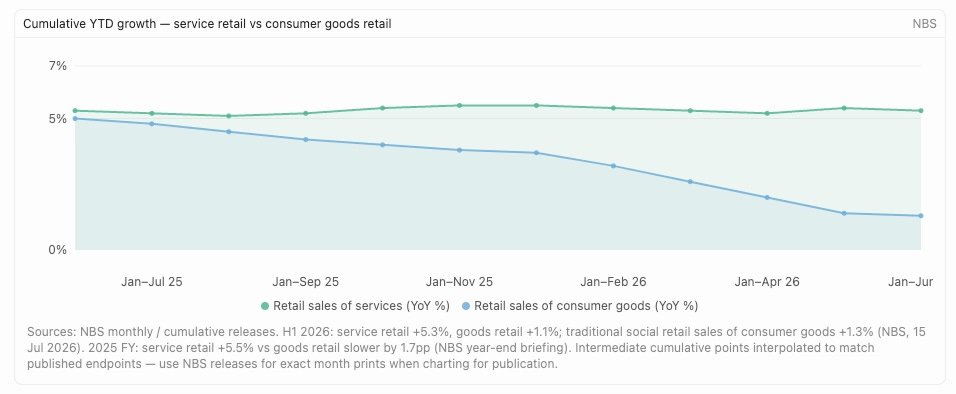
3/4 Households are still spending on services
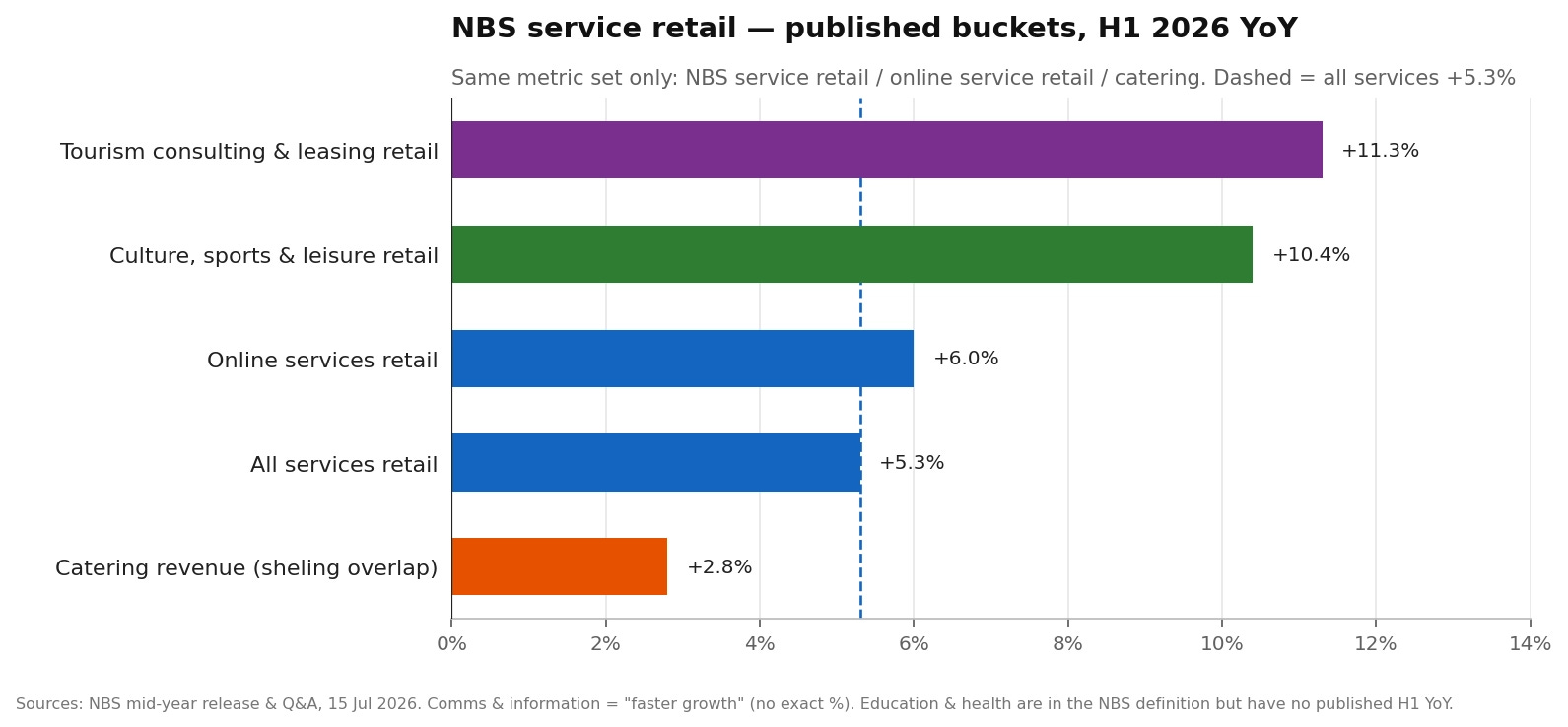
Although consumption of goods and staples is likely to remain sluggish (not a broad beta rebound), China is not in a total spending freeze. Service retail has maintained a mid-5% YoY growth band for a year. (As of 2025, per capita services consumption made up 46.1% of China’s total consumption.)
4/4 “Services” is not one trade: where is organic growth inside services — and how to express it?
Organic growth in the services sector is heavily concentrated in experiences, led by tourism consulting and leasing (+11.3%), as well as culture, sports, and leisure (+10.4%). Conversely, catering (+2.8%) is actually dragging the overall average down.
By “experiences,” I refer to high-engagement, in-person activities. This momentum is vividly captured by the surge in live performances (+28.3%) and museum tours (+24.6%) [*]. Inbound tourism has also rebounded strongly, driven by an expansion of visa-free arrivals that catalyzed a 30.6% year-over-year growth in visitor trips.
Other categories, such as education, are notably absent from the highlights. Given China’s demographic headwind of a declining population, I personally think education is unlikely to drive significant organic growth going forward.
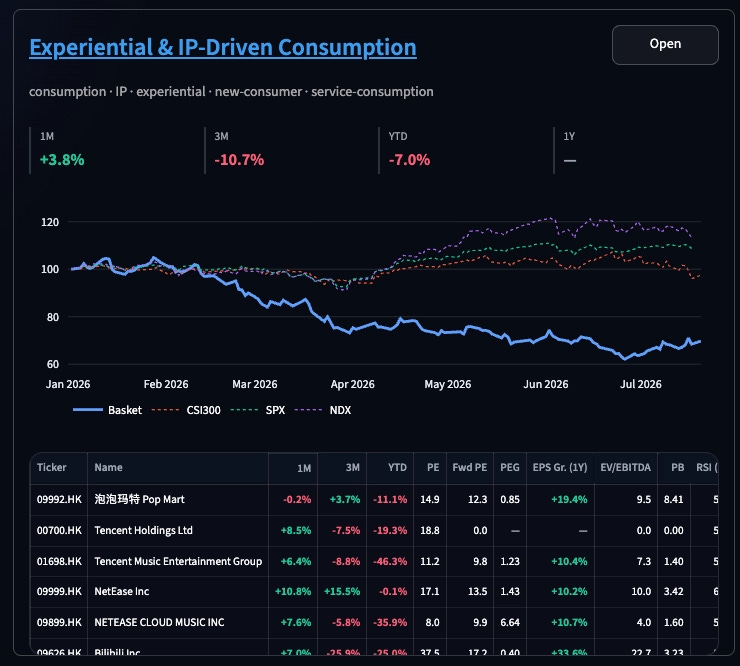
This means that secondary-market expressions need to be selective. Frankly speaking, exact equity proxies for China’s “experience economy” are still quite elusive. To bridge this gap, we are taking a first cut at constructing a basket that best captures this interest-driven, experiential growth. Our basket spans OTAs, live-experience ticketing platforms, hotels, and digital discretionary categories like gaming and entertainment. More on this in our Baiguan Pro tier.
Ending notes: possible 2H catalysts for consumer names
Apart from longer-term themes, HK internet and e-commerce giants could see several positive catalysts in H2 this year as delivery wars quiet down and profit margins improve. Specifically, the commercial landing of AI and agentic applications could provide strong catalysts for upside given current depressed valuations.
For instance, the expansion of cloud services, Kuaishou’s Kling, Tencent’s WorkBuddy (which the company claims is China’s most used productivity AI agent by DAU), and the launch of agents within the WeChat ecosystem could all serve as positive catalysts for H2.
Disclaimer: For informational purposes only. Not investment advice.
About Baiguan Pro
On April 1, we officially launched Baiguan Pro, our professional-tier subscription designed for investors seeking deeper, more specific coverage of Chinese equities. Baiguan Pro delivers the Baiguan team’s monthly outlook on overall Chinese equity assets, our quarterly focus on themes and sectors, richer company-level analysis, and follow-ups on the ideas and companies previously presented in the newsletter.
As a reminder, existing paid subscribers can claim a complimentary upgrade to Baiguan Pro (offer runs through July 31, 2026) by simply replying to this email. You could also consider signing up for a paid subscription and emailing us for a free upgrade! )


