


What Happened?
At the Wuwei Thorium-based Molten Salt Reactor (TMSR-LF1), a 2MWt (megawatt-thermal) experimental reactor, Chinese scientists successfully completed the facility’s first cycle of converting Thorium-232 into fissile Uranium-233 within a liquid fuel environment [*].
This breakthrough, achieved by the Shanghai Institute of Applied Physics (SINAP), marks the world’s first successful use of thorium in a molten salt reactor, which could be pivotal in the development of advanced nuclear energy systems using thorium as a sustainable fuel source.
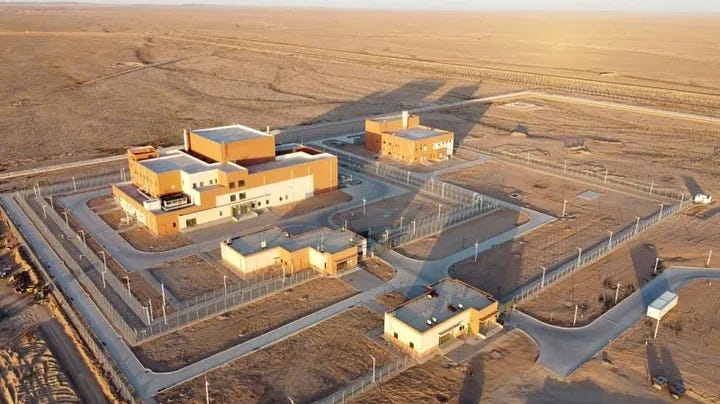
This is a technical milestone—the first time in over 50 years that any nation has successfully operated a molten salt reactor of this type. But viewed through the lens of macro-strategy, this is not just a science experiment. It is the unveiling of a massive “strategic hedge” against China’s most glaring resource vulnerabilities.
For a nation that imports over 70% of its oil and over 80% of its uranium, energy security is a constant anxiety. The breakthrough in Wuwei offers a potential exit ramp from this dependency. (I wrote about this in the previous newsletter: “China is short on crude oil!”, where I explained how China’s vast land can be misleading, leading many to believe that the country is rich in strategic resources. In fact, many crucial resources are actually scarce. This supports the key motivations behind China’s national strategy to pivot toward EVs, sustainable energy, and generational projects such as building the world’s largest hydropower station in Tibet.)

By mastering the Thorium cycle, China is effectively unlocking a domestic energy reserve that has been sitting in its soil for eons, untouched—burning rocks that were once considered waste to power the country for thousands of years.
From “Waste” to “Fuel”
In nature, Thorium and Rare Earth Elements are “twins”—they almost always coexist in minerals like Monazite.
For the rest of the world, this relationship is a curse. When Western companies mine for Rare Earths, they are forced to extract Thorium as a by-product. Because they lack a use for it, it is classified as hazardous radioactive waste, requiring expensive disposal and strict environmental permitting.
For China, however, this relationship is an industrial “cheat code.” Because China has monopolized global Rare Earth refining for decades, it has been passively accumulating massive stockpiles of Thorium. For instance, in the tailing dams of the Bayan Obo mine in Inner Mongolia, thousands of tonnes of Thorium sit waiting. (The Bayan Obo mine is the world’s largest deposit and producer of rare earth elements.)
While the US or Europe would need to permit and dig new mines to access this fuel, China simply needs to open the warehouse door. It is a pre-mined, pre-refined energy inventory that turns a decades-old environmental liability into a tier-one strategic asset.
The History of the Thorium Research and How China Did It
The concept of a molten salt reactor is not new; the technology behind the Wuwei reactor was actually pioneered in the United States. The US Oak Ridge National Laboratory (ORNL) proved the physics worked in the 1960s. In the 1960s, Alvin Weinberg, the legendary director of the ORNL in Tennessee, built and ran the Molten Salt Reactor Experiment (MSRE). It ran successfully for four years. Weinberg argued passionately that thorium was the safer, cleaner future of civil nuclear power [*].
So, why did the US kill the program in 1973?
The answer is a mix of Cold War pragmatism and technical hurdles.
