


A few months ago, we wrote a piece explaining the “Hefei Model” lying behind the success story of Chinese memory giant CXMT. In Hefei, the local government acts as a provider of long-term venture capital for strategic high-tech sectors. The model has thrived and now sits behind moonshot technologies such as controlled nuclear fusion and quantum computing, making Hefei a center of China’s deep tech.
One small, embarrassing detail about that article was that although we can apply our common-sense understanding of China’s institutional mechanisms to appreciate Hefei, the Baiguan team has never been to that city personally! On a face-to-face basis, the city remained a mystery to us as well as to you.
That’s why, when an opportunity recently arose for a group of investors to visit Hefei and ask whether we were interested in tagging along, we happily joined.
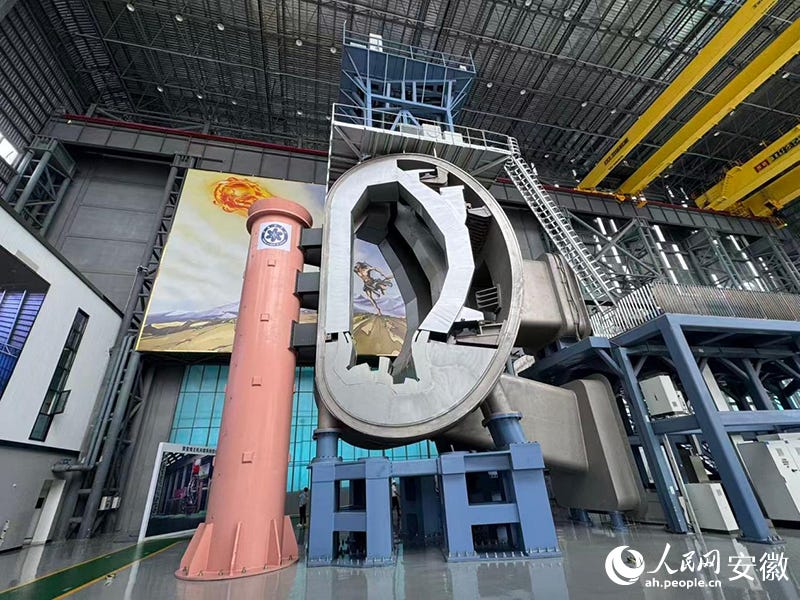
It was an intense 3-day tour during which we visited 20+ companies, funds, research institutes, and government support agencies. We walked the campus of the formidable Chinese University of Science and Technology (CUST), and were even lucky enough to tour some exhibitions of Hefei’s impressive controlled fusion program.
Below are some of our key takeaways from this trip.
Although we are not organizing a tour to Hefei this year, our upcoming Autumn tour program also exhibits some of China’s frontier technologies.
As of now, the Beijing AI & robotics & commercial space tour and the Greater Bay Area advanced manufacturing tour still have some seats left.
Apply form here and read Q&A here.
It’s all about the people factor
A perennial question that’s stuck in our minds during our visit was: why Hefei, an otherwise unremarkable inland city, of all places?
If you read our previous article, you know our theory that it was the unusual sequence in the leadership continuum, which is a bug, not a feature, of China’s local government system, that’s mainly responsible for Hefei's success.
But this idea was far from obvious. For instance, one participant in our tour, a seasoned tech investor, believed that the proximity to CUST, China’s equivalent of MIT, and its endless flow of top talent had a big, if not the biggest, impact.
During our visit, we had a great opportunity to pose the same question to Mr. Y, a founding CEO of a government venture fund, who has seen it all.
Mr. Y’s sharing confirmed Baiguan’s view. According to him, Hefei had the luxury of having a continuous streak of leadership for more than a decade, something quite rare in China’s local government politics. He said that when public-sector peers from bigger cities like Suzhou, Nanjing, and even Shanghai and Shenzhen came to visit Hefei, everyone marveled at this unusual endowment. This continuum made Hefei the only city in China uniquely positioned to think and plan independently and patiently over a 10-20-year timeframe, and invest in future industries under the same timeframe.
Mr. Y also broadened our perspective by pointing out a second, closely related factor. Under the leadership continuum in the past, an entire echelon of cadres and professional managers sharing the same culture and consensus has already been formed. Today, even if leadership changes hands, the backbone of the bureaucracy stays the same, leaving modus operandi intact.
The lesson of Hefei is thus one of many reminders that, despite the mesmerizing technological advances of today’s world, people remain at the core of making or breaking things.
Success breeds itself
Talking about people, during our visit we constantly marveled at the sheer energy and passion of those we spoke with, which was a bit different from what we found in other places in China. We have the feeling that those people really care about what they are doing and have a strong sense of mission. Even the government bureaucrats we talked to have a distinct vibe to them that we don’t easily find elsewhere.
On top of that, we feel that the people in Hefei have a strong sense of belonging. Chinese culture in general harbors a strong homesickness, yet what we see in Hefei is different. There, we saw many top talents who would easily prefer to stay in cities like Beijing and Shanghai but willingly came back to their hometown. This is quite unusual in China, where usually the “tier” of a city is strongly correlated with the level of talent it can attract.
How is Hefei able to achieve this remarkable feat? We can’t find anything inherent in Hefei that helps it attract talent better than other cities in China. The truth seems mundane here, and nothing other than the fact that its model has proven to work.
Good results breed confidence, and confidence attracts more talent, who in turn will help Hefei achieve even better results. This demonstrates that the original farsightedness of Hefei’s previous municipal leadership not only produced industry champions but also laid a solid foundation for continued, self-reinforcing success.
This also shows the difficulty of someone else replicating Hefei once a certain critical mass has been reached.
Investing in 20-year technologies does not mean the rewards can only be reaped in 20 years
Hefei is now globally famous for its large risk appetite for investing in long-term strategic industries, even far-fetched moonshots. The assumption is that Hefei has to endure years, even decades, of loneliness before a long-term bet yields any results.
The reality, however, is far more nuanced and far more practical.
If a technology can only be mature in 10 years, it does not mean its positive impact won’t be felt until then. An often-cited concept in Hefei is “沿途下蛋” or laying eggs along the way, meaning that a strategic industry can usher in other supporting industries that may bear fruit earlier than the core industry.
Take controlled nuclear fusion as an example. Industry estimates for maturation usually fall within a 10-20-year timeframe. But to make it happen, a whole suite of technologies has to be mature as well. For instance, nuclear fusion requires advanced superconducting technology to work. Yet without a huge investment in nuclear fusion, there simply isn't a large enough use case to make superconducting economics scale. In this regard, nuclear fusion is no longer just an end in itself but a means to help related industries to advance as well.
Similarly, at the nuclear fusion institution we visited, we also see great advancements in areas ranging from specialty, complex AI algorithms to vacuum technology that are a must-have for fusion, which individually may have use cases beyond just fusion and are highly likely to be commercially viable before fusion.
There should have been way more M&A activities
In Hefei, we saw a great many high-quality technology companies working in niche sectors. In one example, a company used inexpensive sound-based solutions to do defect detection and prevention on oil and gas pipelines and data center batteries. Another company was a niche eVOTL player that focuses on ultra-small, ultra-low-altitude flying cars that a rancher in Australia can easily use to drive around his ranches without requiring a flying permit.
The consensus today for these companies, as well as for the investors who chose to back them, is that they should go public one day. Yet we question whether the IPO path is the correct one for many of the companies we saw. It appears to us that the more natural, and healthier path is actually for those niche companies to be acquired by larger companies with a more integrated product suite and more mature distribution networks. Yet so far, we have failed to observe a meaningful enough number of interesting M&A deals in Hefei.
Strong hardware, weak software
Our 3-day visit was saturated with complex sci-fi devices of all kinds, and our minds swam through a high density of undaily concepts, from pulsed plasma thrusters to nitrogen-vacancy sensors. Yet, we fail to find any companies (other than perhaps Zepp, a fitness tracker maker) that produce interesting products directly for consumers, nor do we find interesting service companies.
That sturdy, serious vibe is felt everywhere. One perhaps unrelated anecdote is that when we toured the CUST campus, it did not feel like a college campus at all, lacking the youthful energy people tend to associate with college life. “I can’t find a single good-looking face”, one of us exclaimed. Maybe that’s the price we pay for having a university that may breed China’s future Einsteins?
Hefei is a microcosm of China’s broader industry landscape of today. Just like the rest of China, Hefei has an extremely strong hardware and deep-tech ecosystem. But when it comes to consumer technology and the services sector, the city barely exists. This is why during the go-go years of China’s internet boom, you won’t be able to find Hefei on the map. Hefei’s moment to shine only comes when the entire world has entered a tech hardware supercycle.
We do not expect Hefei to only double down on this imbalance. And we believe it should. Every city in China should carve out its own distinct identity and help foster greater diversity at the national level.
Related reads
How would Chinese technology look like five years from now?

Last week, the 2026 World Robot Conference (WRC) concluded in Beijing. ICYMI, Amber published her own field notes about the event yesterday.
When exactly will China’s semiconductor industry catch up with the West?

Last call: Apply for the Autumn 2026 Baiguan China Tour before this Sunday (Sep 13) to claim early-bird discounts.
The "Hefei Model" behind CXMT: a rule or an exception?

On July 15, ChangXin Memory Technologies, better known as CXMT, is scheduled to begin book-building for what may become China’s largest semiconductor IPO. Investor subscriptions will follow on July 16. The company plans to raise RMB 29.5 billion, or about US$4.3 billion, to upgrade its DRAM production lines and develop new memory technologies.