

Lululemon's Great Wall Drum Scandal
What the marketing disaster reveals about China's changing national identity

On May 30, 2026, Lululemon staged a yoga festival on a stretch of the Great Wall in Huairou District, Beijing. The production was lavish: a thousand participants, a sunrise backdrop, and a cinematic centerpiece — brand ambassador and A-list actor Zhu Yilong pounding a massive drum.
The Lululemon marketing named the event “擂响中华大鼓” — beating the Chinese Great Drum — and framed it as a tribute to Chinese cultural heritage.
The footage quickly rolled out across social media. Everything looked on-brand. But soon enough, netizens are starting to ask the question:
“Was that actually a Japanese taiko?”
Within hours, the Chinese internet had an answer.
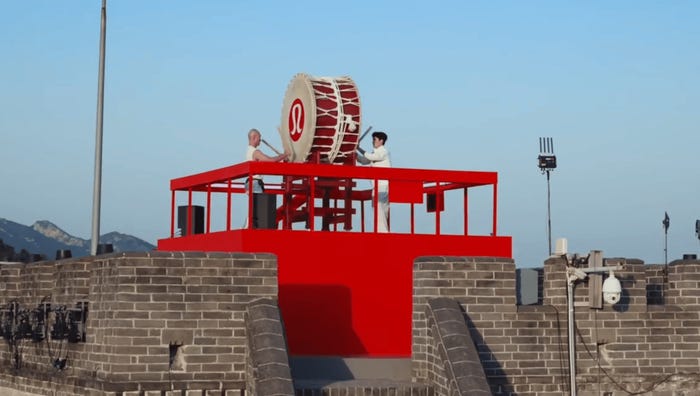
The resemblance was not subtle. Many netizens cited evidence—such as the fact that traditional Chinese drums are short and squat, with drum skins nailed directly to the frame with metal tacks. By contrast, the drum in Lululemon’s Great Wall event was taller and narrow-barreled, its skin lashed tight with a web of crisscrossed red ropes, which are unmistakable signatures of a Japanese Taiko.
The observation was later publicly confirmed by Zhang Yong, a national-level inheritor of Jinnan Weifeng Luogu (a type of Chinese drum and gong music) intangible cultural heritage, who claimed that the drum used in the event was a Shimetaiko. This confirmation left netizens furious, causing a campaign to boycott Lululemon to spread virally within days across Chinese social media.
Some may simply attribute this to anger over foreign brands’ cultural appropriation, or to the anti-Japanese sentiment that has been developing among the general public in recent years. But there is much more to it.
By June 16, Lululemon had apologized, deleted all promotional materials, and pulled its most ambitious China campaign of the year.
In today’s newsletter, I want to move past the cliché of how this is a complete marketing disaster (which is a given) and discuss how this event reveals much more nuanced changes in Chinese cultural identity.
Was that actually a Japanese taiko?
Frankly speaking, I think it’s a blurry line. There is a reason a drum can cross cultural borders unnoticed by the untrained eye: East Asia is not a collection of hermetically sealed containers. For over 1,500 years, goods, scripts, instruments, and aesthetics have flowed across the China-Japan-Korea arc so thoroughly that many daily cultural markers are shared property.
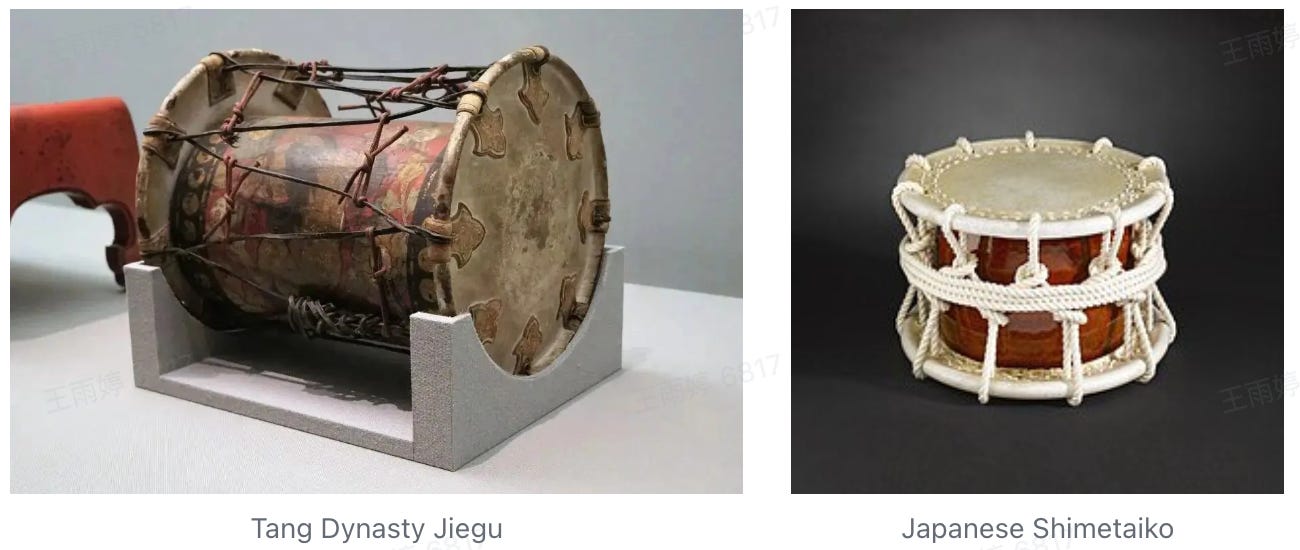
Japanese taiko originated from Chinese drums brought over during the Sui and Tang dynasties, just as Kanji stems from Chinese characters, and the tea ceremony traces back to Song-dynasty diancha.
凡響HiiKO, the drum troupe recruited to perform at the Great Wall, also tried to fight back from that angle. They claimed the instrument was a “reproduction of a Tang Dynasty jiegu“ (唐代羯鼓复刻) — a historical Chinese drum that is indeed the distant ancestor of the Japanese taiko [*].
(You can try to judge the differences yourself. Left is a Tang Dynasty Jiegu, and right a Japanese Shimetaiko.)
What does this drum mirror about a changing Chinese national identity?
Here is where the story turns.
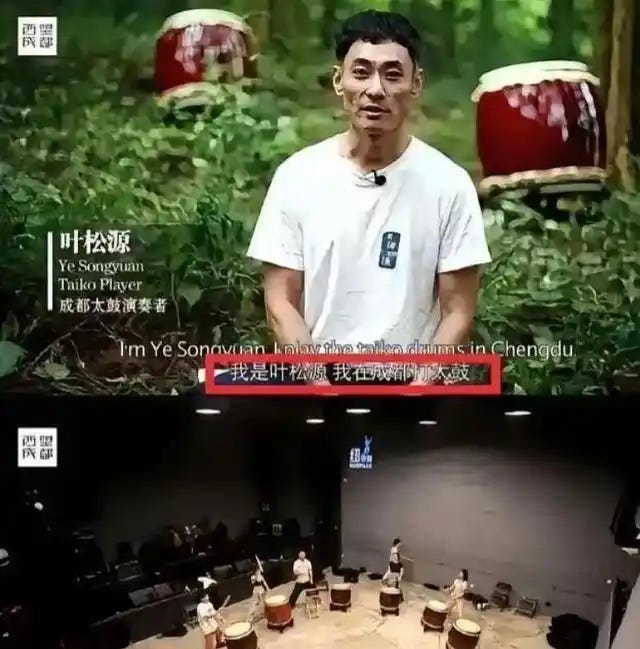
The drum troupe at the center of the scandal, 凡響HiiKO, was founded by Ye Songyuan, who has specialized in Japanese taiko since 2000. Even the name “HiiKO” derives from the combination of the Japanese word hibiki (響), which stands for “sound”, and Taiko.
For most of its existence, the troupe openly marketed itself as a Japanese taiko ensemble. However, after 2024, they suddenly rebranded as “Chinese Great Drums,” “Guochao” (国潮, “China Chic”), and “Intangible Cultural Heritage Inheritors.
A veteran with over 20 years of taiko experience obviously knows the difference between a Chinese drum and a Japanese one. But to secure lucrative commercial contracts, choosing between the two was merely a marketing decision.
Surprisingly, this transformation went unnoticed for years. The troupe collaborated with major brands, performed at high-profile cultural events, and even appeared on CCTV (China’s central television) under their new guochao identity. No one called them out—not state media producers, not event organizers, and not the audiences. Even the explicitly Japanese name “HiiKO” never raised an eyebrow, and they enjoyed smooth, unquestioned approval.
What’s different this time around?
Why did Chinese netizens, in a matter of hours, catch something that professional television producers, brand marketing teams, and event agencies — presumably staffed with culturally-literate people — had all missed, sometimes repeatedly, for years?
What the disastrous marketing campaign reveals is not just a question about Lululemon. It is a question about the changing cultural identity of Chinese citizens.
China’s “cultural authority” is getting decentralized
For most of modern Chinese history, the question “What counts as authentically Chinese?” was answered by institutions: the state cultural apparatus, academia, museums, and the heritage establishment. The Great Wall drum incident reveals how much this has changed.
The people who initially caught this were not angry nationalists or institutional “experts.” They were percussion professionals, music students, instrument hobbyists, and historically literate netizens. These “folk archaeologists” conducted what amounts to a crowd-sourced, rigorous peer review—in real time on social media. They did so by citing Tang Dynasty court music records, analyzing drum rope-tensioning techniques, and comparing the instruments to museum catalogs.
What’s really interesting to me is not that Chinese netizens are criticizing brands, but that their criticism is becoming professional. This was rarely heard of ten years ago. Back then, when a foreign brand blundered, the public response usually followed an emotional and reactive pattern: cries of “insulting China,” boycotts, and demands to “get out of China.”
Today, netizens can and want to debate the hourglass waist of a jiegu drum, the mechanical principles of traditional rope-tensioning, and the specific instrumentation of Tang Dynasty court banquet music.
A massive, highly knowledgeable class of “cultural consumers” is emerging, and their standards for vetting cultural claims can often be higher than those of a brand’s internal consultants. For brands, this poses a massive challenge. The marketing era of “It’s Chinese culture because we say it is” is dead. Today, your work must withstand an audit by public experts.
The “Guochao” trend has fostered a highly discerning consumer bracket.
As we noted as early as 2023, the rise of “China Chic” (Guochao) has carved out a distinct market segment, fueling the success of many domestic brands that feature cultural elements, such as Songmont, Laopu Gold, Tong Shifu, etc.
However, buzzwords like 非遗 (intangible cultural heritage), heritage inheritors, and Guochao have suffered severe inflation over the past years. Too many individuals have co-opted these labels, and too many commercial projects have exploited the banner of “inheriting Chinese culture” for pure profit. As a result, the public is becoming immune to this marketing jargon.
But at the same time, more Chinese are developing a genuine interest in reclaiming and studying China’s cultural roots, rather than simply paying for a superficial “vibe” manufactured by brands.
That level of cultural scrutiny simply was not a priority for most Chinese consumers ten or twenty years ago. I often describe what I’m seeing as the Chinese people’s own Renaissance.
Defining “self” vs. “other”:
Many would argue that anti-Japanese sentiment is the core trigger here, but in reality, Chinese consumers rarely react negatively to Japanese brands solely based on their origin. Even during recent periods of tense Chinese-Japanese relations and government-imposed travel restrictions, commercial pragmatism is eclipsing raw nationalism: Sushiro’s new stores still saw long queues, and vacations in Japan are trending.
What is truly becoming central is a growing need among the Chinese for clearly defined cultural boundaries and identity.
Across 1,500 years of cultural exchange between China and Japan, the boundaries of many cultural symbols have naturally blurred. In daily life, the average person historically had no practical need—nor any desire—to obsess over whether a specific tradition was definitively Chinese or Japanese. Today, however, drawing this line has become increasingly important: what belongs to China belongs to China, and what belongs to others belongs to others—even if they share a common historical root.
Simultaneously, a more intellectual and nuanced form of grassroots cultural engagement is rising. It does not aim to boycott, but to correct. A decade ago, one might have witnessed people mindlessly smashing Japanese cars in protest; today, that purely emotional, irrational response has largely receded. The demand is no longer for foreign brands to “get out of the Chinese market,” but for them to be accurate and accountable for their cultural claims.
At a deeper level, this reflects identity construction in an era where China is going global. As China integrates more deeply into the global system, her people are craving clearer, more distinct boundaries for their own identity.
Related reads


🔐 Baiguan pro exclusive: investment implications for Lululemon
This is not the first public relations crisis Lululemon has faced in the Chinese market. Just this past April, Lululemon’s use of PFAS materials—often called “forever chemicals” and linked to cancer and endocrine disruption—had already impacted sales in China, according to observations by our parent company BigOne Lab.
Lululemon was counting on a comeback during the 618 shopping festival window, China’s largest e-commerce sales event in mid-June, but the drum scandal hit right at this critical moment.
In the Baiguan Pro tier we launched this April, we share monthly updates of data points that are crucial to understanding the equity investment scene in China. We have been regularly updating the sportswear sector sales trends in China, including Lululemon’s sales, in our monthly “Data Update” series.

We are now offering a free upgrade to all paid subscribers to the Baiguan Pro tier until the end of July. If you enjoy our content and like deep dives directly related to equity investment, I recommend that you get an annual subscription (~$188, then email us for an upgrade,) which effectively gives you the Baiguan Pro subscription (priced at $365) for the full year.
