


In one of the weekends for the upcoming Baiguan China Tour, we will have David Fishman to lead us through a 2-day trip through one of the most interesting “small” cities in China: Yiwu.
David is a Principal at The Lantau Group (TLG), a leading Asia-focused energy consultancy based in Shanghai. Having lived and worked in China for 15 years, David specializes in China’s energy sector, industrial development, trade, and political economy. His work has included advising multinational corporations, financial institutions, and industrial clients on topics ranging from power markets and manufacturing competitiveness to supply chains and regional development.
Beyond his professional work, David has traveled extensively throughout China and has a longstanding interest in economic geography, local development, and social ethnography, and has documented many fascinating human stories and observations at Crossing the River by Feeling the Stones.
In this interview, we will ask David what’s so amazing about Yiwu and what lessons about US re-industrialization and the future of globalization we can learn from it.

A county-level city with global reach
Baiguan: David, in the upcoming Baiguan China Tour, you will lead a weekend visit to Yiwu. For readers who know little about the city, where is it, and what is it?
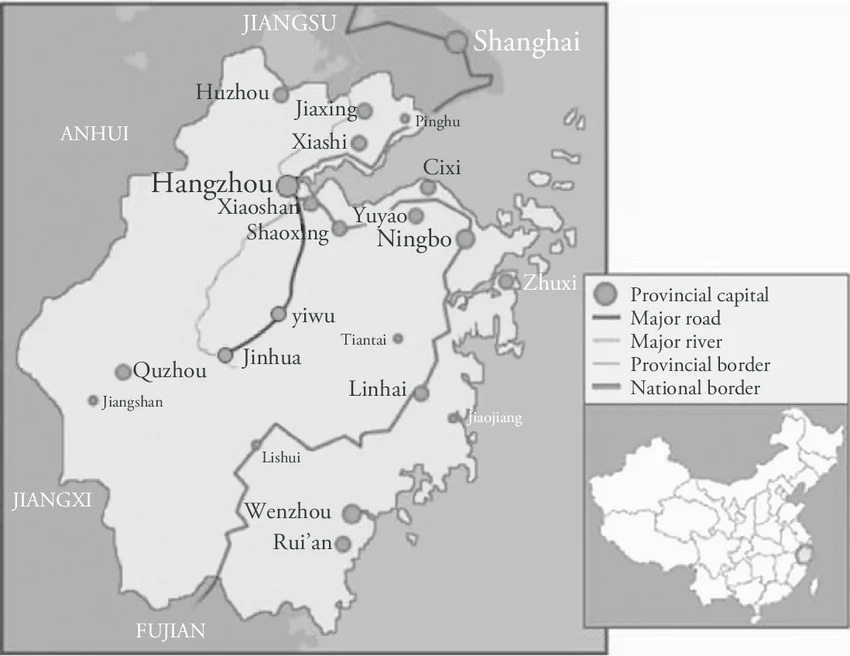
David Fishman: Yiwu is a county-level city under the jurisdiction of Jinhua金华, a prefecture-level city in central Zhejiang Province. It’s south of Hangzhou and easy to reach by high-speed rail. In most ways, it looks like a regular Chinese city. What makes it exceptional is the enormous small-commodities trading business that has grown there.
Baiguan: China’s city-tier system can be confusing to outsiders. Where does Yiwu fit?
David Fishman: The best-known tier ranking comes from Yicai’s Rising Lab, not an official designation. It ranks prefecture-level and higher cities, rather than county-level cities, so Yiwu does not receive its own position. It is folded into Jinhua, which is generally ranked as a second-tier city, after the “first tiers” and “new first tiers”.
So, you could use Jinhua’s ranking as a rough proxy, but that hides the most interesting feature of the region. Jinhua’s urban core is actually not that much larger or stronger than the county-level cities beneath it. Yiwu or another nearby city like Yongkang永康 both have substantial populations and economies, and their strength contributes to Jinhua’s aggregate ranking.
Suzhou is similar to this, because a lot of its overall strength comes from very strong county-level cities like Kunshan昆山.
In the Chinese administrative system, ‘county-level’ is just an administrative designation. It doesn’t necessarily mean that it’s small or poor.
Baiguan: Why visit Yiwu rather than one of China’s many other prosperous county-level cities?
David Fishman: Well, as someone who studied political economy, I would call Yiwu one of China’s greatest celebrations of state-backed private-market capitalism. Its small-commodities economy is built overwhelmingly by private manufacturers and distributors. These companies make products that are not strategic sectors requiring participation by state-owned enterprises, so the private sector dominates
But what makes the model fascinating is the way the municipal government participates. It does not need to operate the factories or distributors. Instead, it builds the giant marketplace and supports the surrounding ecosystem with fast business registrations, easy cross-border settlements, digital platforms, and other support services. So, the state builds and maintains a platform on which private firms can succeed.
In that sense, the municipality is kind of like an incubator or an angel investor, except that its investment is in an entire class of businesses rather than a chosen startup. It backs the general concept of small-commodity trade in Yiwu and trusts that the beneficiaries of that support will go on to make the city successful.
Baiguan: That can sound almost contradictory: an active local state enabling a highly private market.
David Fishman: Many countries support private-sector champions. I guess what’s unique about Yiwu is that the beneficiary is not one or two national champions; it is the small commodities private sector as a broad category. The city has organized itself around making thousands of small private businesses more competitive…that’s the city’s brand, and the source of its success.
The economics of a ten-cent hair clip
Baiguan: Yiwu is known for products that can look almost absurdly simple: socks, toys, Christmas decorations, and hair clips. Why might a ten-cent hair clip tell us as much about China’s industrial capabilities as a smartphone does?
David Fishman: If someone can sell a hair clip for just ten cents and remain in business, the producer has somehow covered raw materials, labor, rent, taxes, logistics, distribution, and a profit margin within that price. If you think about it, that’s an amazing achievement in production efficiency.
When the unit price is so low and the item is so commoditized, tiny differences are actually huge. The gap between ten cents and 9.9 cents may look like nothing to a consumer, but at manufacturing scale it can mean a lot. Each incremental reduction in price requires another improvement somewhere in the system.
There is also no brand premium to hide behind. This kind of product is nameless and interchangeable. It competes with production efficiency and ruthless low prices. Building that capability is, in its own way, as impressive as building a brand for which consumers will willingly pay a large premium.
Baiguan: For at least two decades, people have argued that rising wages should erode China’s advantage in lower-end manufacturing. Why has that not happened in the way many expected?
David Fishman: Wages certainly did rise. So, the mistaken assumption was that wages would always be the key component of competitiveness. Twenty years ago, that may have been closer to the truth for some really labor-intensive products. If most of the cost of a pair of socks was labor, then higher wages should have pushed production elsewhere.
But now the China experience is making it clear that there are so many other variables that matter too, like financing costs, automation level, supplier proximity, logistics depth and speed, reliability…even the returns producers are willing to accept. If firms keep compressing those costs while labor costs rise, they can remain the most competitive producers.
And buyers are not always looking only for the lowest cost. They also care whether a shipment can arrive within 48 hours, whether a supplier is reliable, or if the factory’s sales representative answers on WeChat within five minutes. China has spent all these years refining that whole package. Now their advantage comes from the whole accumulated system, not a single cheap labor input.
Manufacturing is an ecosystem, not a factory
Baiguan: During the tour, what will allow participants to see those efficiency gains rather than simply hear about them in the abstract?
David Fishman: Depending on the factory we visit, participants will probably see a substantial amount of automation. But the more important lesson is the seamlessness of the entire production process. Productivity is not just people working inside a factory. Raw materials, labor, capital, and production equipment all have to come together. Packaging must be ordered and delivered. Finished goods have to leave the factory, enter a logistics network, reach a distribution center, and then continue to the buyer.
In Yiwu, all of those functions are compressed into the same ecosystem. You can visit an automated factory and then a logistics zone that operates 24/7 with remote-controlled cranes and smart autonomous vehicles. Seeing the whole chain makes it clear that the goods are cheap because every part of the process has been coordinated efficiently, not simply because labor is cheap.
Baiguan: When Americans talk about bringing manufacturing back, they often imagine reopening a factory. What does Yiwu reveal about what that ambition actually entails?
David Fishman: First, it is important not to exaggerate. The United States has not forgotten how to make things. It still has a substantial high-tech manufacturing base and workforce. But what has weakened is the broader public understanding of the connections among all the components of productivity.
A productive factory needs machines, industrial robots, laser cutters, CNC equipment, and raw materials. It needs experienced workers and technicians and schools that are training them. It needs capital, sometimes patient capital if returns will not appear immediately. It also needs sales channels, distribution channels, and a reliable, robust logistics solution.
Many Americans are now really disconnected from the business of making things as a complete system. Even much of the workforce that works with its hands is concentrated in trades like HVAC installation or electrical work, rather than manufacturing. Those are valuable skills, but they do not necessarily provide the same view of the entire productivity ecosystem that a factory manager or procurement manager develops.
In Yiwu, you can watch wholesale become retail and see how logistics connects the labor and capital equipment in the factory to the final user. The relationships suddenly click. You appreciate how difficult the system is to assemble, how precious it is once it exists, and how difficult it can be to recover after it has been lost.
Why reliable energy matters
Baiguan: You are primarily an energy specialist. How much of China’s manufacturing competitiveness is really an electricity or energy story?
David Fishman: It varies by sector, of course. But in any energy-intensive business, whether the main input is electricity, coking coal, natural gas, or something else, a procurement manager cares about two things: whether the supply is stable and whether the price is stable. Can the company obtain enough energy at an attractive and predictable price?
China does very well on both dimensions. A manufacturer can build out a cost structure for one year, three years, or even longer in advance and discuss it with a financier. Energy is a bankable input rather than a moving target. The same logic applies very obviously these days to something like a data center, which consumes large amounts of electricity to sell data services. The developer and financier need to know that the electricity supply and price are dependable.
Ideally, energy should be boring. It should not be the input that occupies management’s attention or creates a persistent headache. China has done a very good job of making energy a reliable part of the operating environment.
Baiguan: So predictability can matter even more than absolute cheapness?
David Fishman: Yes. Even if the price is somewhat higher than a manufacturer might have originally hoped, a predictable price allows the company to know what its costs will be years from now. It can then look for efficiencies elsewhere. When energy costs are volatile, they become an X factor in every plan. Stability removes that uncertainty.
Baiguan Note: We have another segment of the China Tour that focuses exclusively on the energy sector.
The Global South and a new geography of trade
Baiguan: China is exporting less to the United States but more to many parts of the Global South. Is that diversification mainly defensive, or are we seeing the creation of a genuinely different geography of globalization?
David Fishman: Well, my most basic thought is that any export revenue is unit price multiplied by volume. If an exporter can sell fewer units at a higher margin to wealthier customers, that is easier from a sales perspective. Replacing the same revenue by selling more units at lower margins to less wealthy markets requires more work. But you can do it.
Companies will do that work because their survival, their health, and their employees’ jobs depend on it. Chinese exporters have already proved that they are entirely capable of doing it. But I would not go so far as to say it was their preferred plan. A solar panel manufacturer does not naturally want to spend 30% more effort or time selling lower-priced products simply to earn the same amount of money.
I would therefore describe the shift as a defensive, second-best strategy rather than an intentional first choice. Nevertheless, the outcome is real. It is reshaping global trade flows and commercial relationships, even if that was not the original objective.
Baiguan: Who will participants actually encounter in Yiwu’s markets and streets?
David Fishman: The most visible foreign traders tend to come from the Middle East, North Africa, sub-Saharan Africa, Eastern Europe, and South America. There are Western European and American buyers as well, but they are not the dominant visual presence in the market, walking around on the streets.
Some visitors come for a week to procure goods, but many foreigners have also settled in Yiwu. They move their families there, buy cars, open stores, and establish trading companies because Yiwu has become the center of their working lives. So, besides the visiting traders, the city has a substantial permanent foreign community. Relative to its size, downtown Yiwu feels like one of the most visibly international places in China.
The food options you have in Yiwu make its international characteristics especially obvious. Yiwu does not merely have one or two good international restaurants. It has multiple strong Turkish restaurants, as well as Afghan, Syrian, Georgian, Armenian, and many other global options. In my view, it has the best Middle Eastern food in China. Those restaurants exist because the international community is durable, not superficial, and they demand authentic food from their own cultures.

Baiguan: If the world becomes more protectionist and fragmented, does Yiwu become less important, or can fragmentation create more opportunities for a place built on matching thousands of suppliers with thousands of markets?
David Fishman: Actually, I would question the premise here. With the exception of a small number of countries that have pulled back from certain international trade flows, the world may be becoming more interconnected, not less. If China replaces one large market such as the United States with ten Global South markets, the number and density of connections increase.
China did not necessarily choose this outcome. It has been forced to replace a few markets with many markets. But the result is that trade relationships are realigning around China rather than disappearing. That makes Yiwu more important as a matching, procurement, and distribution hub.
Buyers do not need to visit Yiwu physically. I heard from vendors in Yiwu that Western European and American customers often work through agents or use online B2B channels. On the other hand, Global South buyers are more likely to come themselves, walk the market for several days, touch the products, and say, ‘I like this one, but I want it in blue and I want my brand name on it.’ Yiwu is still important to everyone, but the physical market provides tangible, visible evidence of the Global South’s role in contemporary trade.
Baiguan: Finally, what will participants see in Yiwu that they are unlikely to grasp from trade data or a conventional factory visit?
David Fishman: One of the most striking features is the Muslim ecosystem that has developed around the city’s international trade. Because so many traders from the Middle East and North Africa seek halal food and services, Yiwu has this huge network of halal restaurants, mosques, and businesses with signs in Arabic.
That demand has also attracted Chinese Muslims from other parts of the country to work in restaurants and related service businesses. Foreign traders settle in the city and form families there. During my visits, I have seen many intercultural couples and families of a kind that I do not often encounter elsewhere in China.
Yiwu is therefore not only a trade hub. It is a wealthy, developed, modern city with unusually cosmopolitan street life for a place of its administrative size. People often assume that international China means Beijing, Shanghai, or Shenzhen. Yiwu is an example of a different model, built from wholesale trade and everyday interaction between Chinese residents and visitors and settlers from the Global South.
In some way, it might be a glimpse of a future China with more immigration and deeper integration with the rest of the world. Yiwu is not merely a place where China sells to the world. It is also a place where you can see what a more diverse, internationally integrated China might look like.
If you want to know more details about the upcoming Yiwu tour in collaboration with David, RSVP and get full details below.
To ensure the best experience, space is limited to 20 seats for each leg.
Early-bird pricing ends September 13.
RSVP Now: 2026 Autumn Baiguan China Tour “Marathon”

Aug 21 update: Click here to read a Q&A of regularly asked questions
To read a previous Q&A with Mr. Gao Erji of Caixin, our partner in the AI & Robotics leg, read here:
How would Chinese technology look like five years from now?

Last week, the 2026 World Robot Conference (WRC) concluded in Beijing. ICYMI, Amber published her own field notes about the event yesterday.
You can also check out the Q&A of regularly asked questions below:
What you will actually learn in Baiguan China Tour?

On Wednesday and Thursday, Robert hosted two live Q&A sessions about the upcoming Baiguan China Tour, attended by more than 30 of you.
Please feel free to contact us at Baiguan_ChinaTour@bigonelab.com with any questions.
Great interview. Mr. Fishman provides thoughtful insights into a fascinating city, how actual businesses operate, and why China's private sector remains a great driver of the Chinese economy.
To add to Mr. Fishman's comments on the practical needs of businesses, I was briefly in a graduate economics program before working at a large multinational. During a conversation with a former economics colleague, I observed that the things that keep business people awake at night are the things economists assume away - all of the issues Mr. Fishman mentions.