


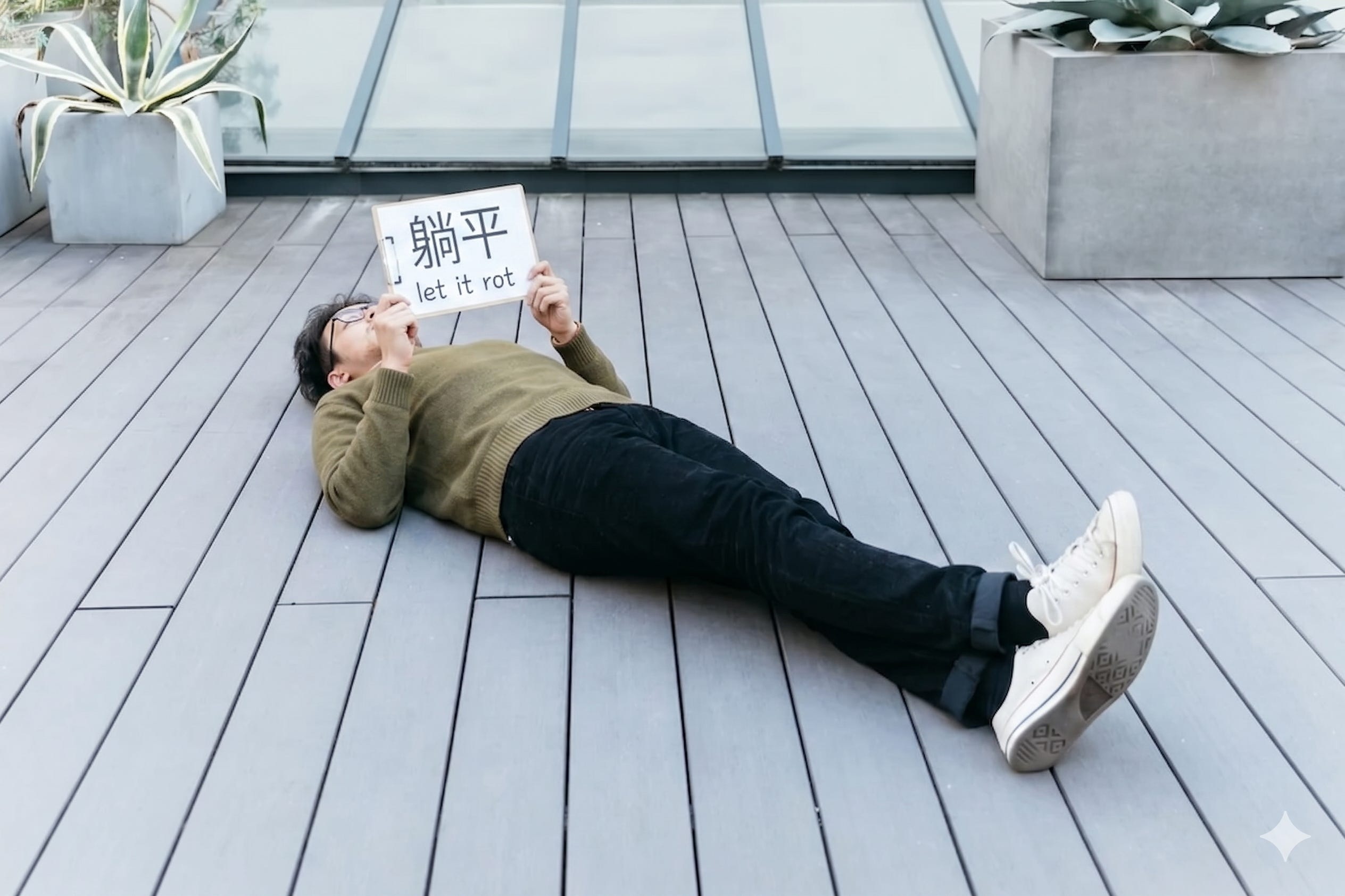
”Lying flat”, or Tang Ping, is a concept that started to become popular around 2021 in China. At its simplest, Tang Ping means doing the bare minimum to get by. It is a rejection of the traditional Chinese rat-race culture. Instead of working 996 (9 am to 9 pm, 6 days a week) to afford a house or a car, a person “lying flat” chooses to work only enough to cover basic needs, reject marriage, children, and property ownership, and prioritize personal time and mental health over career advancement.
At Baiguan, we’ve been covering this social phenomenon many times in the last couple of years.
Recently, the concept has taken on a political tone, with authorities redefining it from a social trend to a critical national security concern. In April 2026, the Ministry of State Security (MSS) released an unprecedented official warning, labeling the "lying flat" rhetoric as a form of "ideological infiltration" orchestrated by hostile foreign forces to brainwash and destabilize China's youth and made it clear that "lying flat" is no longer just a lifestyle choice, but a political act that the state is prepared to actively suppress. (You might want to read this satire piece by ChinaTalk related to this topic.)
Why has “lying flat” become such an important topic? Apart from the economy being in a slower-growth mode, what else explains it?
We offer face-to-face discussions with Baiguan Pro subscribers. A few weeks ago, I had such a meeting with a Baiguan Pro subscriber from Europe at our Shanghai office. We discussed the economy, generational differences, and employment.
Clearly, household confidence in China is on a trajectory of stabilization and moderate recovery. The negative wealth effect from a falling real estate market seems to be tempering, while the positive wealth effect from a gradually rising stock market is also having a positive impact.
But when it comes to the job situation, the picture is fuzzier. We have indirect proxies, such as job posting data, that can give us a view of the quality and supply of jobs. However, as for the actual unemployment situation, we do not have visibility beyond official statistics. Even in official statistics, the youth unemployment rate remains elevated at 16.9% as of March 2026, and that’s after counting anyone with no fewer than one hour of work in a week as “employed”.
Yet, despite the serious situation, we have yet to see severe social disturbance and a rise in crime that's prevalent in countries where youth unemployment is this high.
Obviously, China’s tight system of social control, ever vigilant in identifying and responding to potential flashpoints, partially explains this “gap”. But I would argue that mere control can only be expected to delay discontent, but can’t fundamentally change a historic trend.
I believe two powerful social mechanisms are more important here.
First, the young generation of today are the children of those born between the 1960s and 1970s. Their parents, China’s “baby boomer“ generation, have gradually entered their “silver” age.
This generation is special. Their careers have grown in lockstep with the 3 decades of rapid economic development from the 1990s to the late 2020s, making them the wealthiest population cohort in China today. This means that if their kids run into career troubles, these parents are always ready (and generally willing) to step in as the provider of the last resort. For each child who can’t strike out on their own in a first-tier city, there is usually an idle apartment in a second- or third-tier city belonging to their parents that they can always return to.
The other important social mechanism is the “lying flat” culture itself. At the same time, there aren’t as many job opportunities as before. Meanwhile, we have a parent generation who have both the willingness and the means to support their children. Furthermore, a deflationary environment is making everything cheaper than before. So lying flat and not having a job become easy choices for many people.
On China’s short-video platforms, there has been a wave of popular videos (at least before censorship hammered them down) about how to live on an extremely low budget. One vlogger that I sometimes watched documented every day of his life: woke up at about 2:00 PM, played some video games, went out and spent 10-15 yuan ($1-$2) on street food (sometimes even a beer), came back to the apartment he paid almost 0 for and played video games again until midnight and called it a day.
Essentially, this vlogger would only need to spend less than $50 a month and could still get by.
“I can never get my head around the idea that there are so many young people in China who are okay with this,” said my European guest. “For me, to work is not just for money. Working provides a sense of meaning. So it is scary to me when this sense of meaning is lost.“
This comment made me pause and reflect. At that very moment, I suddenly connected the dots and saw why “lying flat” became a thing in a culture that historically has prized hard work above everything else.
Here is my own personal understanding, take it or leave it:
When previous generations of Chinese people worked hard, it usually wasn’t for a “sense of meaning”. It was purely about survival.
Consider the boomer generation: when they were born and raised, they really had nothing in material terms. Because they had nothing, when there was an opportunity to finally have something, they all worked extremely hard. They were genuinely afraid they would be poor forever if they did not work hard. They were also genuinely afraid to be left behind by their classmates, colleagues, and neighbors in this great golden rush away from poverty.
In other words, for most people in China until now, the psychological impetus behind economic growth has been fear-driven rather than purpose-driven.
And because every one of their generation worked so hard, China reached an economy of abundance so quickly and on such an unimaginable scale. Such is how the miracle of the Chinese economy came about.
But then, this miracle provided a new problem. The fear factor is no longer there. “I do not want to live in poverty” is no longer a strong enough motive for people to work. Yet in the meantime, “to work as the meaning of life” hasn’t really existed yet.
Hence, “lying flat” occurred. It’s also why “lying flat” became a trend without creating any real destabilizing factor for society. Had Chinese people always been “purpose-driven”, a lack of things to do would make them restless. But as long as they can keep living without fear of falling into poverty, they can be just fine.
To be sure, lying flat is still not a dominant sentiment right now and is mostly associated with the youngest generation. But in the longer term, perhaps in 10-20 years, as the younger generation get older, this will be a fundamental concern for China’s economy. We risk becoming weary too quickly without getting mentally prepared for this fast abundance.
In this sense, although Beijing’s messaging against “lying flat” may be too heavy-handed, their intention to try to turn back the tide in advance is not wrong in itself.
However, I am quite pessimistic that these “anti-entropy” measures will work, unless our society manages to cultivate a much stronger sense of purpose. But we are talking about changing the fundamental psychological setup of a whole nation here, and obviously this will take an extremely long process and a huge dose of soul-searching at both individual and societal levels.
So my conclusion is, “lying flat” is deeply structural and won’t change just because economic growth re-accelerates in the future. It is here to stay.
As for investors, we should also focus on segments that cater to an ever-growing population with nothing to do, who just want to kill some time and fill some parts of their spiritual void. In the meantime, we should look for entrepreneurs whose inner drive is no longer driven by fear (because the basis for fear is rapidly dwindling), but by genuine love for what they do.
Because fear can only bring you so far, it is love and a sense of purpose that can drive you forward.
Related Reads
POP MART: no longer a playground for hedge funds, but interesting for long money?

Seasoned Baiguan subscribers will remember that we have been covering the story of POP MART from the very early on.
The Commercialization of China's Intangible Heritage

I must apologize for the slightly clickbaity subtitle.
Do Chinese households feel confident again?

One of the most important questions about China’s economy right now is whether and when household confidence could stabilise, ending the deflationary sentiment that has dominated the last few years.
I'm curious about your referencing your conversation with your European guest who said, “I can never get my head around the idea that there are so many young people in China who are okay with this. For me, to work is not just for money. Working provides a sense of meaning. So it is scary to me when this sense of meaning is lost.“.
I don't think you intended to suggest that tanping in a uniquely Chinese phenomenon, but I do think it is worthwhile pointing out that across Europe and England where there have been state provided social handouts for decades, this has been a real phenomenon since the 1960s and '70s. I'm a little surprised your European guest did not reference this group of people in his own country.
This is because I've had conversations with persons in England who work with unemployed young persons, and there is definitely a non-negligible cohort of young people in England who are quite happy to engage in their own version of tanping, relying on state handouts to get by. I personally know one young man in England who prefers to focus on his own hobbies and not work at all, living off a stipend from the state.
It seems to me that the main difference between those in Europe and England and those in China is the source of their funds: one receives stipends from the state, the other receives stipends from their indulgent parents. To the extent that young persons from families with money to maintain them have always been able to tanping, this is not really different in kind from trust fund kids. And China has had no shortage of those pampered sons in the past.
So, I would like to pose the question to you: Do you think that there is something about this tanping phenomenon that is unique to China in this time (as compared to other countries, and as compared to other times), and if so, what is it about the tanping movement that makes it uniquely different from what we have seen in England and Europe? My own bias is to think that there isn't, but you are far closer to what is happening in China than I am.