


“Charts of the Week” is Baiguan’s series that features key data points to help you quickly grasp the general state of affairs in China in just a few minutes. We handpick the highlights of the data charts from a variety of sources, analyzing and delivering insights trusted by 100+ top institutional and corporate clients worldwide at BigOne Lab. Don’t forget to subscribe before you continue reading!
China Customs released January-October 2026 trade figures today (10 November): goods exports were 25.99 trillion yuan in the first ten months, up 17.6%. Imports were 18.82 trillion yuan, up 23.6%. The useful question now is whether this pace can last into 2027, and what kind of boom this is.
Let’s look at some key data points:
Net exports have been doing more of the growth work
Since 2024, net exports of goods and services have been doing more of the growth work, as final consumption contributed less to GDP growth. In the first three quarters of 2026, net exports added 1.2 points to 4.6% GDP growth, according to the National Bureau of Statistics.

The boom is concentrated in AI-related electronics
In January-September, official goods exports were USD 3.37 trillion, up 21.3% (the yuan increase over the same window was 16.4%). An AI-related electronics basket we built from those official lines (integrated circuits, storage units, parts of automatic data processing machines, and central processing units, excluding complete PCs and phones) was USD 436 billion, 13% of exports, and up 119%. A green / new energy basket (electric vehicles, lithium-ion batteries, and solar cells) was USD 191 billion, 5.7% of exports, and up 52%. The rest of mechanical and electrical products still make up 46% of exports, but grew only 14%.
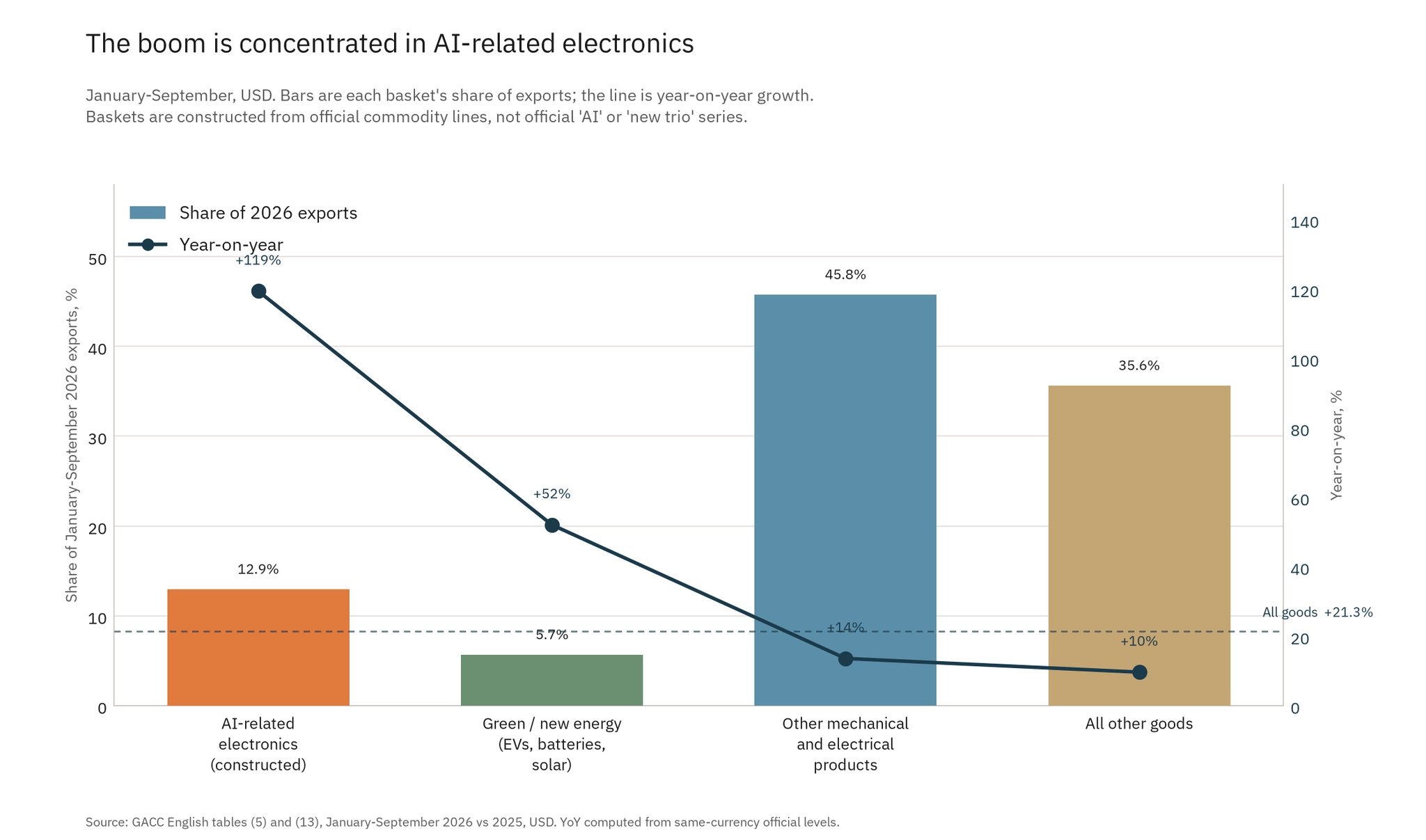
Vehicles are the other official line that is both large and fast: motor vehicles including chassis were USD 150 billion, 4.4% of exports, and up 54%. Electric vehicles already sit inside both that line and the green basket. A few other official items also grew faster than the 21.3% headline: ships (+30%), basic organic chemicals (+30%), refined petroleum (+38%), unwrought copper (+54%), unwrought aluminum (+37%), printed circuits (+41%), and insulated wires and cables (+34%). But each of these is still a small share of exports, under 2%.
That concentration matters for 2027: if the AI-related basket cools, the headline will cool with it.
AI-related volume has already slowed; unit values are still carrying 2026
Compared with 2025, AI-related export quantities have already slowed. Integrated circuits rose 17% in quantity in 2025, and only 3.8% in January-September 2026. Storage units and parts of automatic data processing machines have already fallen in quantity. Unit values are still carrying the growth: integrated circuits were up 108% in value.
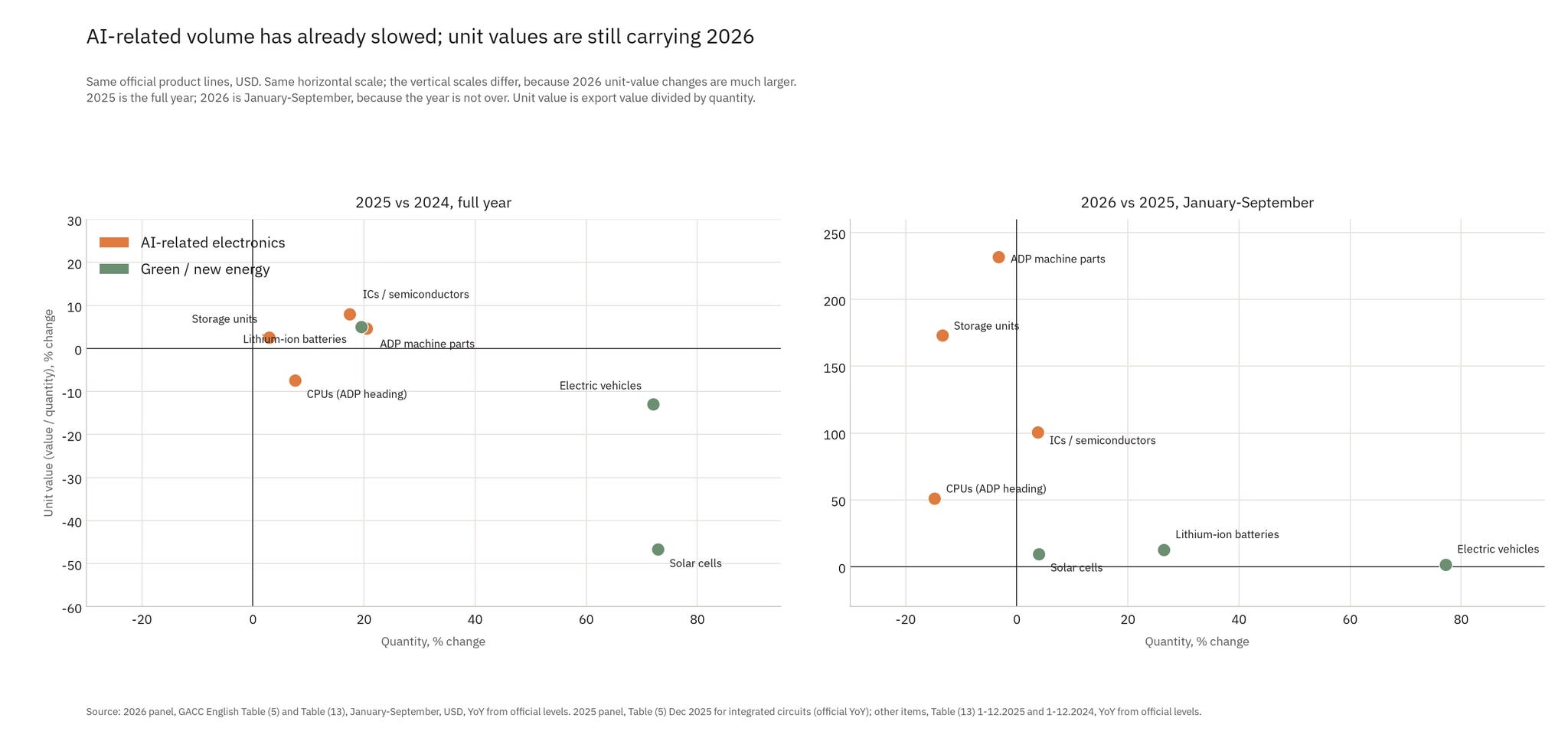
That is the risk for 2027. AI-related growth can slow if unit values cool once the shortage eases, even if shipments hold.
Green-related exports go the other way. They have stayed a volume story, but unit values have turned back up: electric vehicles and solar cells saw unit values fall in 2025, then turn slightly positive in the first nine months of 2026. The normalization could present a healthy export growth opportunity into 2027.
2027 starts from a high base
January-October exports of 25.99 trillion yuan are already 96% of 2025’s full-year 26.99 trillion. Imports in those ten months, 18.82 trillion yuan, have already passed last year’s full-year total of 18.48 trillion. The goods surplus is still getting larger: 7.17 trillion yuan so far this year, versus 6.87 trillion a year earlier.
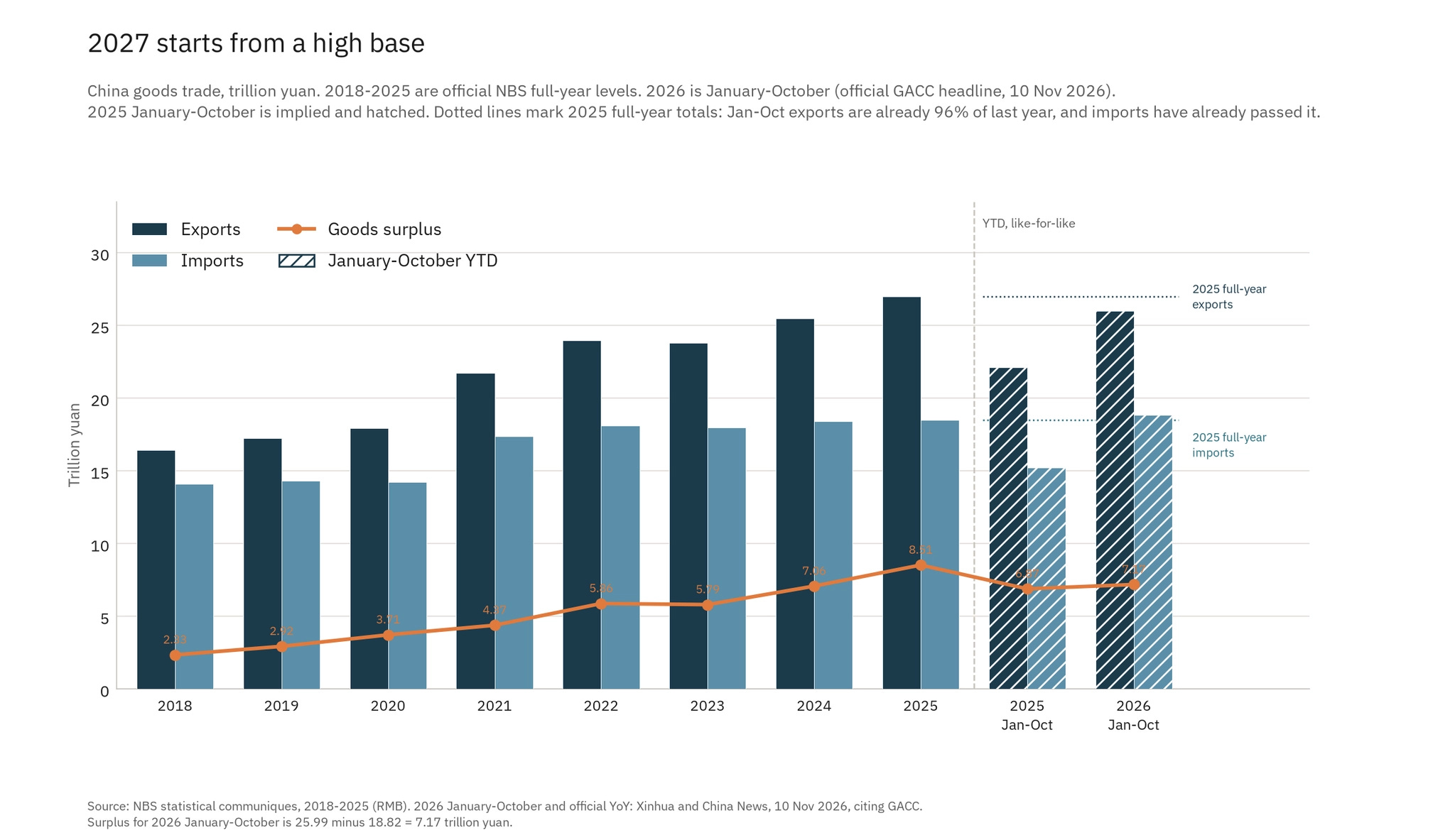
If the global AI supercycle peaks in 2027, will that weigh down China’s export contribution to GDP?
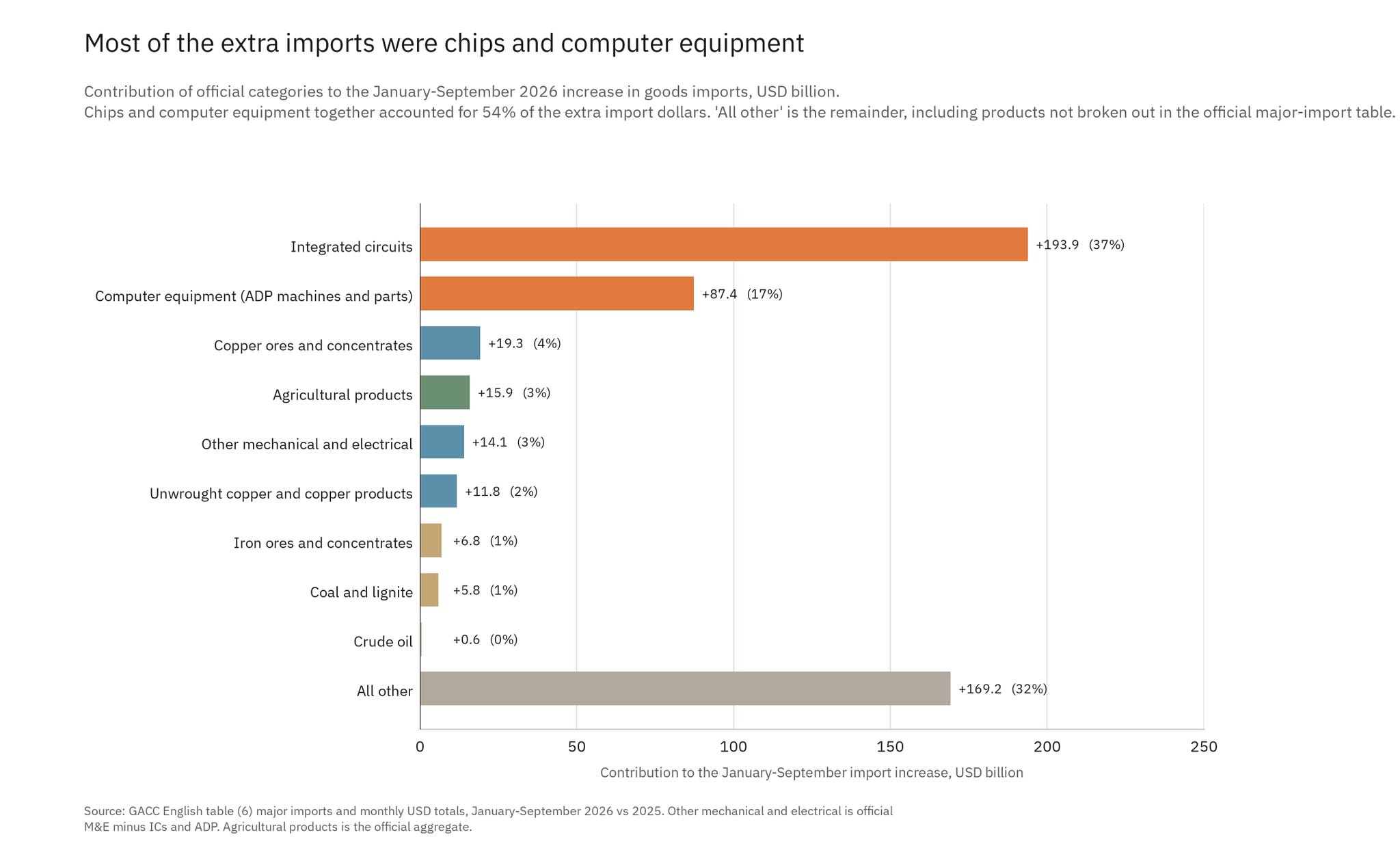
In 2026, most of the extra imports were chips and computer equipment. In January-September, official USD imports rose by USD 524.9 billion. Integrated circuits accounted for USD 193.9 billion of that increase, or 37%, and automatic data processing machines and parts for another USD 87.4 billion, or 17%. Together, chips and computer equipment made up 54% of the extra import dollars.
China also sells a lot of chips and parts: integrated circuit exports were USD 302 billion in the same nine months, but imports were USD 499 billion. The higher-end chips and servers used in AI compute still have to be bought abroad. This is why a much faster export year has not produced a larger net-export contribution to GDP.
Vehicles show the other side. China already makes that chain at home: the surplus rose by USD 57 billion, close to the entire USD 68 billion rise in the all-goods surplus. Integrated circuits widened the deficit by about USD 37 billion.
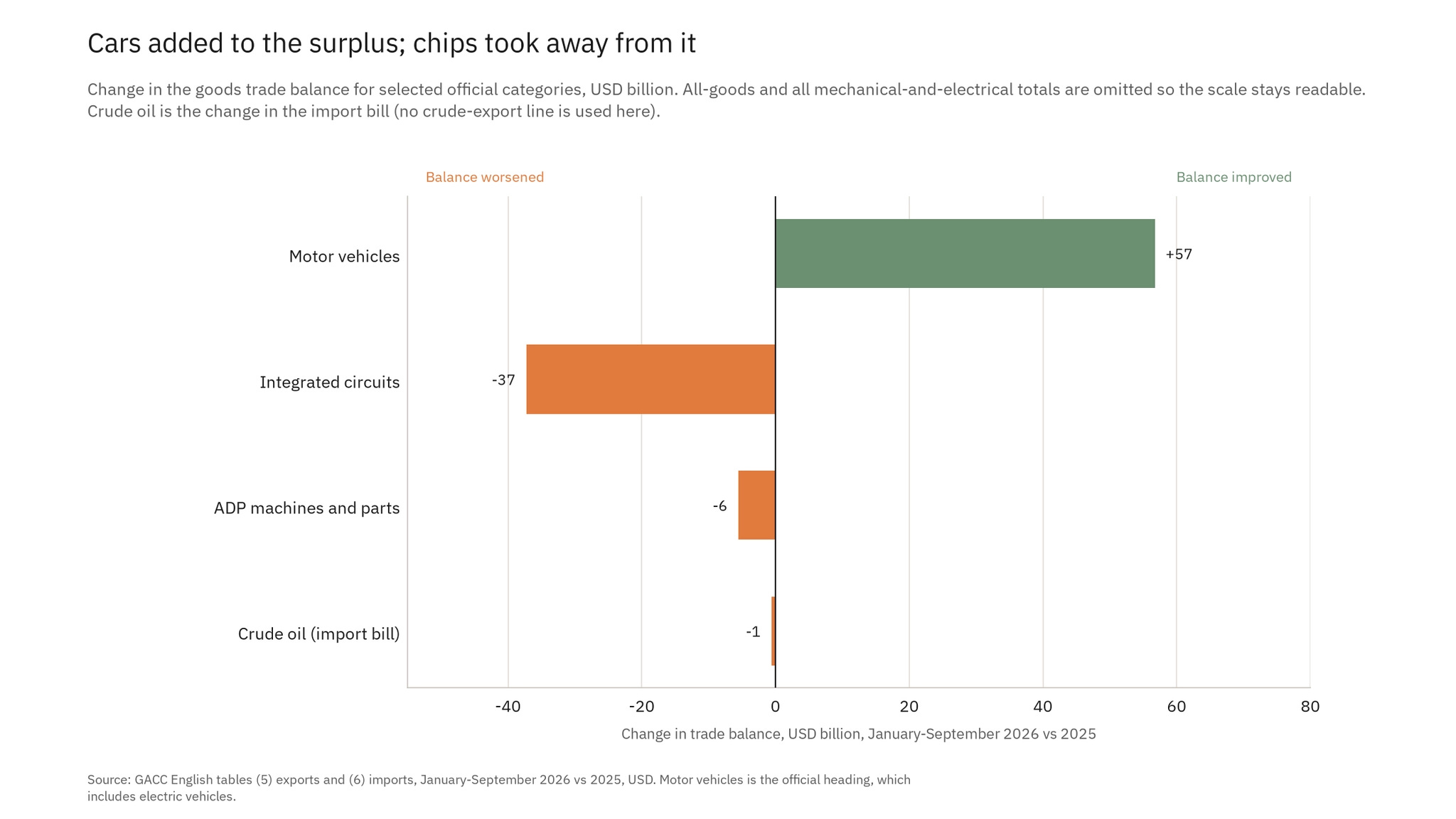
If the AI supercycle peaks, these imports would likely fall as well, so the net contribution to GDP could stay more balanced, rather than simply crashing.
Improving unit prices for green and EV products are likely to become the next growth engine. These products are also largely made in China, so they should add more to the surplus and to GDP. (Of course, this still depends on geopolitical issues around EVs with Europe; the politics could work both ways. For instance, a Democratic sweep in the US could put green energy back on the agenda and create external demand.)
A soft signal: BigOne Lab data shows that outbound hiring is still up, but growth has slowed
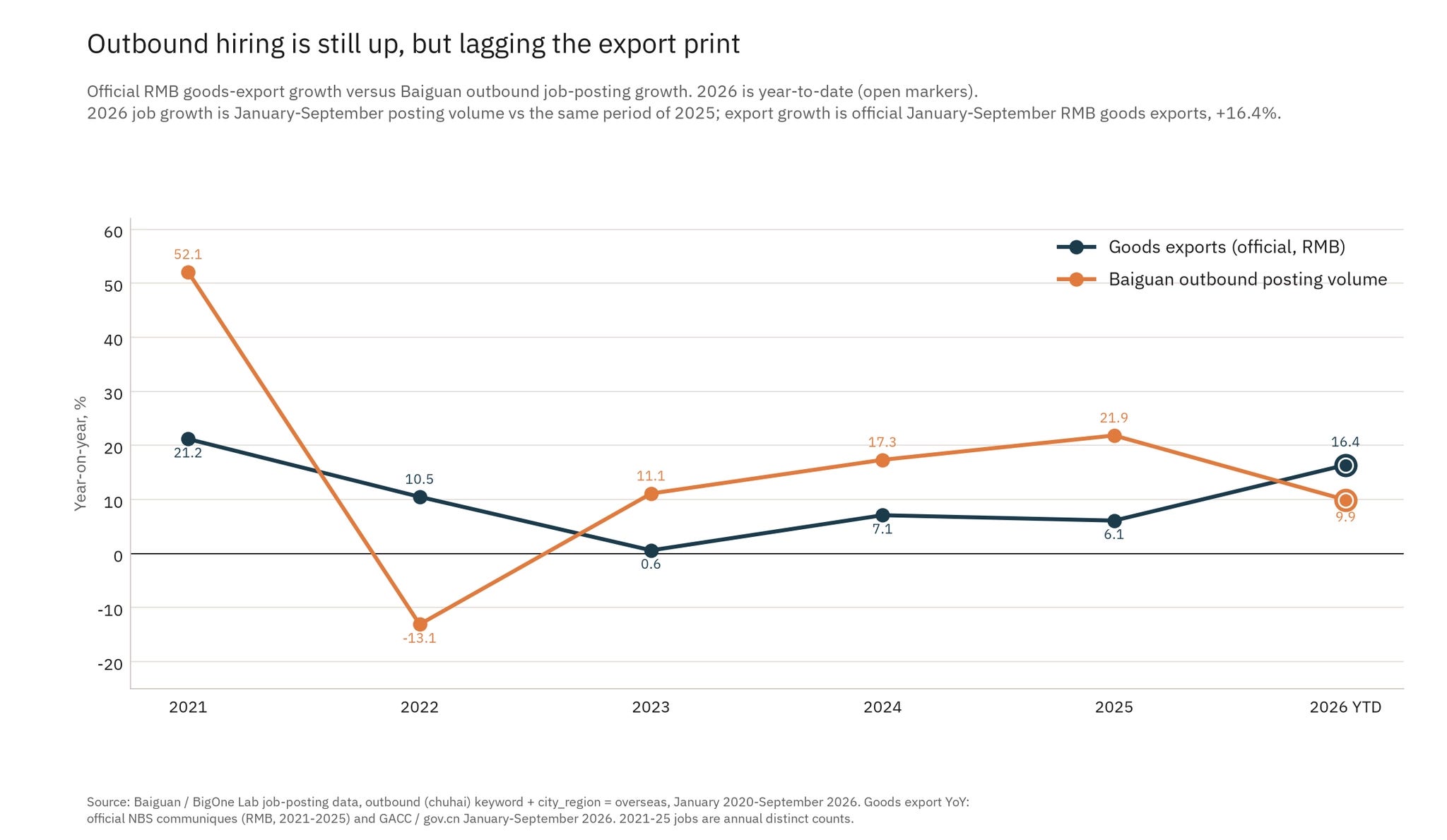
In January-September, postings for overseas markets or overseas roles were still up 9.9%, faster than the domestic hiring market. But the growth has slowed from the double-digit pace of 2024 and 2025, when the same measure rose about 18% in both years’s comparable period.
The bottom line
I do think AI-related exports could be affected if the global supercycle peaks in 2027, or at least slow down. Volume in those lines has already cooled this year, and much of this year’s growth has been unit values. But if that cycle peaks, the net contribution to GDP could stay more balanced, rather than simply crashing. The related imports would likely fall as well.
The offset may come from supply chains that are already largely made in China, such as new energy, solar, and lithium-ion batteries. Unit values there have started to turn up after a long trough. If that continues, they could add more to the surplus and to GDP.
Baiguan Pro
Baiguan Pro is our professional-tier subscription for investors who want deeper, more specific coverage of Chinese equities. It includes the team’s Monthly View on Chinese assets, and Data Updates that follow company and brand performance with BigOne Lab’s proprietary data. If you want to go deeper:
Our view on Chinese assets: October 2026. That issue already flagged that current export strength has been helped by the overseas semiconductor / AI cycle. But the changing external demand could present different investment implications into 2027. We will update our perspective in our upcoming monthly outlook series.

Data Update — September 2026. Our latest monthly read of brand-level performance, using BigOne Lab’s offline payment data.

Disclaimer: For informational purposes only. Not investment advice.
Sources
NBS, Zheng Xuegong, first three quarters of 2026: https://www.stats.gov.cn/sj/sjjd/202610/t20261019_1965647.html
NBS statistical communiques, for annual GDP contribution and full-year goods trade: 2025, 2024, 2023, 2022, 2021, 2020, 2019, 2018
NBS, Zhao Tonglu, for the 2018 and 2019 GDP contribution figures: 2018, 2019
GACC January-October 2026 headlines: Xinhua, China News (both citing Customs)
GACC January-September 2026, yuan: gov.cn / People’s Daily
GACC English tables: major exports, January-September 2026, major export commodities, January-September 2026, major exports, 2025, major export commodities, 2025, major export commodities, 2024, major imports, January-September 2026
Hiring: Baiguan / BigOne Lab job-posting data, January 2020-September 2026.


