


Before today’s post — a quick note. Applications are open for the 2026 Autumn Baiguan China Tour, a month-long “marathon” of modular expeditions across October and November: Robotics & AI in Beijing, advanced manufacturing from Foshan to Shenzhen, the next energy cycle across Shanghai–Suzhou–Hangzhou, and premium consumption in Shanghai — plus weekend immersions in Datong, Yiwu and Nanjing. Early-bird pricing through September 13.

We’re hosting two live info sessions with open Q&A: Wed, Aug 19 (9 pm Singapore / 9 am ET / 2 pm London) and Thu, Aug 20 (4 pm Singapore / 9 am London / 4 am ET). Interested participants can join via the Zoom link here.
Please also note we have just added a “no accommodation” option for the pricing table, you may check about it here.
*On April 1, we officially launched Baiguan Pro, our professional-tier subscription designed for investors seeking deeper, more specific coverage of Chinese equities. Baiguan Pro delivers the Baiguan team’s monthly view on overall Chinese equity assets, our focus on themes and sectors, richer company-level analysis, and data follow-ups on the ideas and companies previously presented in the newsletter.*
This is the fourth deep dive of themes & baskets we are tracking, after China’s robotaxi, China Global Champions 30, and Total Shareholder Return. This one is about the shift from goods to experience, service, and digital consumption — why we think it is durable, why it is unusually hard to own, and the twelve-name basket we have built to track it.
In May 2026, China’s total retail sales fell 0.6% year on year — the weakest print since the post-reopening period began in 2023. Read on its own, that number describes a consumer who has given up.
In the first half of 2026, Chinese residents took 3.46 billion domestic trips, up 5.4% [*]. Box office revenue recorded RMB 30.4 billion, up 9.4% — and inside that, RMB 17.1 billion went to concerts and festivals above 5,000 seats, up 17.7% [*]. They spent RMB 188.5 billion on gaming, up 12.2% [*].
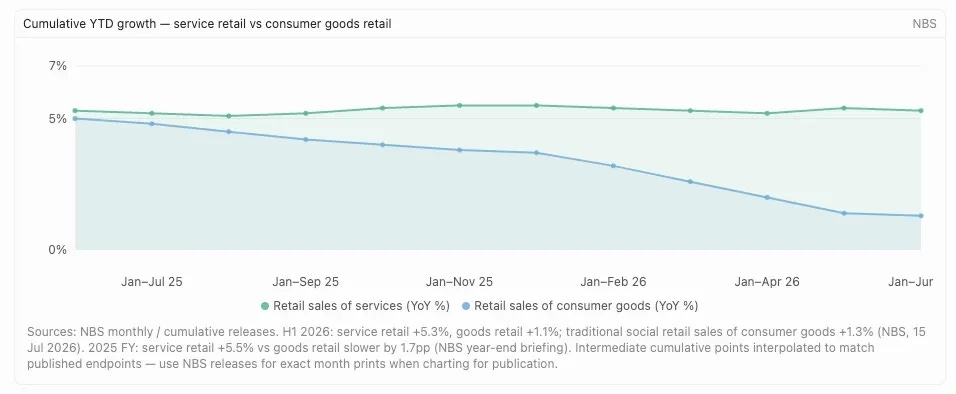
Service retail grew about 5.3%; goods retail grew about 1.3%. The gap between them is the whole thesis: it has now widened for four consecutive reporting periods, which is long enough to stop calling it a durable trend.
Where the money went
The National Bureau of Statistics (NBS) service-retail breakdown for H1 2026 is clear about where the growth sits:
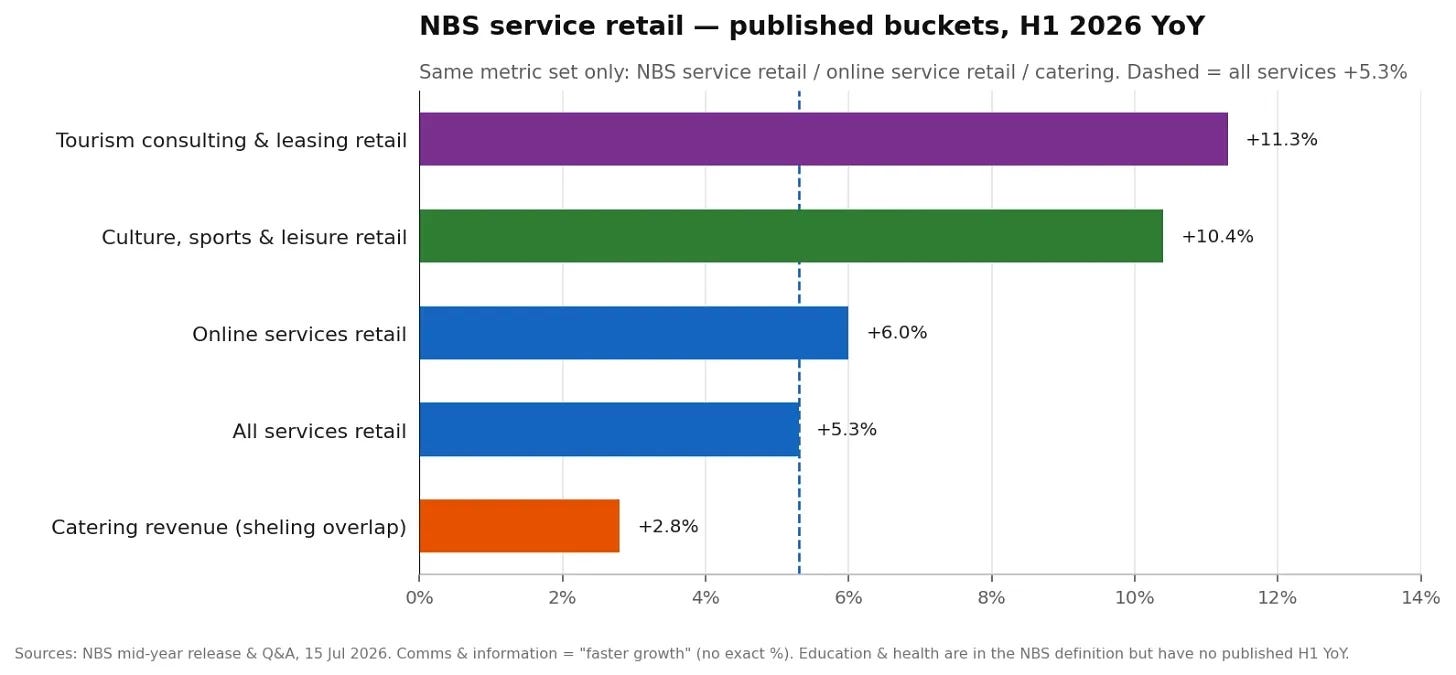
Catering — the biggest services category, and the one with the most listed vehicles attached to it — is unfortunately dragging the average down.
The spending is landing in three different-looking places that turn out to be similar behavior.
Great demand came from people’s desire to go out of the house: to be somewhere and experience something. This contributes to the burgeoning market for tourism.
Spending also went into content and screens. The gaming numbers deserve a second look, because the headline hides the interesting part. According to the CADPA industry report released at CDEC on 30 July, domestic game revenue grew 12.2% in H1 2026 while the user base grew 0.82% to 684 million—revenue grew because existing users paid more. PC and client games up 27.9%, mini-program games up 36.0%, with in-app purchases up 38.1% and now two-thirds of that segment’s revenue.
The same pattern appears in long-form audio, a market that grew roughly 15% to around RMB 28.7 billion in 2024 and is estimated to have reached the low thirty-billions in 2025, with Chinese podcast listeners at 134 million and forecast to approach 180 million by 2027 — of whom nearly two-thirds are between 21 and 35, and most say they subscribe for substance rather than background noise. As “paying for knowledge” becomes a rising trend, durable subscriptions on music and streaming platforms are increasingly generating recurring revenue.
Some spending went into IPs and personal interests. Pop Mart’s revenue grew 184.7% in 2025 and another 75–80% in the first quarter of 2026, with China alone doubling. That is a single company, but the category around it is broader — guzi retail, card games, IP toys, IP-licensed collaborations. Purchases of these products are driven purely by interest, and the object has almost no functional utility at all.
Our previous piece about the emerging “Guzi economy”:

Three destinations, one behavior: people paying for meaning, interest, and identity rather than for objects and utility. The fan who buys the album also buys the membership tier that grants priority ticketing, then the ticket, then the merchandise at the venue.
A trend that mostly isn’t listed
We intend to construct a theme basket to track this structural trend, but do acknowledge that many fastest-growing sub-sectors are simply not investable via listed instruments at this stage. For instance, museums, scenic, and cultural sites are overwhelmingly administered pricing, and concerts and festivals are dominated by private, unlisted operators. And the long tail of new formats, from escape rooms and script-murder to live-houses and immersive theatre, is spread across hundreds of thousands of SMEs.
What is listed sits at the platform level: ticketing & booking platforms, hotel franchisors, and OTAs. They mostly don’t create the experience, but they benefit from this broader trend.
We aim to explore four subcategories that directly benefit from this trend. We define “experiential” spending as capital allocation that is:
Chosen by the consumer, not obligatory.
Purchased for identity, passion, or experience—not pure utility.
Reflected in corporate core business models. We ensure each candidate company’s revenue mix genuinely captures this structural shift.
Our objective is to establish a clear framework that tracks and expresses this macro view, rather than relying on stock-picking to generate alpha. In other words, a company can stay on our list as long as its core operations align closely with the underlying thesis even if the business is currently struggling or presents sub-optimal financials.
In other words, the core question is not “which of these individual names will outperform,” but rather: given the scarcity of pure-play secondary market names, what is the most accurate listed expression of this shift available today?