


“Charts of the Week” is Baiguan’s series that features key data points to help you quickly grasp the general state of affairs in China in just a few minutes. We handpick the highlights of the data charts from a variety of sources, analyzing and delivering insights trusted by 100+ top institutional and corporate clients worldwide at BigOne Lab. Don’t forget to subscribe before you continue reading!
The 2026 National Day “Golden Week” (Oct 1–7) has wrapped up, and the headline is familiar from last year: China travels more than ever, but spends cautiously while doing it. Underneath, the K-shape we flagged last year has sharpened — cross-border travel, premium stays and live experiences are growing faster than the domestic mass market.
One calendar quirk matters for reading this year’s numbers. In 2025, Mid-Autumn fell inside National Day, creating a single 8-day holiday. This year Mid-Autumn was a separate break (Sept 25–27), with just three workdays in between. “Take 3 days off, get 13” became the season’s travel hack, so demand was spread over a longer window. Official comparisons below are therefore on a daily-average basis against last year’s 8-day holiday.
Let’s look at the key data points.
More trips, less spent per trip
China made 826 million domestic trips and spent 738.4 billion yuan over the 7-day holiday, according to the Ministry of Culture and Tourism. On a daily-average basis, trips rose 6.3% and spending 4.3% versus last year. Because spending lagged trips, average spending per trip slipped about 2% to 894 yuan — the lowest reading since before the pandemic.
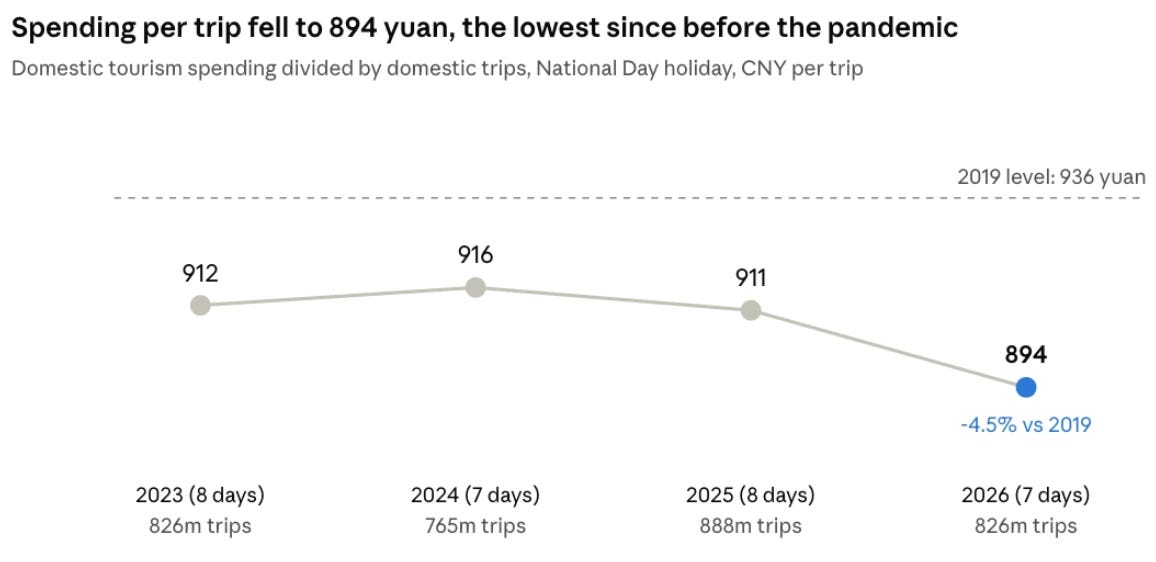
This isn’t a one-off. At every major holiday this year, spending growth has trailed trip growth: May Day trips rose 3.6% against spending of 2.9%, and Dragon Boat trips rose 4.4% against 4.0%. The “responsible spending” mindset among households is now entering its fourth year since COVID.
Further, longer, smaller
The 13-day window changed how people traveled more than how much they spent. Travel platforms’ own data show trips stretching longer and farther, and spreading into smaller towns. On Trip.com, trips of 8 days or more rose from under 6% of domestic holidaymakers in 2024 to over 10%, and the average stay reached about 3.9 days [*].
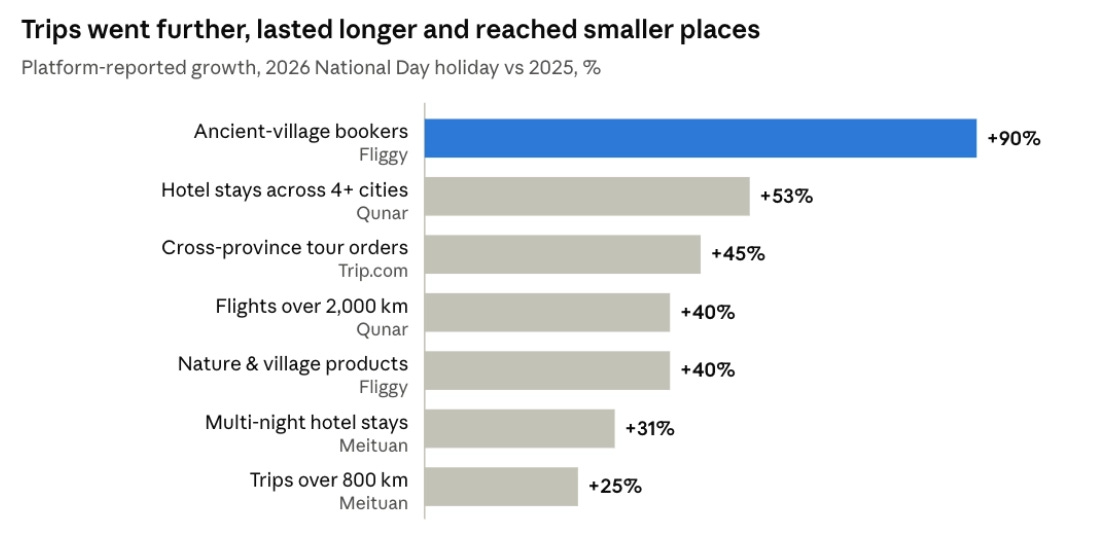
Smaller towns gained the most. Fliggy’s fastest-rising destinations were small towns like Kashgar (Xinjiang), Baise (Guangxi) and Wuwei (Gansu), and Dianping said visits to leisure venues in third-tier and smaller cities rose about 1.9 times as fast as in tier-1 and tier-2 cities.
This also explains part of the per-trip squeeze. A longer rail trip to a cheaper town spreads a similar budget over more days.
Still K-shaped: quiet at home, busy at the border
Cross-border travel outgrew domestic travel this holiday. The National Immigration Administration handled 15.46 million border crossings, or 2.21 million a day, up 6.7%. Mainland residents departing the country rose 9.3% to 4.44 million.
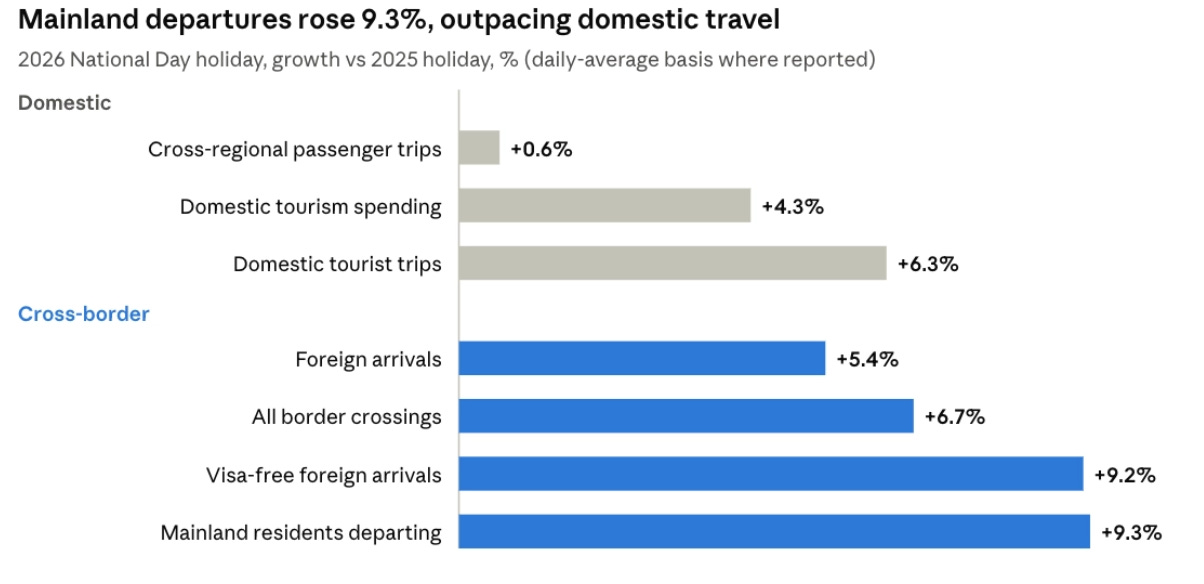
Platform data shows how households with bigger budgets traveled. On Trip.com, the share of outbound holidaymakers taking trips of 8 days or more rose from about 29% to about 42%, Europe’s share of bookings ran at about 1.5x normal, and New Zealand orders doubled.
Domestic demand, by contrast, was spread thin rather than strong. Trip.com’s peak-day domestic orders were only about 1.75x the daily average, versus 2.4x in 2025. Earlier this year, Trip.com’s international bookings grew 40–50% in Q2 while its domestic air ticketing fell more than 20% [*].
Services over goods — again
Last year, services overtook goods as the larger share of holiday spending for the first time. This year the gap kept widening. According to State Taxation Administration VAT invoice data, sports services revenue rose 29.4% and culture and arts services 20.9%, while turnover at 78 shopping streets monitored by the Ministry of Commerce rose just 4.7%.
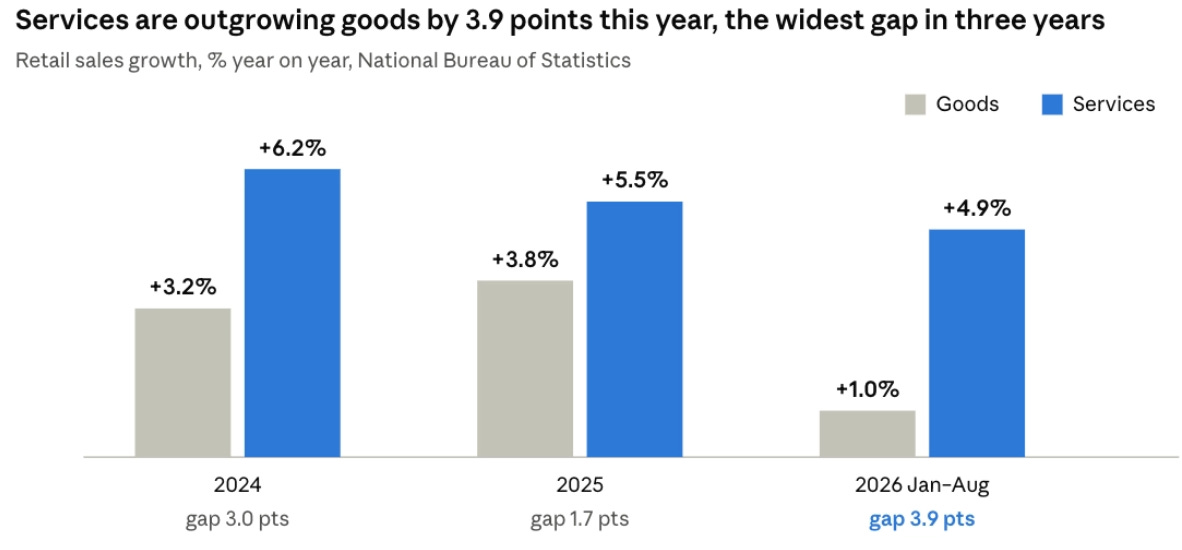
The drivers are the ones we covered in our experiential consumption deep-dive: live events, sports, and culture. The tax authority credited the China Open Games for much of the jump in sports spending. The Ministry of Culture and Tourism counted 180 large-scale shows nationwide, including 125 concerts and 55 music festivals, and grassroots soccer leagues such as the Jiangsu “Su Chao” and the new Northeast league kept pulling fans across cities.

Even within goods, growth came from novelty rather than staples: embodied-robot sales on key platforms rose 130%, smart glasses doubled, and exoskeletons rose 12.8%. The trade-in program drove 33.5 billion yuan of sales for 6.39 million consumers, and tax data shows phones and wearables up 119.8% and home appliances up 40.1%.
The top of the K kept trading up — for the experience
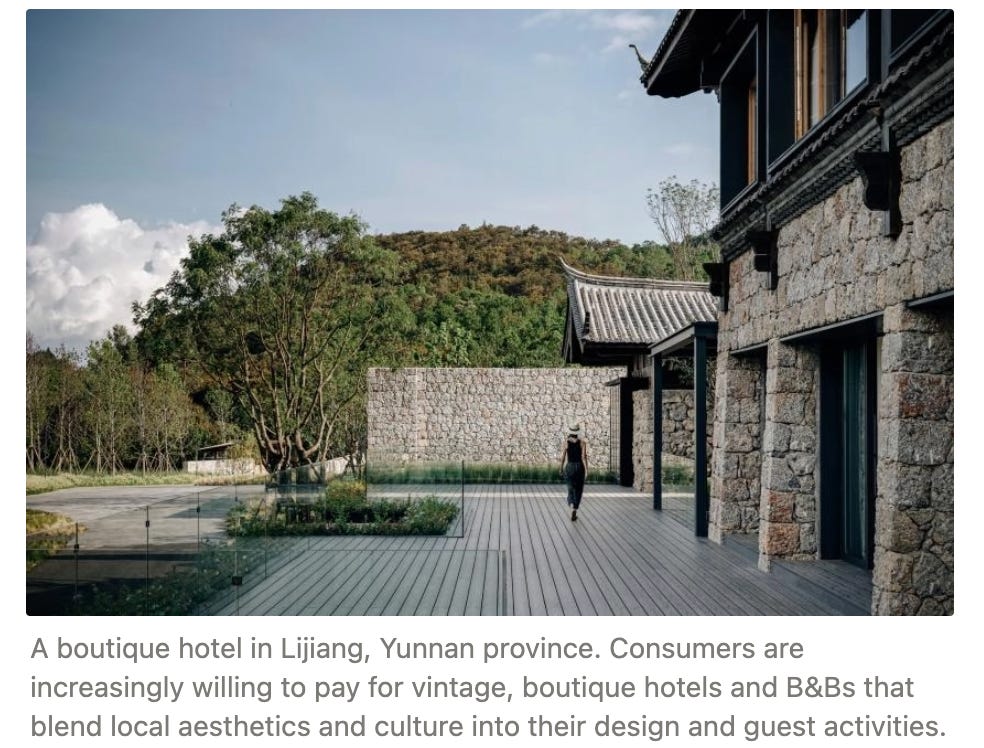
The better-off kept paying more, as long as it came with an experience. On Fliggy, high-star hotel room nights rose more than 80% over the long holiday, ahead of roughly 70% for all hotels. Qunar users who stayed five days or more booked 40% more high-star hotel nights than others.
What they bought was the experience around the room. Meituan’s top destinations for high-star hotels were Lijiang, Dali, Yan’an, Huangshan and Yili, and the Grand Hyatt Kunming, which bundled rooms with sailing and mushroom foraging experience, saw bookings jump 275% in the first three days. Fliggy reported a 60% rise in immersive and role-play attraction tickets.
Which experiences worked?
Not every experience works. Golden Week box office came to just 1.15 billion yuan, a 12-year low and down from 1.84 billion last year.
The money went instead to experiences you have to show up for. Tax invoice data shows amusement parks up 41.2%, grassroots sports and cultural events up 28.3%, and artistic creation and performing arts services up 21%.
In Hengdian, Zhejiang Province—China’s largest film and television shooting base—tourists can now pay several hundred yuan to experience being a lead actor or actress as a unique attraction. As short dramas go viral, many tourists love to play their favorite characters, recreate iconic scenes, and potentially become the next big social media hit.

Theme parks were the clearest winners. Shanghai Disneyland and Universal Beijing were the two most-booked attractions on Trip.com, and Qunar said interest in Shanghai’s new Legoland was up over 40%.
Concerts and sports events became reasons to travel in their own right. Nanjing’s 10 large shows drew 194,000 people and 172 million yuan in ticket sales [*], and Jay Chou’s three Qingdao shows sold 150,000 tickets, lifting nearby hotel bookings 36% on Meituan.
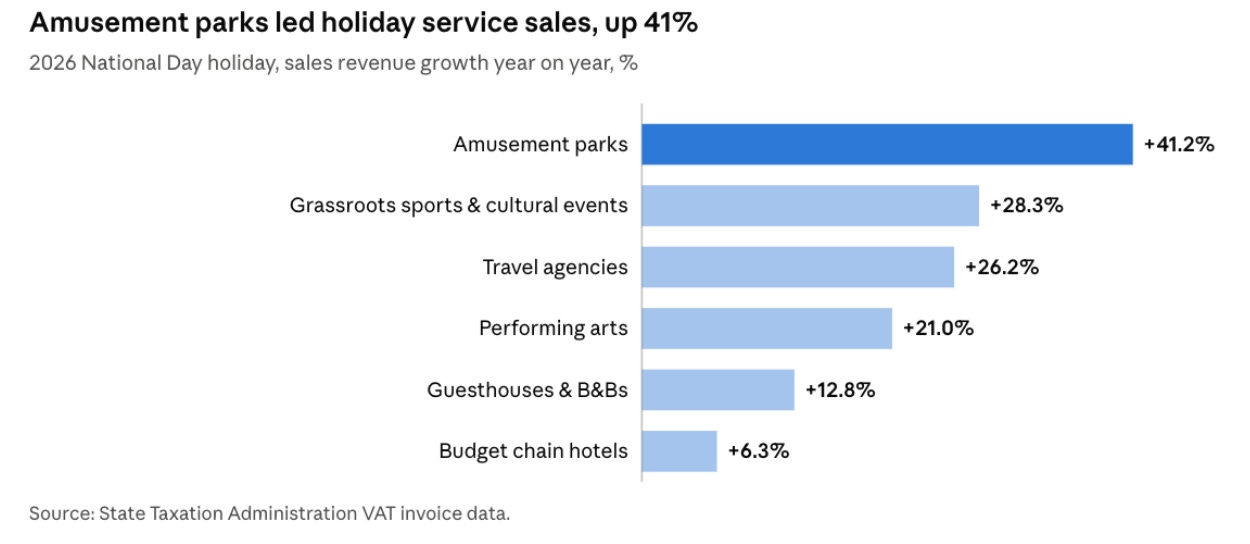
Experiences that are social, participatory, and hard to replicate at home are winning. People also paid to learn something or look after themselves: Meituan searches for makeup lessons rose 377%, pilates classes 133% and tennis coaching over 100% [*], and the tax data flags pet services, fitness and beauty as fast growers.
The bottom line
Golden Week 2026 confirms two things.
First, the consumer is still K-shaped: volume is there, but per-capita spending at home keeps slipping while the better-off spend abroad and on premium stays.
Second, the shift from goods to experiences is not a one-holiday blip — it’s the structural trend of Chinese consumption now. The winners are businesses that sell something irreplaceable: experience-led hotels, live events and IP.
So has consumption bottomed? We’ve been tracking that question all year with our proprietary data. If you want to go deeper:
Has China’s consumption bottomed — and what it means for Chinese equities.
Which consumer brands are actually growing, from our offline payment data. Our August consumer data report tracks Louis Vuitton, Laopu Gold, Luckin, Guming, Pop Mart, Nike, Lululemon and more.
The experiential consumption basket.


