


This is an analysis of CXMT’s listing impact on the Chinese market, with a scenario analysis of Day-1 outcomes. One month past the peak, China’s two tech boards have given back a chunk of their 2025 gains. The trigger is partly global -- Korean deleveraging, AI-ROI anxiety -- but the China-specific factor is a single name: ChangXin Memory Technologies lists Monday. Most investors are simply waiting, holding their breath.
Data: Tushare / Wind | Data Through: Jul 24, 2026 close
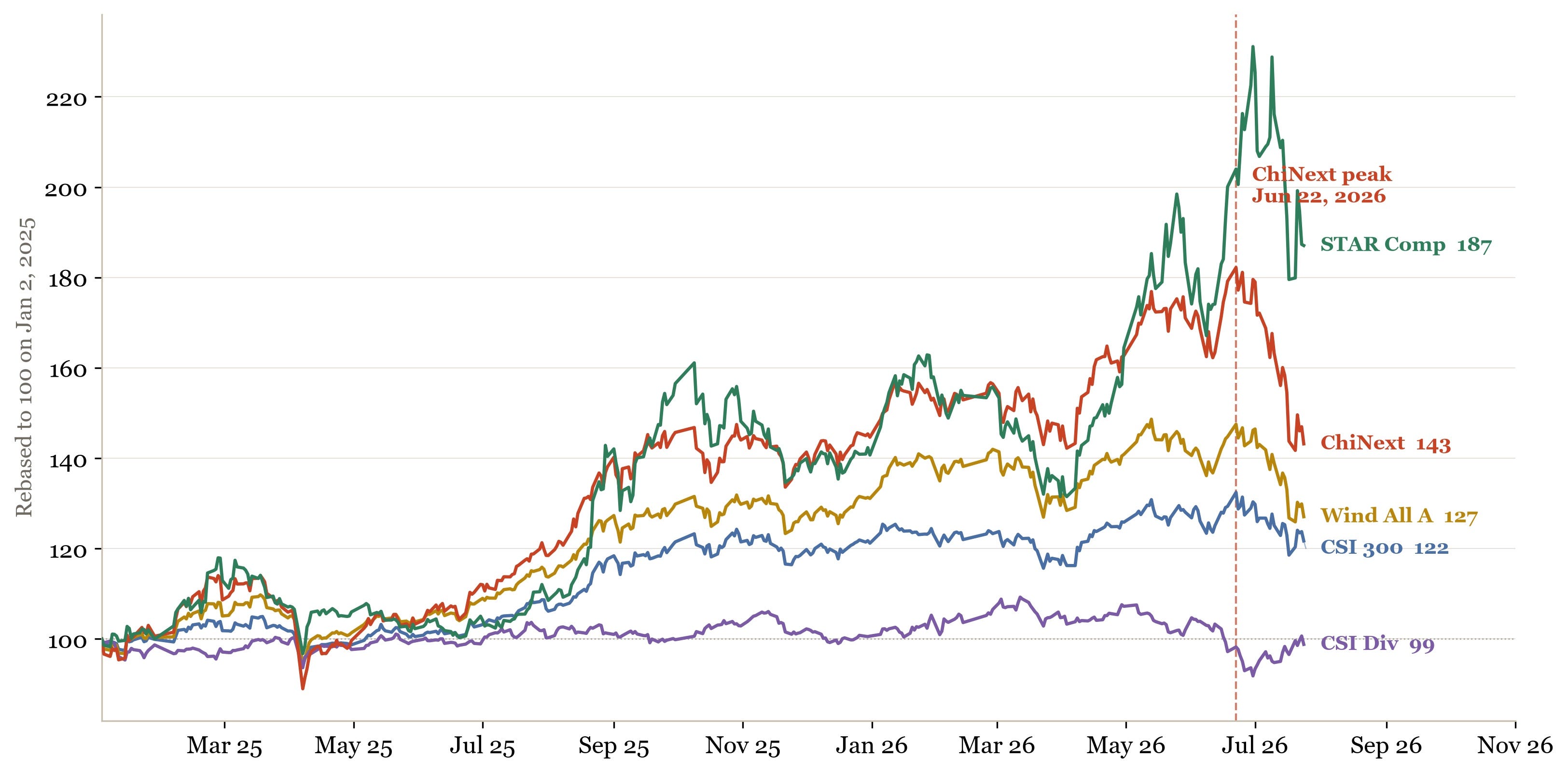
China’s two technology boards -- the ChiNext and the STAR Market -- have ranked among the top-performing equity indices globally since the start of 2025. We have tracked this run in multiple prior notes. As in every other major equity market, AI has been the core engine of the upside.

Since late June, however, the tech indices have suffered a sharp correction. The defensive CSI Dividend index has begun to rebound. This move is broadly synchronous with the pullbacks in the US SOX and Korea’s KOSPI.
STAR nearly doubled while ChiNext surged -- then the peak arrived and the market started to reverse
Two forces, one China-specific factor
The global tech correction shares plenty of common causes. Both trading technicals and industry fundamentals are working in tandem.
On the trading-technical side: the prior run-up was simply too far, too fast. We have built a two-dimensional framework to track China’s AI bubble across various sub-themes, and found many of them have surpassed the peak expected growth rates and valuations of the last renewable energy bubble.

On the fundamental side, which is more central: the entire semiconductor chain -- i.e., upstream AI hardware -- has captured a disproportionate share of AI profits, cannibalizing downstream earnings. The long-term ROI remains uncertain, and the market is growing more anxious about this.
But the pressure facing the Chinese market has one factor that is its own: the imminent listing of ChangXin Memory Technologies (CXMT).
Monday: CXMT begins trading
July 27, Monday -- CXMT formally lists on the A-share STAR Market.
A widely circulated belief in the Chinese market holds that the IPO of a super-mega-cap inevitably marks the end of a bull run -- corresponding to an interim high in the index. The chart below, making the rounds across social media over the weekend, captures this sentiment.
Every major mega-IPO has clustered near an interim market top
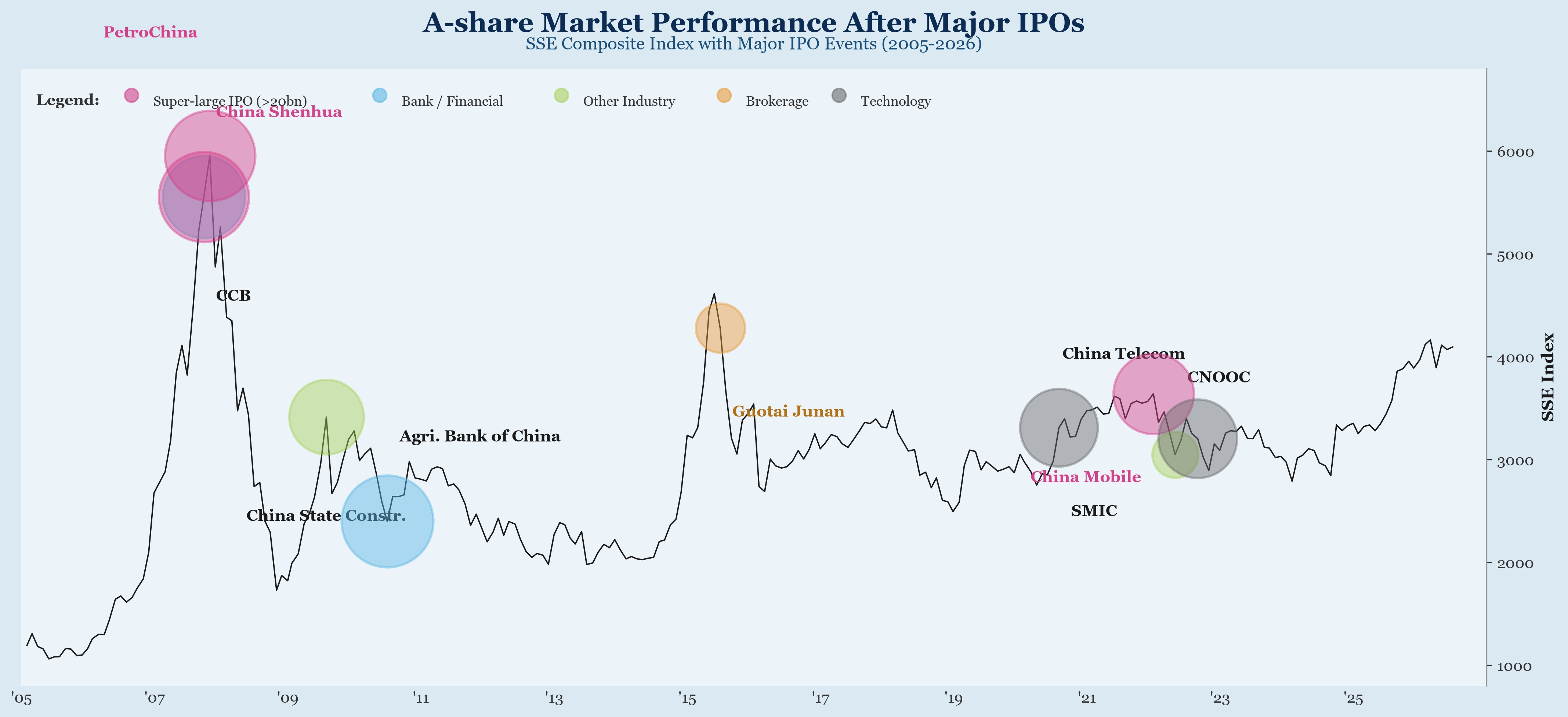
I tend to look at it the other way around. Companies themselves prefer to IPO and issue stock at the peak of market sentiment, at a good price. That is what makes the pattern appear so consistently. The mega-IPO doesn’t cause the top -- the top, more precisely the extreme sentiment, enables the mega-IPO. But historical regularity is enough on its own to make investors de-risk ahead of time, and that may well be one reason for the magnitude of the recent sell-off -- even though China’s own leverage problem is nowhere near as severe as Korea’s.
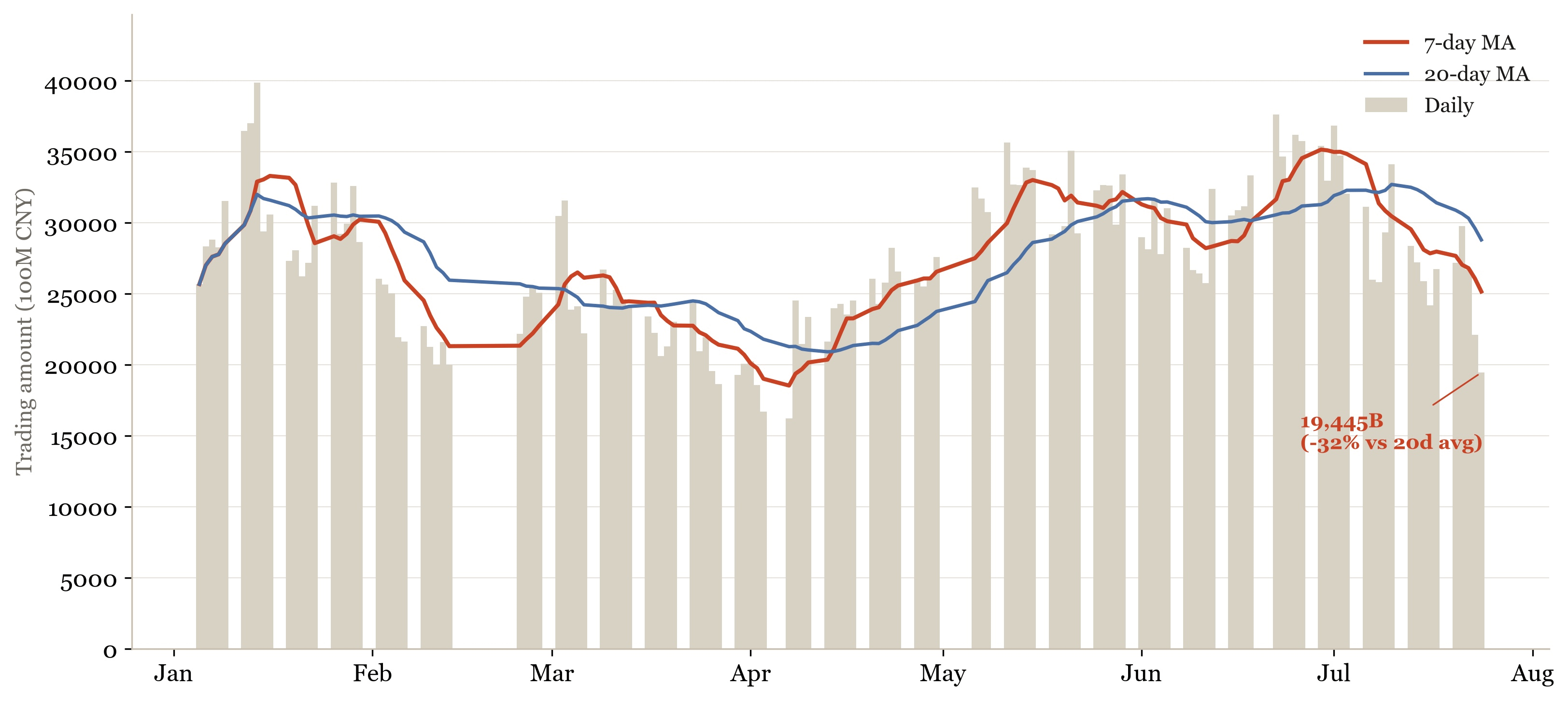
Most investors are choosing to watch and wait. You can see it in the volume. The market is, literally, holding its breath for CXMT.
Volume has collapsed -- the lowest turnover of the entire drawdown
Why CXMT matters beyond China
The listing of this memory giant on the A-share market means China finally has a proper domestic DRAM player -- one with global scale and, potentially, global spillover effects.
Once CXMT has the capital markets’ backing, capacity expansion is a given. Historically, China’s pattern of pouring massive capital into manufacturing capacity expansion has earned the reputation of a “developed-country meat grinder” -- a process that can restructure profit pools across the entire supply chain.
That is not good news for competitors. Think autos and new energy vehicles. But it is potentially good news for consumers, and for companies unwilling to tolerate upstream price gouging -- a consumer-electronics giant like Apple, for instance, which is already reported to be sourcing memory from new Chinese suppliers.
ChiNext vs STAR: the split tells you where the pain is
Drilling into the A-share market, the first thing that stands out: ChiNext has fallen more than STAR.
The ranking inverts: dividends are the only positive line since the peak, and ChiNext suffered a bigger loss than STAR
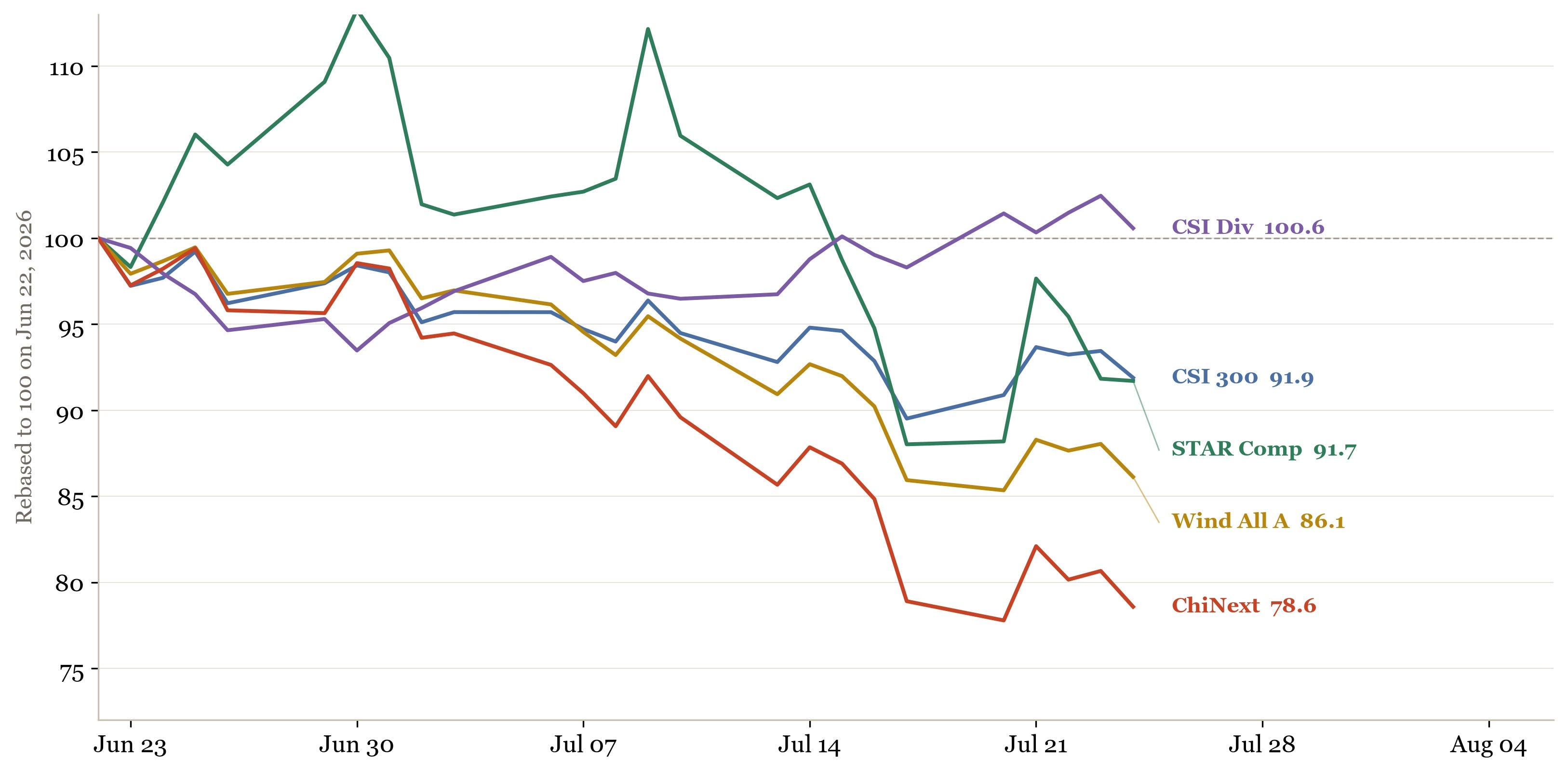

Both are China’s tech boards, but the composition differs in a way that matters here. In short: the core optical module and memory companies sit on ChiNext before CXMT’s listing, while semiconductor -- including equipment, materials, and manufacturing -- is concentrated on STAR. The STAR Market was established later than ChiNext, and its listing rules tolerate pre-profit companies, specifically to support capital-intensive early-stage semiconductor businesses. As a result, semiconductor density on STAR is far higher.
Let’s first look at the ChiNext market.
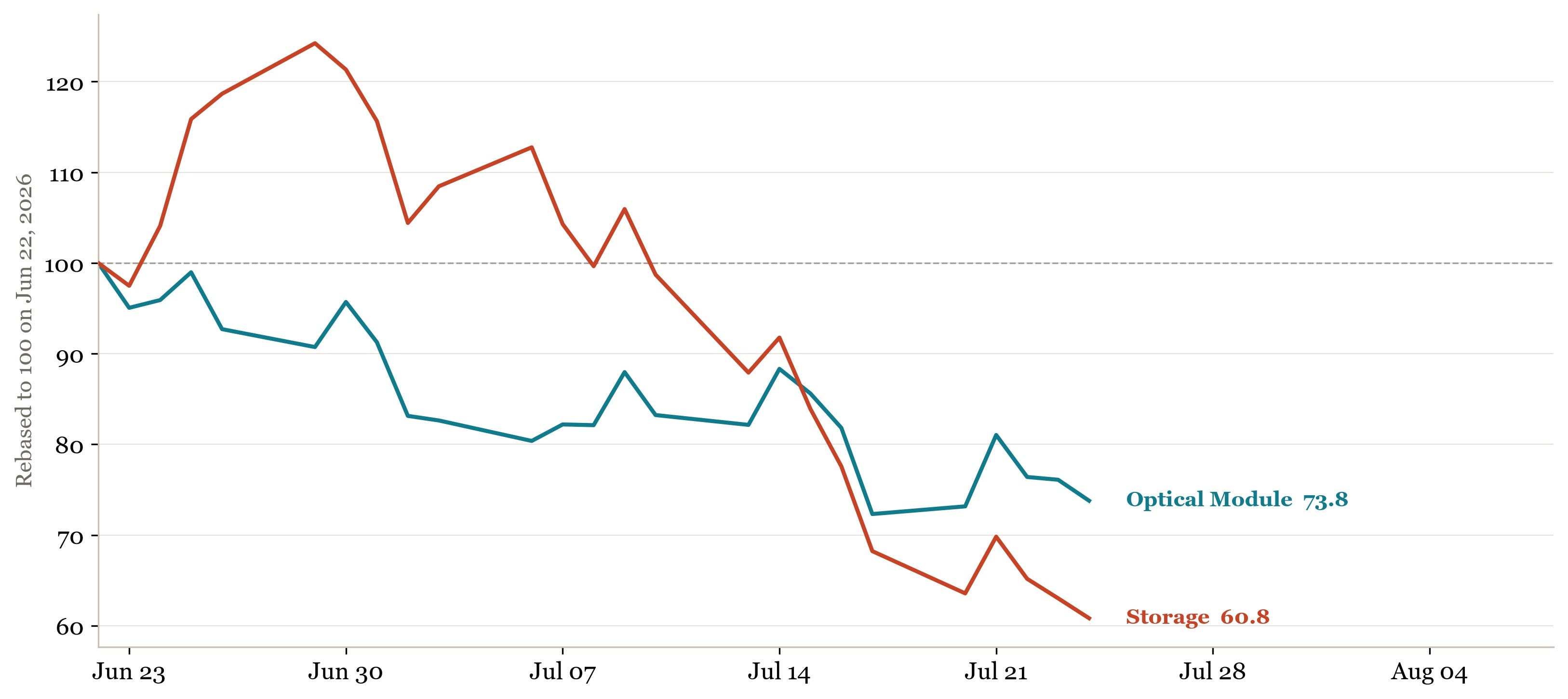
Chinese investors habitually sort the optical-module names into the “overseas chain” -- they follow US AI capex, and many supply directly to NVIDIA or American hyperscalers. Most memory names, by contrast, were until CXMT’s arrival peripheral players -- companies that profited from the appreciation of memory inventory without being the primary beneficiary. Their valuations have been cut recently as the real big guy is coming.
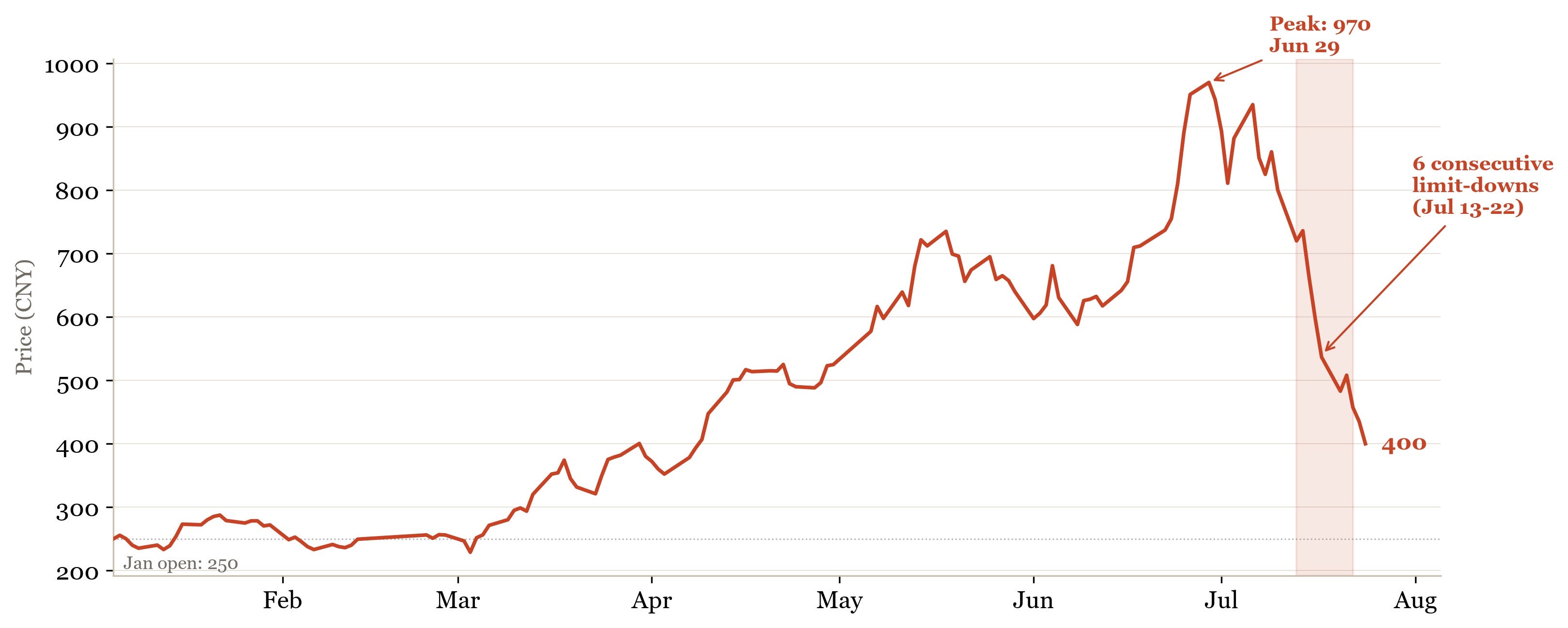
For example, Techwinsemi (001309.SZ) -- a storage controller chip designer -- has hit consecutive limit-downs and is now treated as a sentiment bellwether for the entire speculative memory trade.
Storage has been cut nearly 40% -- far worse than optical modules
Six consecutive limit-downs: Techwinsemi as the market’s sentiment bellwether
STAR’s resilience: self-reliance premium, and the picks-and-shovels bid
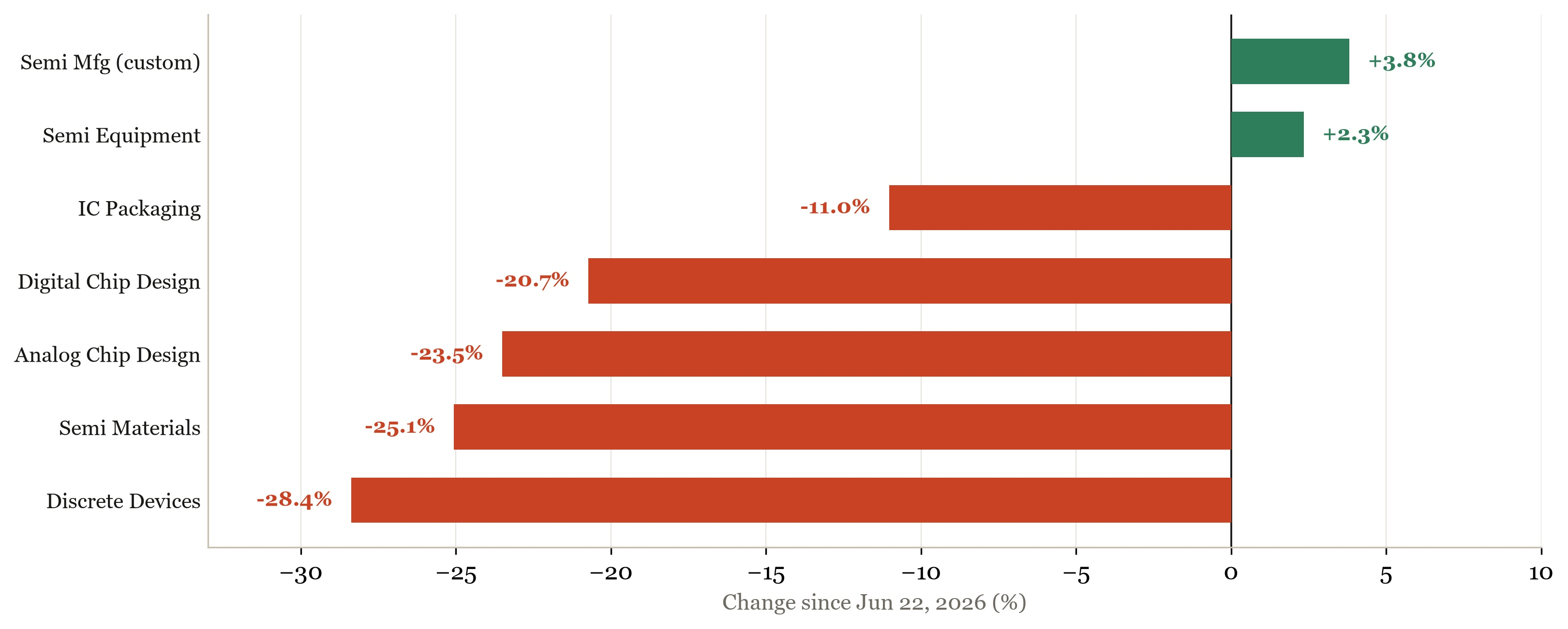
STAR’s drawdown is light compared to ChiNext, and close to CSI 300 -- the latter stuffed with high-dividend names that have been relatively defensive in this sell-off. STAR also carries something CSI 300 does not: a semi self-reliance premium, the narrative of China’s domestic semiconductor ascent.
Here is the interesting part. If you crack open the semiconductor sector itself, you find that semiconductor equipment and manufacturing are actually up during this drawdown.
Equipment and manufacturing held firm
What is the market thinking? Part of the answer, in my view, is that CXMT’s listing, expansion, and the broader memory capacity build-out all depend on massive upstream semiconductor investment. These equipment and materials companies are the direct beneficiaries.
This logic lines up with a recent Bernstein note, dated 13 July 2026: Global Semis -- Can semi cap work if memory doesn’t? Their answer is yes. Bernstein shows that the historical correlation between memory and semiconductor equipment (WFE) share prices is only 0.4-0.6. There have been multiple two-year stretches where WFE outperformed memory by 38-49 percentage points while memory went sideways or down. Their argument: memory capex is accelerating globally, and that capex is the WFE order book. Equipment can work even when memory doesn’t.
Semiconductor manufacturing and equipment in Chinese market are especially resilient for the same reason: The companies in those two sub-indices are, in many cases, directly linked to CXMT -- they are its suppliers. The market may well be pre-trading the benefit of CXMT’s capex ramp before the listing even happens.
The pricing map: huge divergence, freezing sentiment
As for what happens after CXMT lists, the market itself is deeply divided. One thing that is different this time: in the month or so before the offering, the market has already absorbed a violent drawdown. Sentiment has reached a relative freezing point -- the ¥1.94tn turnover print on July 24 is the lowest of the entire correction.
The most optimistic prediction earlier was that CXMT would open straight to ¥5 trillion in market cap. That number is now scoffed at by most investors.
Below is a widely circulated scenario analysis of CXMT’s Day-1 market cap and its market impact.
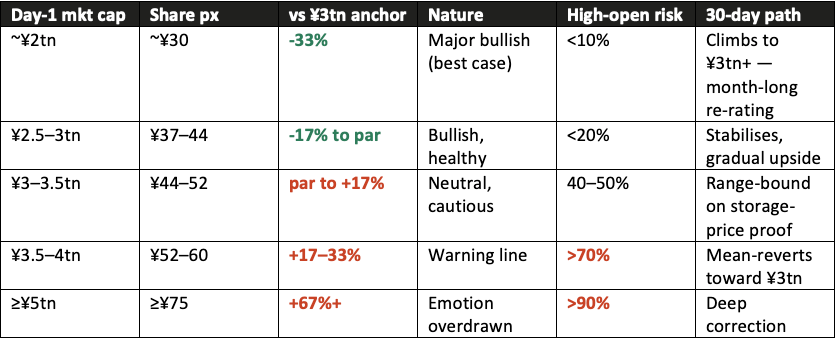
Accordingly, the best outcome for the market is a mild open -- a Day-1 print near or below the ¥3tn fair-value anchor, letting the re-rating of related names unfold over a month rather than cashing it in on day one. On the prediction markets, fewer than 35% of participants now believe CXMT will open above ¥3tn. If that is the case, it would be a healthy de-expectation. We will see what happens tomorrow.
Related read

About Baiguan Pro
We publish more deep dives like this in for our Baiguan Pro subscribers. In the article, you’ve seen a few examples, including our recent take on the framework proposed to evaluate China’s AI bubble:
and our latest check up after the market correction:
The aforementioned rebound of the dividend stocks is actually a much long-term themes we think that worth investors' attention, which we discussed in a previous Baiguan Pro deep dive:
We also share our team views toward Chinese assets every month, and our proprietary data at BigOne Lab to help you stay updated on the performance of key names and sectors.


For investors who wish to receive more targeted content on Chinese secondary market investments, we recommend that you get a paid subscription with us, as we are offering free upgrade to Baiguan Pro for all existing paid subscription tier. The offer ends on Jul 31.
If you are already a paid subscriber with us, feel free to reply and let us know if you would like to be upgraded to the Baiguan Pro tier.